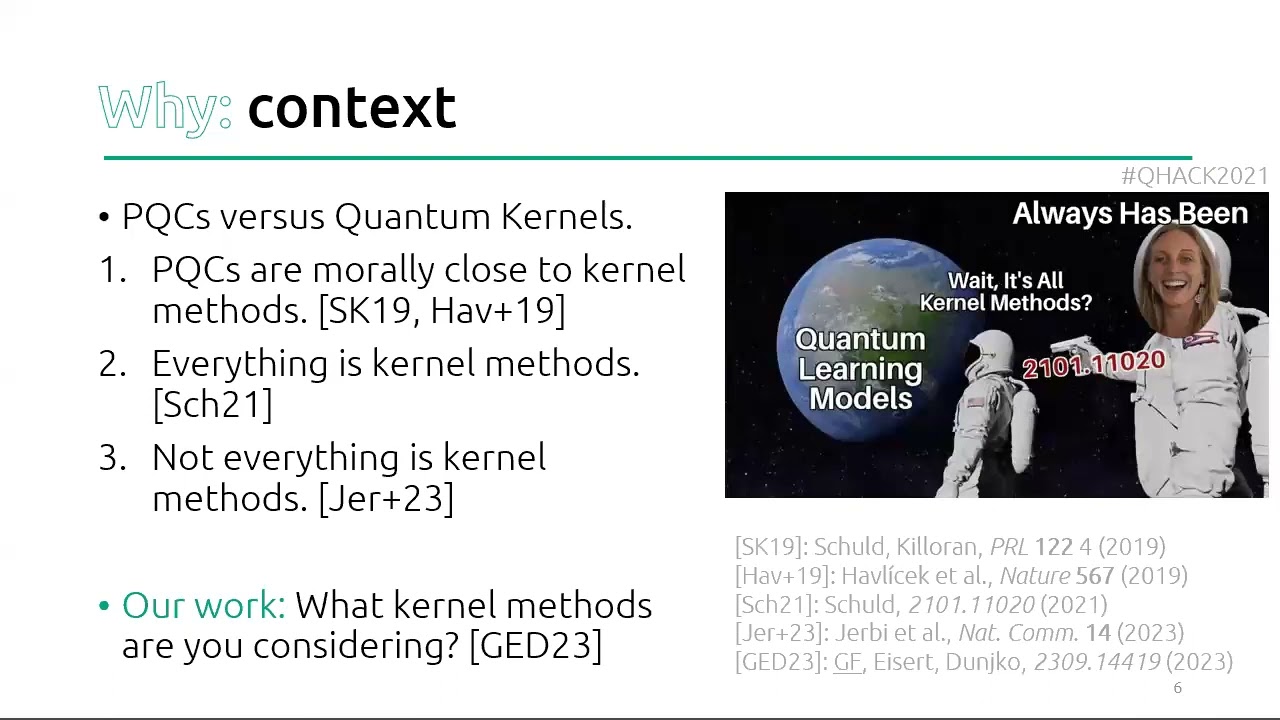
On the expressivity of embedding quantum kernels
Keywords
Summary
156 words
Critical Evaluation
Value of the Information & Strength of the Argument
The value of the information lies in providing a rigorous theoretical framework for understanding the limits of embedding quantum kernels. The argumentation is solid, built on formal definitions, theorems, and proofs. The speaker clearly delineates between unbounded and efficient constructions, and uses established techniques like random Fourier features to establish universality. The talk is well-reasoned, with a clear logical flow from motivation to results, and it critically situates the work within existing literature on quantum machine learning.
86 words
Title / Content Match
The title accurately reflects the content: the talk focuses on the expressivity of quantum kernels built via embeddings, exactly as the title states.
Quality & Reliability
8/10
Rigorous mathematical presentation of original research, with clear definitions and proofs of universality results. The talk is well-structured and grounded in established literature, referencing an arXiv preprint. The quality is high, though the technical depth limits accessibility.
Key Moments
Markers derived by PSI from the transcript: the creator did not define chapters.
- Introduction and motivation: Why study expressivity of quantum kernels?
- Overview of quantum machine learning landscape and the role of kernel methods.
- Classical kernel methods: definitions, feature maps, and the kernel trick.
- Formal introduction to embedding quantum kernels and the canonical construction.
- Main results: universality for all kernels (unbounded) and for efficient shift-invariant kernels.
- Extension to composition kernels and discussion of open problems.
- Summary, acknowledgments, and closing remarks.
Cited Sources
- On the expressivity of embedding quantum kernels — The paper presented in the talk, containing the detailed proofs and results.
Contribution & Novelties
87 words