Quantum machine learning beyond kernel methods
Keywords
Summary
122 words
Critical Evaluation
Value of the Information & Strength of the Argument
The value of this presentation lies in its provision of a unified theoretical framework that clarifies the relationship between several widely used quantum machine learning models. The argumentation is rigorous and well-supported by mathematical proofs, drawing on quantum information theory and classical machine learning results. The speaker builds the case step by step, starting with classical kernel methods, then introducing quantum models, and finally presenting the mapping and complexity results. The reasoning is coherent and the claims are substantiated by published research in Nature Communications. This work significantly advances the understanding of quantum machine learning model families and their resource trade-offs.
Scientific Rigor, Source Quality, Title Accuracy
The scientific rigor is high: the core results are published in a top-tier journal (Nature Communications), and the talk directly references this work. All technical details are treated with precision, and the presenter acknowledges the limitations and approximations involved. The title accurately reflects the content, focusing on quantum machine learning beyond kernel methods. The sources are credible, including only the paper and general references inner presentation. The talk does not overstate findings and clearly distinguishes proven results from conjectures.
195 words
Title / Content Match
The title accurately represents the content: the talk focuses on quantum machine learning approaches that go beyond kernel methods, discussing the relationship between different model classes and their resource implications.
Quality & Reliability
9/10
The content is derived from a peer-reviewed publication in Nature Communications, featuring rigorous mathematical proofs and clear technical explanations. The speaker is an expert and the presentation is well-structured.
Key Moments
Markers derived by PSI from the transcript: the creator did not define chapters.
- Introduction to supervised learning, classification/regression, linear separability and kernel methods.
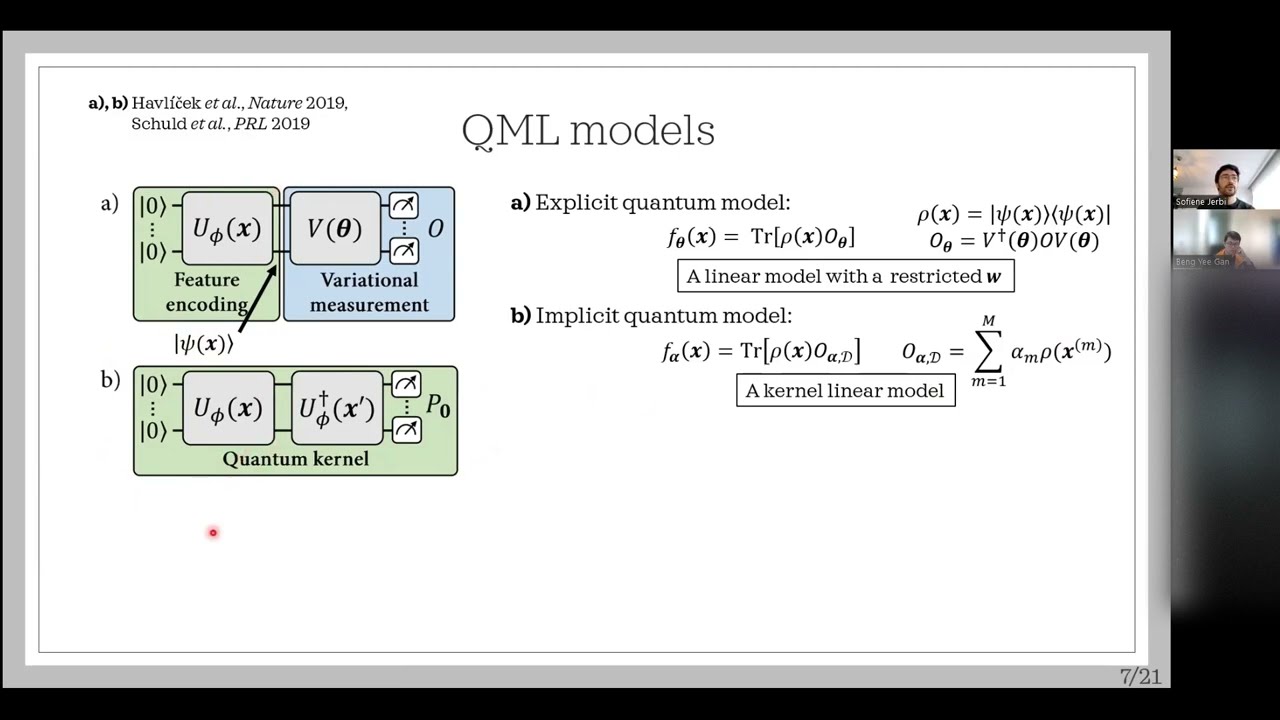
- Definition of explicit and implicit quantum linear models, and discussion of data re-uploading models.
- Presentation of the unifying question and the need for a constructive framework.
- Approximate mapping from data re-uploading circuits to explicit models using ancillary qubits and bit encoding.
- Exact mapping via gate teleportation gadgets, achieving exact function representation.
- Resource analysis: qubit and data requirements, proof of exponential separations between model classes.
- Discussion of NISQ compatibility, conclusions, and outlook.
Cited Sources
- Quantum machine learning beyond kernel methods — Paper presenting the main results of the talk, published in Nature Communications, 2023.
Concurring Sources
- Quantum machine learning beyond kernel methods — The paper itself supports all claims made in the talk, as it contains the detailed proofs and results.
Contribution & Novelties
The talk offers a novel unified framework that encompasses all standard parametrized quantum circuit models, showing that data re-uploading circuits can be represented as explicit linear models with auxiliary qubits. It provides rigorous resource separation results, proving that linear quantum models require exponentially more qubits than data re-uploading models for certain tasks, and that kernel methods also need exponentially more data. These insights are crucial for selecting appropriate models in practical NISQ applications.
Pour aller plus loin :
- Quantum machine learning — Overview of the field and its main approaches.
- Kernel method — Classical background on kernel-based learning algorithms.
- Parametrized quantum circuits — General concept and applications.
- Data re-uploading classifier — Original proposal of data re-uploading in quantum circuits (if URL is certain).
123 words
Radar Profile
The radar profile is high across all dimensions, indicating a deeply technical, well-sourced, and information-dense presentation. The level of technical detail is maximal, while the quantity and quality of information are also rated highly, reflecting the comprehensive coverage of the subject and the reliance on peer-reviewed research.