Exponential quantum advantages in learning quantum observables from classical data
Keywords
Summary
213 words
Critical Evaluation
Value of the Information & Strength of the Argument
The value of the information lies in providing a concrete, physically motivated learning separation that goes beyond cryptographic constructions. The argumentation is rigorous and well structured: the speaker first clarifies the distinction between computing and learning a function, then reviews existing separations, and finally presents a new theorem with a clear proof sketch. The classical hardness argument is elegant—it reduces the learning problem to deciding a BQP-complete language on average, leveraging the assumption that BQP is not contained in HeurP/poly. The quantum learnability argument is non-trivial: it uses a quantum algorithm to prepare time-evolved states and estimate Pauli expectation values, followed by a classical Lasso regression to recover the unknown coefficients. The speaker emphasizes that the concept class is continuous (effectively exponential in size), so brute-force search does not work, making the quantum learner genuinely necessary. The extension to ground states follows the same strategy, showing the generality of the approach. The argumentation is careful about assumptions and does not overclaim: the result is conditional on a complexity-theoretic conjecture. The main limitation is that the separation is proven for a specific class of observables and Hamiltonians, and the practical relevance for near-term devices is not discussed in depth.
Scientific Rigor, Source Quality, Title Accuracy
The scientific rigor is high: the work is based on a preprint (arXiv:2405.02027) and the speaker clearly states the assumptions and proof strategy. The sources cited in the description include the arXiv link to the paper itself. The talk references prior work by Casper Gyurik and others on learning separations, and the PAC framework (Valiant) and advice classes (P/poly, HeurP/poly) are standard. The title accurately reflects the content, though it does not mention the conditional nature of the result. The presentation is technical and assumes familiarity with quantum computing and computational learning theory. No comments were provided, so no audience trend analysis is included.
317 words
Title / Content Match
The title accurately reflects the content: the talk presents exponential quantum advantages for learning quantum observables from classical data, covering both time-evolved and ground-state settings. The title is faithful, though it omits the conditional nature of the result.
Quality & Reliability
9/10
The presentation is a research seminar by the paper's first author, based on a peer-reviewable arXiv preprint (2405.02027) with a clearly stated theorem, explicit assumptions (BQP ⊄ HeurP/poly), and a two-part proof sketch (classical hardness via BQP-completeness of time evolution, quantum learnability via a non-trivial quantum learner plus Lasso regression). The speaker is transparent about the conditional nature of the result and about the limitations of prior work. No unsupported empirical claims are made.
Key Moments
Markers derived by PSI from the transcript: the creator did not define chapters.
- Introduction and welcome by the host.
- Speaker introduces himself and the paper title.
- Motivation: when are quantum computers better at learning tasks?
- Review of prior learning advantages: cryptographic functions and BQP-complete problems.
- Introduction to the PAC framework and the learning task.
- Differences between computing and learning a function: data gap, quantum learnability, average-case.
- Example of how data can change hardness: trigonometric function fitting.
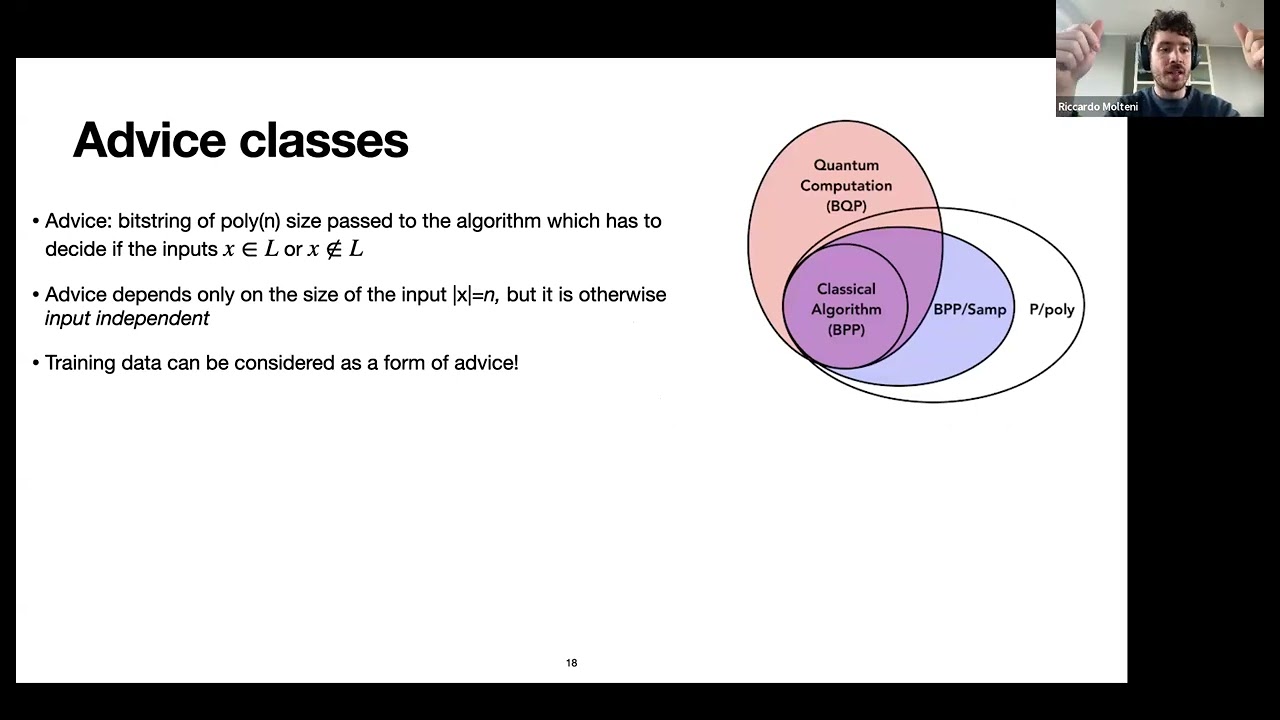
- Advice classes and HeurP/poly definition.
- Main theorem: exponential quantum advantage for learning time-evolved observables.
- Proof sketch: classical hardness and quantum learnability via Lasso regression.
Cited Sources
- Exponential quantum advantages in learning quantum observables from classical data — The arXiv preprint of the paper presented in this talk.
Contribution & Novelties
The novelty of this work is that it provides a physically motivated learning separation, unlike previous quantum advantages in learning which relied on cryptographic functions. It shows that for learning quantum observables from classical data, there is an exponential quantum advantage under the assumption that BQP is not contained in HeurP/poly. The quantum learner is non-trivial and uses quantum capabilities to extract information from data, and the concept class is continuous (exponential size), so brute-force search is not applicable. The result is extended to ground-state problems.
Pour aller plus loin :
- PAC learning — The framework used to formalize the learning task.
- BQP — Complexity class for problems solvable by quantum computers in polynomial time.
- Hamiltonian simulation — The quantum simulation task that underlies the time-evolution learning problem.
- Lasso regression — The classical regression algorithm used in the quantum learner.
140 words
Radar Profile
The radar profile shows high technical level and information quality, with strong reliability. The quantity of information is substantial, though the talk is dense and assumes prior knowledge. The overall profile reflects a rigorous theoretical contribution.