Evan Peters - Generalization despite overfitting in quantum machine learning models
Keywords
Summary
173 words
Critical Evaluation
Value of the Information & Strength of the Argument
The value of the information lies in providing a concrete, mathematically grounded characterization of benign overfitting in quantum machine learning, a phenomenon that had been observed empirically but not fully understood theoretically. The argumentation is solid: Peters builds on well-known results about Fourier representations of QML models, constructs a classical analog with clear intuition, and then transfers the analysis to the quantum setting. He clearly explains the roles of data encoding and input states in shaping the inductive bias, and supports his claims with illustrative examples and asymptotic scaling arguments. The presentation is logically structured, with a clear progression from classical to quantum concepts, and the mathematical derivations are elegant and accessible to a technically trained audience.
Scientific Rigor, Source Quality, Title Accuracy
The talk is based on the preprint ‘Generalization despite overfitting in quantum machine learning models’ (arXiv:2209.05523), which is a reliable and citable source. The presentation aligns with the content of the paper, and the speaker appropriately references existing literature on Fourier analysis of QML and classical benign overfitting. The title is accurate and not sensationalized. While the presentation is high-level, it does include technical details near the end, and the claims are supported by derivations and numerical demonstrations. No sources are explicitly cited beyond the arXiv reference, but the talk is clearly based on rigorous research. The public comments (if any) are not provided, so no analysis of audience reaction is possible.
244 words
Title / Content Match
The title accurately reflects the content: the talk explains how overfitting can coexist with good generalization in quantum machine learning, exactly as stated.
Quality & Reliability
8/10
The talk presents a preprint with a rigorous theoretical framework, including mathematical derivations and numerical demonstrations. It relies on known literature (e.g., Fourier analysis of quantum models) and is presented by an expert in the field. However, the work has not yet been formally peer-reviewed, and the presentation is a high-level overview with technical details only near the end.
Key Moments
Markers derived by PSI from the transcript: the creator did not define chapters.
- Introduction and outline: overparameterization vs generalization, classical and quantum Fourier pictures.
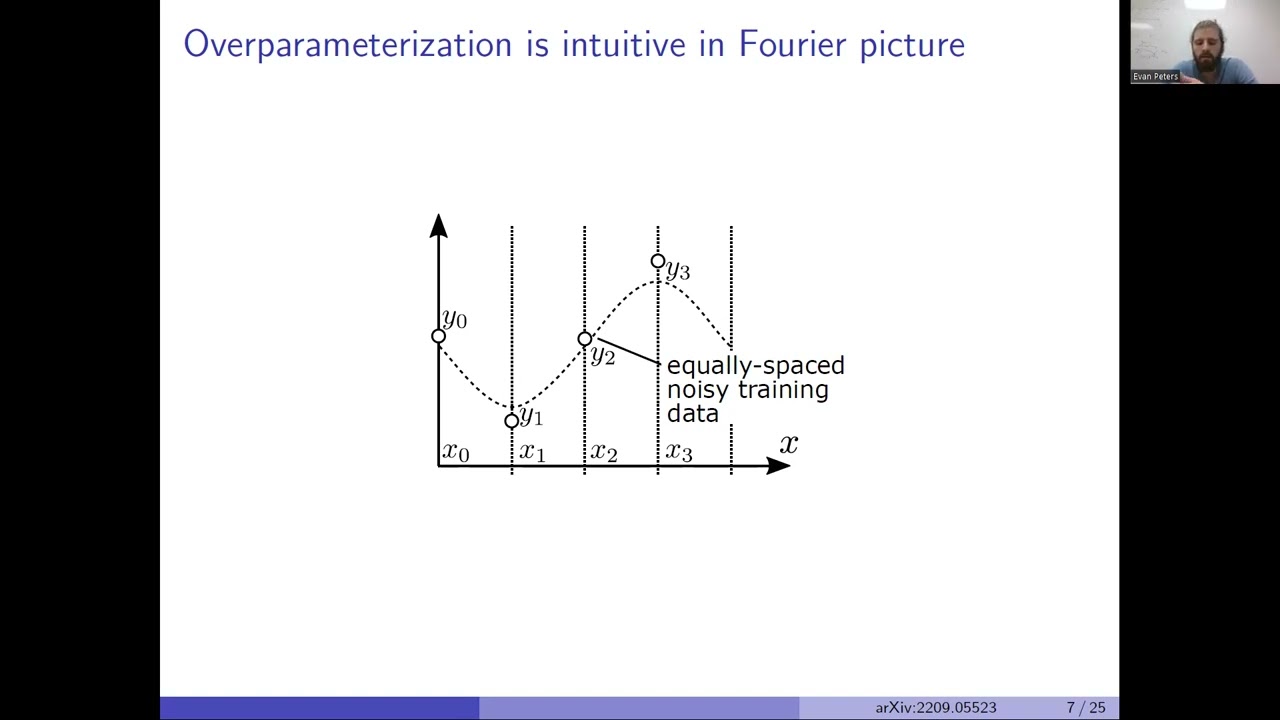
- Explanation of benign overfitting in classical regression with a line fitting example.
- Transition to Fourier analysis: target functions with sparse spectra, noise sampling, and regularization.
- Formulation of classical Fourier feature model with trainable coefficients and fixed feature weights.
- Extreme examples: zero target with noise vs noise-free target, illustrating the effect of bandwidth.
- Impact of feature weights (inductive bias) on the model's ability to generalize despite interpolation.
- Introduction of quantum circuit model and expression of its output as a Fourier series.
- Derivation of feature weights in the optimized quantum model and connection to data encoding and input state.
- Examples of data encoding (local rotations vs exponential prefactors) and their feature weight distributions.
- Demonstration of benign overfitting in a QML model with concentration of feature weights on target frequencies.
- Asymptotic behavior: generalization error vanishes as n and D increase, while perfectly fitting training data.
- Conclusion and questions.
Cited Sources
- Generalization despite overfitting in quantum machine learning models (arXiv preprint) — The main reference for the talk, containing the full technical details of the results.
Concurring Sources
- arXiv:2209.05523 — The preprint itself, which the speaker directly references.
Contribution & Novelties
The talk provides a novel characterization of benign overfitting in quantum machine learning, linking the phenomenon to the inductive bias induced by data encoding and input states. It shows that overparameterized QML models can generalize well despite exactly interpolating noisy training data, provided that the feature weights are concentrated on the target frequencies. This bridges classical understanding of Fourier-based interpolation with quantum circuit structure. The work offers intuitive explanations and a concrete example, opening avenues for designing QML models with better generalization properties.
Pour aller plus loin :
- Benign overfitting in machine learning — Related classical concept and background.
- Quantum machine learning — Overview of the field and common techniques.
- Fourier series — Mathematical foundation for expressing functions as sums of sinusoids.
122 words
Radar Profile
The radar profile shows high scores in technical level, information quality, and reliability, with slightly lower but still high marks for quantity and balance. This indicates a dense, rigorous, and well-sourced presentation, though not exhaustive in breadth.