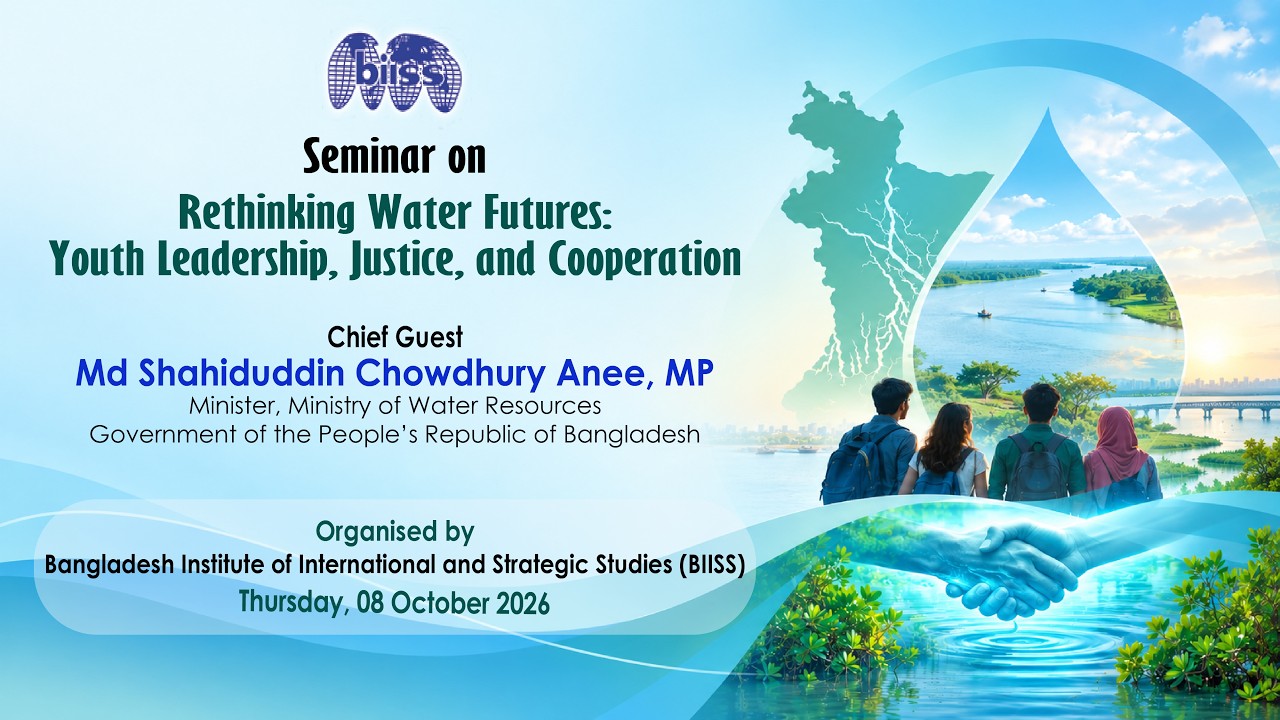
Seminar on Rethinking Water Futures: Youth Leadership, Justice, and Cooperation on 08 Oct 2026
Title history
- Seminar on Rethinking Water Futures: Youth Leadership, Justice, and Cooperation on 08 Oct 2026 — observed on 20261115-0809 UTC (YouTube)
Keywords
Summary
150 words
Critical Evaluation
Value of the Information & Strength of the Argument
The seminar provides valuable insights into Bangladesh’s water diplomacy strategy, including official positions on international water law and benefit sharing. The argumentation is largely persuasive, aiming to justify Bangladesh’s stance and advocate for multilateral cooperation. The speakers emphasize the importance of youth leadership and propose concrete steps like the hydro-diplomacy course. However, the arguments are sometimes repetitive and rely on political statements rather than detailed data or evidence. The Q&A session adds some critical perspectives on past failures in negotiations, but the overall discourse remains policy-oriented rather than rigorous scientific analysis.
Scientific Rigor, Source Quality, Title Accuracy
The seminar demonstrates moderate rigor: speeches reference international conventions (UNECE 1992, UN 1997) and mention specific initiatives, but no formal sources are cited in the description. The title accurately captures the seminar’s scope. The content is from official and expert speakers, lending credibility, yet the partisan tone (support for the current government) may introduce bias. No comments were provided for analysis, so the public’s reception cannot be assessed.
174 words
Title / Content Match
Title accurately reflects content: a seminar on rethinking water futures with focus on youth, justice, and cooperation.
Quality & Reliability
7/10
Content is based on expert speakers from official and research institutions, discussing policy and diplomacy. However, it reflects national perspectives and may have political bias. The seminar is informative but lacks peer-reviewed sources.
Key Moments
Markers derived by PSI from the transcript: the creator did not define chapters.
- Welcome address by Major General ASM Vidanu Rahman, DG of BIISS, outlining objectives of the seminar.
- Keynote speech by State Minister for Foreign Affairs on water security, benefit sharing, and youth diplomacy.
- Q&A session where minister addresses failed negotiations and political challenges.
- Panel discussion on private sector engagement, youth agency, and hydro-diplomacy course announcement.
- Closing remarks and compilation of insights.
Contribution & Novelties
The seminar contributes to the discourse on water diplomacy by emphasizing youth leadership and justice, and announces a novel hydro-diplomacy certification course. It also discusses Bangladesh’s accession to the UNECE Water Convention and the need for a new international water organization. The integration of youth voices and public-private partnerships as key elements offers a fresh perspective on transboundary water governance.
Pour aller plus loin :
- Water diplomacy — Overview of water diplomacy concepts and practices.
- UNECE Convention on the Protection and Use of Transboundary Watercourses and International Lakes — The 1992 convention Bangladesh acceded to in 2025.
- Convention on the Law of Non-Navigational Uses of International Watercourses — The 1997 UN convention mentioned in the seminar.
- Benefit sharing in water resources — Concept of sharing benefits beyond water allocation.
129 words
Radar Profile
The radar profile shows high scores in information quantity but moderate in technical level and reliability. This suggests a broad but not deeply technical discussion, with a reliance on expert opinion rather than empirical data.