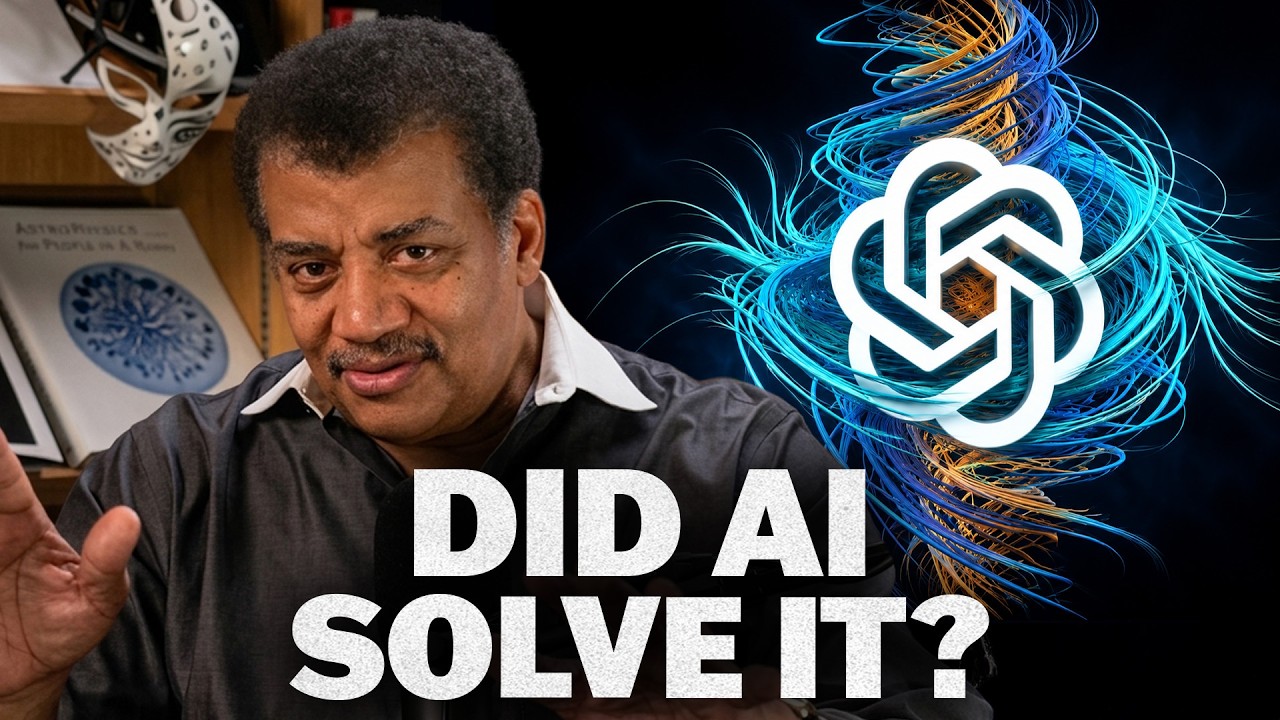
Did AI Solve One of Math’s Hardest Problems?
Keywords
Summary
212 words
Critical Evaluation
Value of the Information & Strength of the Argument
The video provides substantial value by demystifying a complex mathematical problem and the role of AI in its potential resolution. It clearly explains the Navier-Stokes equations’ significance and the nature of the Millennium Prize, making the topic accessible to a general audience. The argumentation is solid, built around expert commentary from Mac Low, who is directly engaged in fluid dynamics research. The hosts critically evaluate the OpenAI claim, distinguishing between a formal mathematical proof and physical relevance, and they appropriately highlight the absence of human-readable insight in the initial AI-generated solution. However, the discussion is inherently limited by the lack of public details about the OpenAI proof, and some simplifications (e.g., ’two dudes’) might understate the historical nuance. The overall reasoning is compelling and encourages viewers to think critically about AI’s contributions to fundamental science.
Scientific Rigor, Source Quality, Title Accuracy
The scientific rigor is moderate: while the hosts are reliable, the content originates from a popular science podcast and does not cite peer-reviewed sources or original papers. Specific references are absent; instead, the discussion relies on the speakers’ expertise. The title is highly appropriate, as it frames the central question, and the video answers it with a balanced perspective, noting that the ‘solution’ is neither fully verified nor universally accepted. The video also includes promotional mentions of books by Neil deGrasse Tyson, which are not sources of scientific information but are part of the episode’s format. No public comments were provided for analysis, so audience reception could not be assessed.
260 words
Title / Content Match
The title accurately reflects the core topic—whether AI solved a Millennium Problem—and the video directly addresses this question, offering both context and a critical perspective.
Quality & Reliability
7/10
The discussion is led by Neil deGrasse Tyson and astrophysicist Mordecai-Mark Mac Low, both credible experts, but it is a conversational explanation without peer-reviewed evidence or independent verification of the OpenAI claim. The content is accurate in its descriptions of Navier-Stokes and Boltzmann equations, but the speculative aspects about the AI proof are presented without formal validation.
Chapters
Cited Sources
- Lost in Space - StarTalk book on Amazon — New collaborative book by Neil deGrasse Tyson and Lindsay Nicks Walker, mentioned at the end of the video.
- Take Me to Your Leader - Neil deGrasse Tyson — Another book by Neil deGrasse Tyson promoted in the video description.
Contribution & Novelties
The episode offers an original contribution by presenting the Navier-Stokes Millennium Problem through the lens of a recent AI-driven claim, coupling it with expert interpretation from a researcher who actively uses these equations. It highlights the philosophical and practical questions of whether AI proofs are acceptable if not human-understandable, and contrasts Navier-Stokes with the Boltzmann equation to illuminate physical limitations. The discussion also touches on the use of AI in scientific literature exploration, adding a forward-looking perspective.
Pour aller plus loin :
- Navier-Stokes equations — Standards for the mathematical problem discussed.
- Lean (proof assistant) — The language used by OpenAI for the formal proof.
- Boltzmann equation — The more fundamental description that overcomes Navier-Stokes singularities.
115 words
Radar Profile
The radar profile shows a balanced performance: quantity of information (+8) is strong, while quality (+7) and reliability (+7) are slightly lower, reflecting the episode's educational but informal nature. The technical level (+6) indicates moderate depth, suitable for a general audience, with the overall shape suggesting a well-rounded and trustworthy popular-science discussion.