Lecture 19 Perceptron Convergence Part1
Keywords
Summary
180 words
Critical Evaluation
Value of the Information & Strength of the Argument
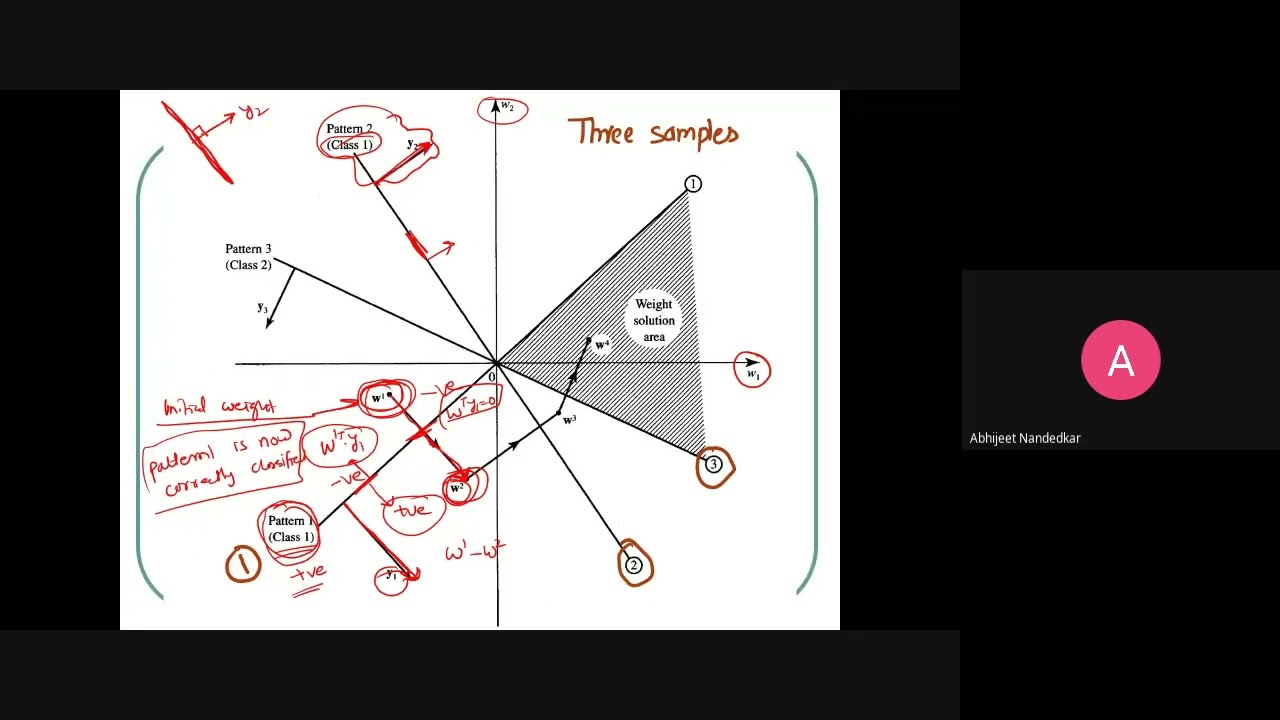
The lecture offers substantial value by building intuition for the perceptron learning rule through clear geometric reasoning. The argumentation is structured and logical: it starts from the basic update rule, derives the direction of weight adjustment from the gradient of the discriminant function, and then applies this to a concrete example. The use of weight space diagrams effectively conveys why the algorithm works and how the solution zone emerges. The instructor carefully distinguishes between the desired and actual outputs, showing how the error term (d - o) automatically determines whether to add or subtract the input vector. The discussion of the learning rate C is practical and well-argued, highlighting the trade-off between slow convergence and overshooting. The introduction of the convergence theorem is appropriately placed, setting the stage for a formal proof. The argumentation is self-contained and does not rely on external references, which is typical for a lecture. The only weakness is the lack of a formal proof in this session, but that is explicitly deferred.
Scientific Rigor, Source Quality, Title Accuracy
The lecture is rigorous in its mathematical treatment, with no apparent errors in the logic or derivations. However, it does not cite any external sources, books, or papers, which reduces its scholarly traceability. The content is standard and can be found in classic machine learning textbooks, but the instructor does not reference them. The title ‘Lecture 19 Perceptron Convergence Part1’ accurately reflects the content: it is the 19th lecture in a series, focuses on the perceptron, and introduces the convergence theorem (Part 1). The title is not misleading. No comments were provided for analysis.
276 words
Title / Content Match
The title accurately reflects the content: the lecture covers the perceptron learning rule and introduces the convergence theorem, with a promise to prove it in the next session.
Quality & Reliability
8/10
The lecture presents a mathematically sound and standard treatment of the perceptron learning rule and the convergence theorem. The reasoning is internally consistent, the geometric interpretation in weight space is correct, and the practical guidance on the learning rate is appropriate. No external sources are cited, which limits verifiability, but the content aligns with established machine learning literature.
Key Moments
Markers derived by PSI from the transcript: the creator did not define chapters.
- Introduction to the perceptron learning rule and weight space visualization.
- Explanation of how to move the weight vector using the gradient of the discriminant function.
- Derivation of the weight update rule: W_new = W_old ± C * y.
- Three-pattern example: step-by-step weight adjustments and classification.
- Introduction of the solution zone concept and its geometric interpretation.
- Discussion on the learning rate C and its effect on convergence.
- Exercise: finding the area of convergence for a five-pattern problem.
- Summary of the perceptron learning rule and the role of (d - o).
- Introduction to the perceptron convergence theorem and its practical implications.
- Conclusion and preview of the next lecture on the convergence proof.
Contribution & Novelties
This lecture does not present new research but provides a clear pedagogical explanation of the perceptron learning rule and the convergence theorem. Its originality lies in the effective use of weight space diagrams to build intuition. For those familiar with the topic, it serves as a solid review. For learners, it offers a step-by-step guide to understanding how the perceptron adjusts its weights and why it converges for linearly separable data.
Pour aller plus loin :
- Perceptron — Wikipedia article covering the history, definition, and learning algorithm.
- Perceptron convergence theorem — Section on the convergence theorem and its proof.
- Rosenblatt, F. (1958). The perceptron: a probabilistic model for information storage and organization in the brain. Psychological Review, 65(6), 386–408. — The original paper introducing the perceptron.
126 words
Radar Profile
The radar profile shows high scores in information quality and reliability, reflecting the accurate and well-structured content. The technical level is moderate, suitable for an intermediate audience. The quantity of information is good but not exhaustive, as the convergence proof is deferred.