Lecture 25 Generalized Delta LR Derivation
Keywords
Summary
172 words
Critical Evaluation
Value of the Information & Strength of the Argument
The lecture provides a clear, step-by-step demonstration of how a two-layer threshold logic network can implement a non-linear decision boundary. The manual analysis of each neuron’s contribution is pedagogically valuable, as it concretely shows how individual linear boundaries combine to form a non-linear region. The argument that a single perceptron cannot solve such problems is well-illustrated by the impossibility of drawing a single line to separate the classes. The transition to the generalized delta rule is logically motivated: the need to train hidden layers without direct desired outputs. The derivation is set up rigorously, defining the squared error and invoking gradient descent, but it is incomplete in this session. The reasoning is sound and follows standard neural network theory, though the lecture relies on the instructor’s verbal explanation rather than external references.
Scientific Rigor, Source Quality, Title Accuracy
No external sources or references are cited in the lecture. The content is based on standard, well-established concepts in neural network theory (threshold logic units, perceptron, delta rule, backpropagation). The title ‘Lecture 25 Generalized Delta LR Derivation’ accurately reflects the content: the lecture does begin the derivation of the generalized delta learning rule, though it is not completed. The adéquation between title and content is good, with the caveat that the derivation is truncated and promised to continue in the next lecture. No comments were provided for analysis.
235 words
Title / Content Match
The title accurately reflects the content: the lecture begins with a two-layer threshold logic unit problem and then transitions into the derivation of the generalized delta learning rule, though the derivation itself is cut short and promised to continue in the next lecture.
Quality & Reliability
8/10
The lecture is a rigorous, mathematically grounded derivation of the generalized delta learning rule, building on established neural network theory (threshold logic units, perceptron limitations, backpropagation). The reasoning is internally consistent and the pedagogical progression is clear. No external sources are cited, but the content is standard, well-established material in the field.
Key Moments
Markers derived by PSI from the transcript: the creator did not define chapters.
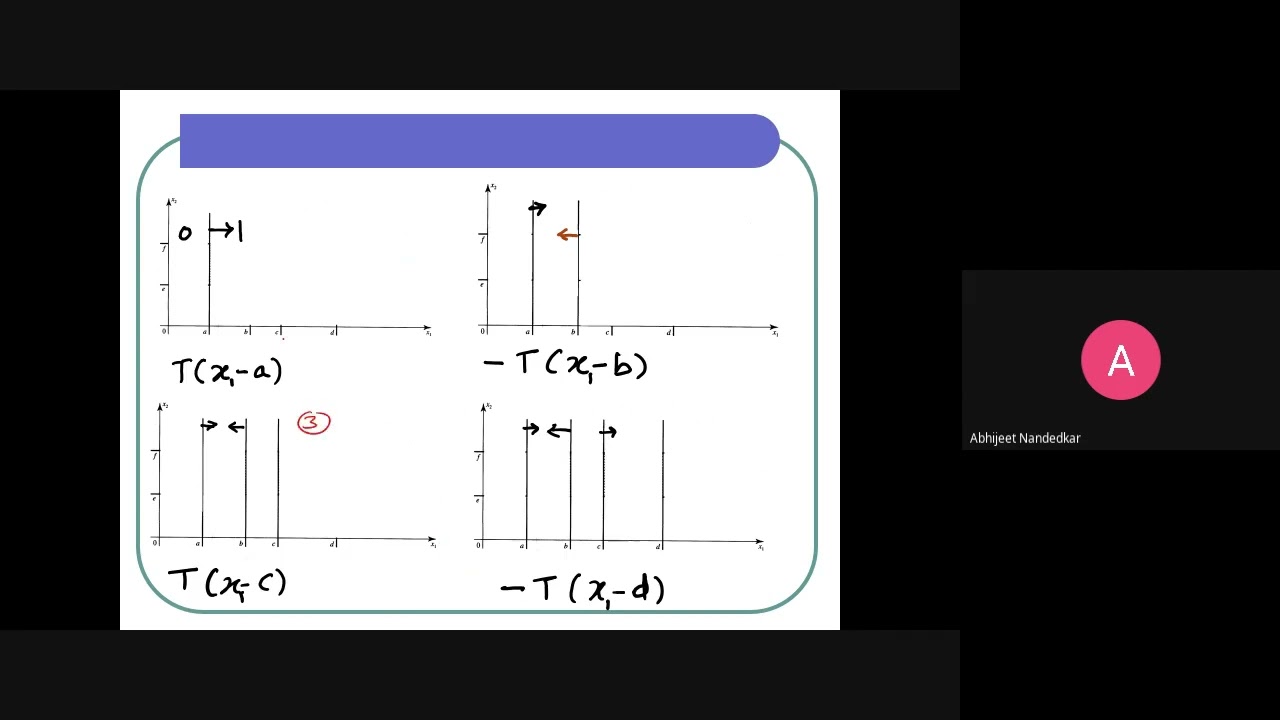
- Introduction and problem statement: find the region where TLU7 fires in a two-layer network.
- Analysis of neuron 1: threshold a, fires when X1 > a.
- Analysis of neuron 2: threshold b with weight -1, fires when X1 < b.
- Analysis of neurons 3 and 4: thresholds c and d, defining a band for X1.
- Analysis of neurons 5 and 6: thresholds e and f for X2, defining a band for X2.
- Combining neuron outputs to find regions where the sum exceeds 3.5, activating TLU7.
- Conclusion: the firing region is non-linear and cannot be separated by a single line.
- Transition to the generalized delta rule and backpropagation.
- Review of the delta learning rule and the need for differentiable activation functions.
- Introduction to gradient descent and error surface.
- Setup for the derivation: network structure, notation, and error function.
- Beginning of the derivation of weight updates for the output layer using chain rule.
Contribution & Novelties
This lecture does not present new research but offers a clear pedagogical walkthrough of two fundamental concepts: (1) how a two-layer threshold logic network can solve non-linear classification problems, and (2) the motivation and initial steps for deriving the generalized delta rule (backpropagation) for multi-layer networks. The manual analysis of the two-layer network is a valuable exercise for understanding how hidden layers create non-linear decision boundaries. The derivation of the generalized delta rule is standard but well-structured.
Pour aller plus loin :
- Backpropagation — Wikipedia article covering the algorithm and its derivation.
- Delta rule — Wikipedia article on the delta learning rule.
- Perceptron — Wikipedia article on the perceptron and its limitations.
- Gradient descent — Wikipedia article on gradient descent.
- Multilayer perceptron — Wikipedia article on multilayer perceptrons.
128 words
Radar Profile
The radar profile shows high technical level and good information quality, with moderate information quantity due to the lecture's focus on a single derivation. Reliability is high as the content aligns with established neural network theory. The overall profile reflects a solid academic lecture.