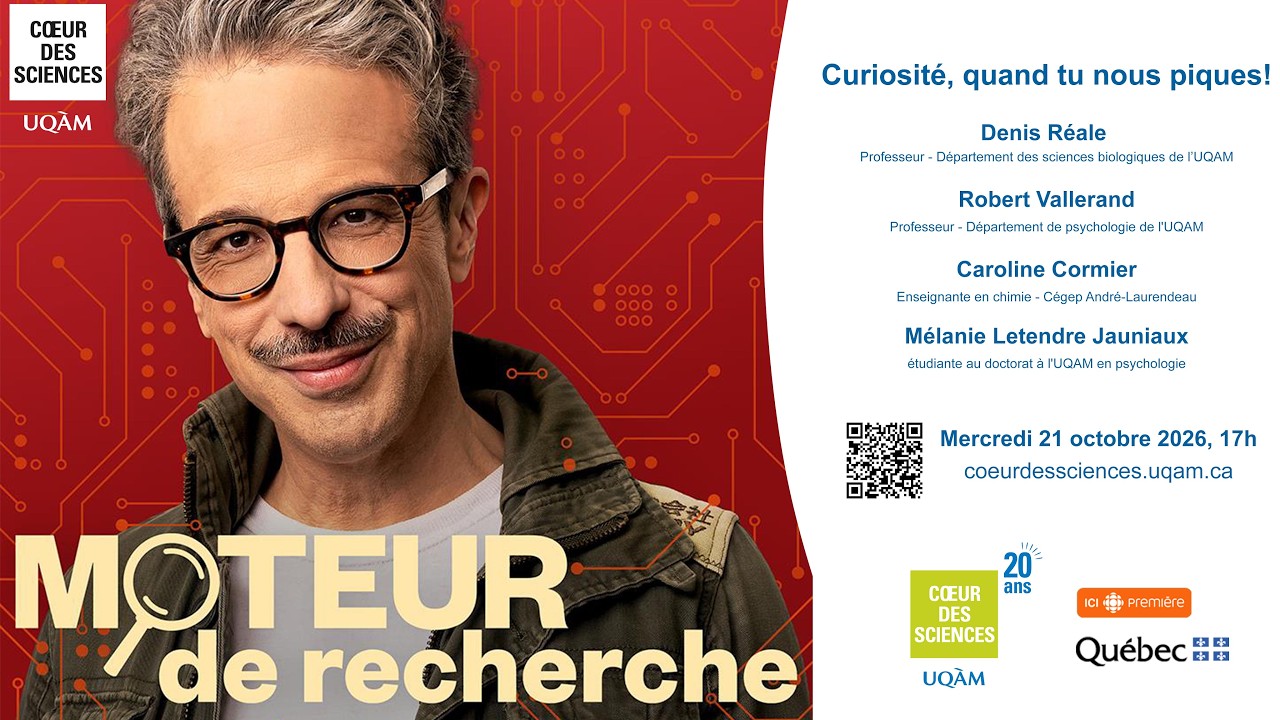
Curiosité, quand tu nous piques! - Moteur de recherche
Curiosity, how you sting us! - Search engine
Title history
- Curiosité, quand tu nous piques! - Moteur de recherche — observed on 20261111-2155 UTC (YouTube)
Keywords
Summary
196 words
Critical Evaluation
Value of the Information & Strength of the Argument
The discussion offers substantial intellectual value by bringing together four distinct research perspectives on a single concept — evolutionary ecology (Réale), educational science (Cormier), motivational psychology (Vallerand), and interpersonal curiosity (Letendre Jauniaux). Each speaker grounds claims in empirical work: Réale describes concrete experimental protocols (new-object tests, exploration boxes) and evolutionary trade-offs; Vallerand references a large body of studies and the philosophical tradition on passion; Cormier articulates a clear conceptual distinction between curiosity and interest. The arguments are cumulative and mutually reinforcing, with panelists explicitly building on each other’s contributions, and the moderate level of technical depth keeps the science accessible without trivializing it. The live Q&A format adds authenticity and addresses genuine public misconceptions.
Scientific Rigor, Source Quality, Title Accuracy
The rigor is high for a popularization format: panelists are active researchers at UQAM (Réale, Vallerand) or in education, and they reference recognized frameworks such as the Big Five (OCEAN) model, neophobia/neophilia, stabilizing selection, and the dualistic model of passion. The empirical examples (chipmunk exploration, bird behavior) are presented accurately. The main limitation is the absence of explicit bibliographic references or direct study citations in the broadcast itself, typical of a live panel. The title ‘Curiosity, when you sting us!’ matches the content well, as the entire episode is dedicated to the theme, and the playful tone reflects the accessible yet substantive treatment. No audience comments were available for analysis, so no comment-trend assessment was possible.
245 words
Title / Content Match
The title evokes the theme of curiosity with wordplay ('when you sting us'), and the content fully delivers a multifaceted scientific treatment of curiosity across species and across the lifespan.
Quality & Reliability
8/10
Panel of credentialed academics (professors in evolutionary ecology and psychology, an education researcher, a doctoral student) in a live university setting; theoretical claims anchored in established models (Big Five, dualistic model of passion) and empirical studies on animal behavior. Format is popularization but scientifically solid.
Key Moments
Markers derived by PSI from the transcript: the creator did not define chapters.
- Opening by Stéphane (director of Cœur des sciences), celebrating 20 years and introducing the special episode.
- Matthieu Dugal frames the theme: curiosity as an evolutionary strategy, passion, and interpersonal curiosity.
- Denis Réale introduced; he addresses 'curiosity killed the cat' and positions curiosity in an evolutionary framework.
- Réale explains the evolutionary benefits of curiosity: reducing uncertainty for survival and reproduction.
- Methods for studying animal curiosity: new-object tests, neophobia vs neophilia, and exploration styles in chipmunks and birds.
- Réale discusses the exploration-exploitation trade-off and stabilizing selection maintaining intermediate curiosity levels.
- Caroline Cormier defines curiosity as non-instrumental information seeking and distinguishes it from interest; touches on whether curiosity is innate or acquired.
- Survey result: 69% of the audience believes curiosity is innate; Cormier discusses implications for education and why curiosity can fade in learning contexts.
Cited Sources
- Curiosité, quand tu nous piques! - Moteur de recherche — The video itself, recorded live at UQAM for the 20th anniversary of Cœur des sciences, featuring the panel described in the description.
Concurring Sources
- Big Five personality traits — Aligns with Denis Réale's description of openness to experience as the personality factor associated with curiosity.
- Exploration-exploitation dilemma — Supports the trade-off argument presented by Réale regarding curiosity and information acquisition in animals.
Contribution & Novelties
The episode’s original contribution lies in its interdisciplinary synthesis: instead of presenting a single disciplinary view of curiosity, it juxtaposes evolutionary ecology, educational science, motivational psychology, and interpersonal curiosity in a live Q&A format. This cross-disciplinary dialogue highlights the concept’s polysemy and its shared evolutionary and psychological underpinnings. The panelists also bridge theoretical models (Big Five, dualistic model of passion) with concrete practical implications for education and aging, offering the public a coherent, research-based picture of why we seek novelty and information.
Pour aller plus loin :
- Curiosity — Relevant foundational overview of the concept across psychology and biology.
- Big Five personality traits — Presents the OCEAN model and ‘openness to experience,’ directly anchored in Denis Réale’s discussion.
- Exploration-exploitation dilemma — Formalizes the trade-off Réale describes between acquiring new information and exploiting known resources.
- Dualistic Model of Passion (Vallerand) — Mentioned by Robert Vallerand; well-documented in the psychology literature, but without a confirmed exact URL here, cited by name only.
160 words
Radar Profile
The profile shows high scores on information quantity, quality, and reliability, with a slightly lower technical level. This reflects a substance-rich, well-credentialed discussion that remains deliberately accessible to a general live audience, prioritizing breadth and clarity over technical depth.