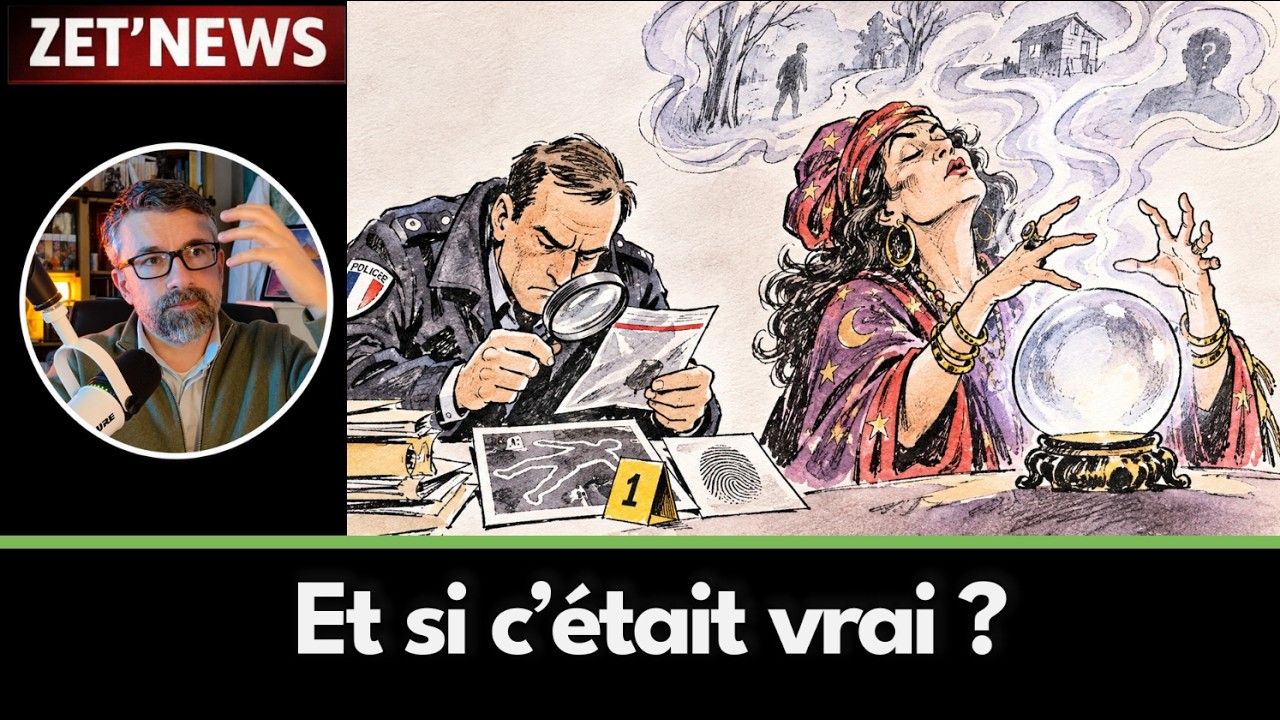
Les médiums contribuent aux enquêtes criminelles ?
Do Mediums Help in Criminal Investigations?
Title history
- Les médiums contribuent aux enquêtes criminelles ? — observed on 20261117-1127 UTC (YouTube)
Keywords
Summary
226 words
Critical Evaluation
Value of the Information & Strength of the Argument
The video provides solid value by presenting empirical evidence and documented cases that challenge the effectiveness of mediums. It cites peer-reviewed experiments and real-world examples, making the argumentation strong. The host carefully explains the psychological and social factors that make families vulnerable, and he avoids dismissing the sincerity of mediums while pointing out the harm caused by their unverified claims. The argumentation follows a logical progression from the specific case of Geneviève Delpech, to experimental studies, to the notorious Sylvia Browne case, and finally to ethical considerations. The reasoning is coherent and well-supported, although it relies on a limited number of studies due to the scarcity of scientific literature on the topic.
Scientific Rigor, Source Quality, Title Accuracy
The scientific rigor is high: the video references original studies published in reputable journals, such as the 1994 experiment by Wiseman et al. and the 2025 review by Schouten. It also mentions articles from the AFIS (French Association for Scientific Information) and a journalistic piece on Actu juridique. The host is careful to note the limitations of the research, including the difficulty in verifying all predictions and the lack of comprehensive data. The title accurately reflects the content, as the question posed is thoroughly examined with evidence. The adéquation between title and content is excellent, with no sensationalism but a measured, evidence-based discussion.
230 words
Title / Content Match
The title directly asks a question that the video comprehensively answers with evidence, demonstrating that mediums do not effectively contribute to criminal investigations.
Quality & Reliability
8/10
The video is based on peer-reviewed studies (Wiseman & West, Schouten) and a journalistic article, with a coherent critical approach. The sources are reliable and the claims are well documented, leading to a high reliability rating.
Key Moments
Markers derived by PSI from the transcript: the creator did not define chapters.
- Introduction to the topic: mediums and criminal investigations
- Presentation of Anne-Laure Pineau's article on mediums
- Discussion of Geneviève Delpech's claims and the need for verification
- Description of the 1994 Wiseman, West & Stemman experiment and its results
- Analysis of Sibo Schouten's 2025 study on missing person cases
- Case of Sylvia Browne and the Hornbeck and Berry families
- French case of Didier Derlich on RTL in 1988
- Ethical considerations: vulnerability of families and burden of proof
- Concluding thoughts on rationalism and the cost of manipulation
Cited Sources
- Support the independent work of La Tronche en Biais via Ulule — Crowdfunding platform mentioned in the video description for supporting the channel.
- Newsletter NEWS'Zet — Mentioned as a way to follow the author's work without depending on platforms.
- La Tronche en Biais on Twitch — The video is an excerpt from a live stream on Twitch, mentioned for the Sunday show 'Ça Coule de Source'.
- Full live stream of November 8, 2026 — Mentioned as the original magazine episode from which this excerpt is taken.
Contribution & Novelties
This video contributes a critical synthesis of scientific literature and documented cases regarding mediums in police investigations. It highlights the scarcity of rigorous studies and the challenges in verifying claims, while pointing out the real human harm caused by such claims, particularly the traumatic impact on families. The novelty lies in the compilation of these cases and the plea for a rationalist approach, emphasizing the burden of proof.
Pour aller plus loin :
- Psychic detective — Provides an overview of the phenomenon and examples of investigations involving psychics.
- Cold reading — Explains a technique often used by mediums to appear accurate, relevant to understanding how they might seem convincing.
- Burden of proof (law) — The legal principle that those making extraordinary claims must provide evidence, a key point in the video’s argumentation.
132 words
Radar Profile
The radar profile shows high scores in information quantity, quality, and technical level, with a slightly lower score for technical depth due to the non-technical nature of the subject. Overall, the profile indicates a well-researched, reliable, and informative video with strong argumentation.