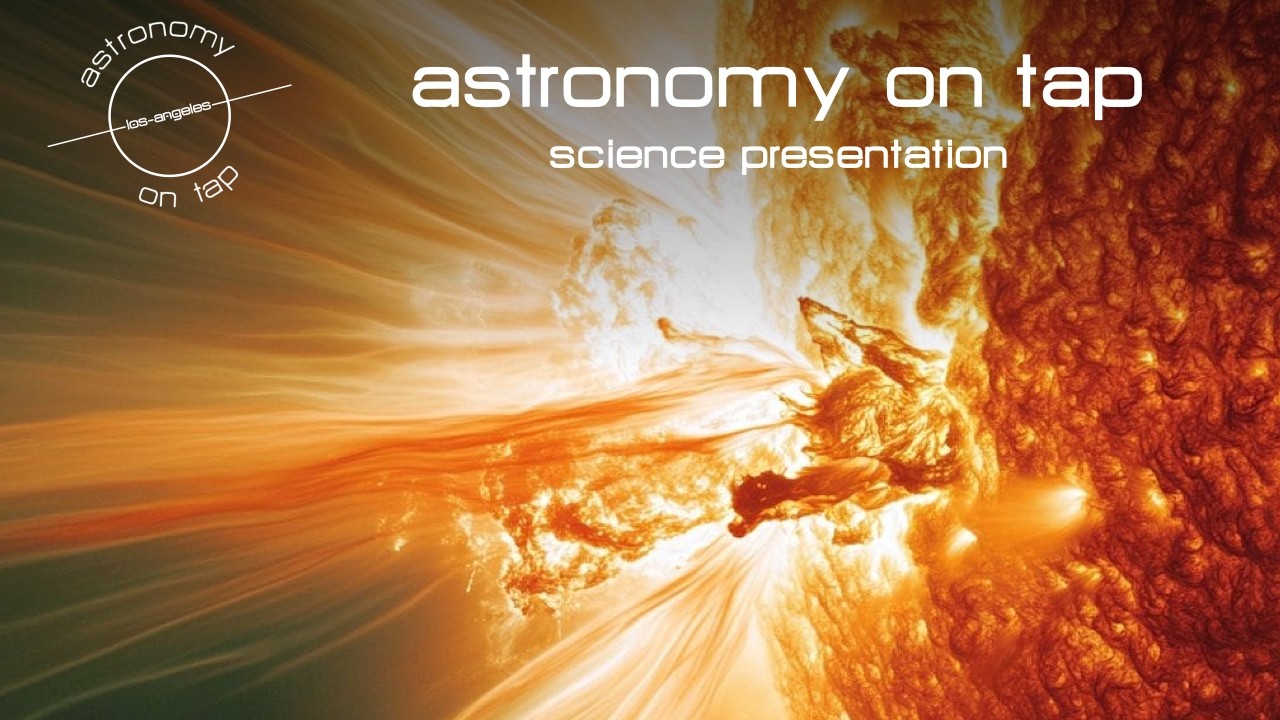
What Makes a Solar Eruption Extreme?
Keywords
Summary
211 words
Critical Evaluation
Value of the Information & Strength of the Argument
The information is highly valuable for a general audience, providing a clear and accessible explanation of complex solar phenomena. The argumentation is solid, built on well-established concepts such as the solar structure, magnetic field dynamics, and the Parker spiral, all supported by specific spacecraft observations (Parker Solar Probe, STEREO, ACE). The speaker uses analogies and clear visualizations to reinforce understanding. He also presents recent research from May 2024, showing the connection between flares, CMEs, and SEPs, and explaining how multi-spacecraft observations help pinpoint particle origins. The logic is coherent, from solar physics fundamentals to practical space weather impacts, making the case for the relevance of the field. However, some explanations are simplified for a lay audience, which is appropriate for the setting, but experts might find certain nuances condensed.
Scientific Rigor, Source Quality, Title Accuracy
The scientific rigor is high: the speaker is a Caltech postdoctoral researcher who directly works on the data he presents, citing specific spacecraft instruments and events. He distinguishes between observations and inferences, and acknowledges uncertainties (e.g., in predicting SEP arrival times). The sources mentioned are primarily the spacecraft missions (Parker Solar Probe, STEREO, ACE) and his own research, and the video description includes a link to his Caltech profile for verification. The title is apt, as the content directly addresses what makes some eruptions extreme (size, energy, effects) and includes discussion of Carrington-type events. No comments were provided for analysis, so no audience trends are considered here.
251 words
Title / Content Match
The title accurately reflects the content, which explains the physics of solar eruptions and what makes them extreme, including spacecraft observations and space weather effects.
Quality & Reliability
9/10
Highly reliable presentation by a Caltech solar physicist (Gabriel Muro) with accurate, up-to-date information drawn from spacecraft observations, though some simplifications for a general audience.
Chapters
Cited Sources
- Gabriel D. Muro — Caltech PMA — Profile of the speaker, confirming his affiliation and research focus.
Concurring Sources
- NOAA Space Weather Prediction Center — Government agency monitoring solar activity and space weather, corroborating the video's claims about recent events and forecasts.
- NASA Sun Science — NASA's official page on solar science, supporting the spacecraft observations and findings discussed in the video.
Contribution & Novelties
The video’s original contribution lies in its presentation of current solar physics research in an accessible format, integrating results from Parker Solar Probe and multi-spacecraft studies to explain extreme solar eruptions. It offers a rare insight into how scientists determine particle origins using composition ratios (e.g., iron-to-oxygen) and highlights the practical consequences for technology on Earth. The speaker’s personal experience with the May 2024 storms adds a contemporary perspective.
Pour aller plus loin :
- Coronal mass ejection — Overview of CMEs, their causes and effects, directly relevant to the video’s main topic.
- Parker Solar Probe — Official NASA mission page describing the probe’s objectives and fascinating close-up measurements of the Sun.
- Solar energetic particles — Detailed explanation of these particles, their acceleration mechanisms, and space weather impact.
- Carrington Event — Historical context for extreme space weather events, referenced in the Q&A section.
142 words
Radar Profile
The profile shows strong scores in reliability (9) and information quality (8), with moderate scores in quantity (8) and technical depth (6). This indicates a well-informed presentation that is factually solid but not overly technical, balancing accessibility with scientific depth.