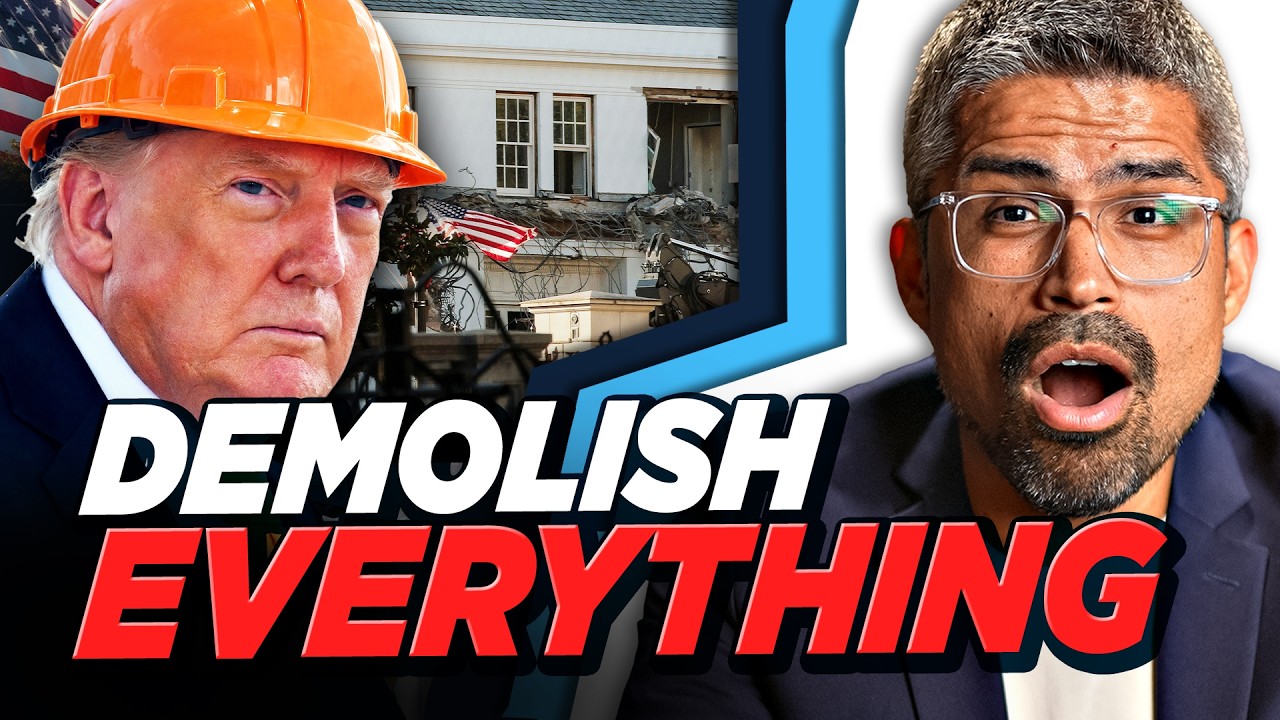
SCOTUS Says Trump's Ballroom is Illegal, Build It Anyway
Keywords
Summary
158 words
Critical Evaluation
Value of the Information & Strength of the Argument
The video provides substantial legal value by breaking down a complex Supreme Court ruling and its procedural history. It explains standing doctrine clearly, referencing Lujan v. Defenders of Wildlife and applying it to the facts. The argumentation is persuasive and well-structured: it first establishes the factual background, then details the lower court’s findings of illegality, and finally critiques the majority’s standing analysis. The host supports each point with specific statutory citations and quotes from court opinions, making the argument robust. However, the presentation is one-sided, with a clear critical stance toward the administration, and it does not fully address counterarguments beyond a brief acknowledgment that not every aesthetic complaint should create standing. Overall, the analysis is rigorous and informative, though it is framed as commentary rather than neutral reporting.
Scientific Rigor, Source Quality, Title Accuracy
The video demonstrates high scientific rigor by relying on primary legal sources: the U.S. Code, court opinions, and the record of the case. The host accurately cites the relevant statutes and explains their applicability. The quality of sources is strong, with references to the district court’s findings and the Supreme Court’s order. The title is faithful to the content and not misleading; it encapsulates the surprising outcome. The video does not cite external URLs within the narration, but the description includes links to LegalEagle’s courses and services, which are not directly related to the case. No comment data was provided for analysis.
246 words
Title / Content Match
The title accurately reflects the content: the Supreme Court allowed the ballroom to be built despite acknowledging its likely illegality, which matches the ironic framing. The title clearly conveys the central contradiction.
Quality & Reliability
8/10
The video presents a detailed legal analysis of a Supreme Court ruling, citing specific statutes (3 USC §105D, 40 USC §8106, 54 USC §101) and key case law (Lujan v. Defenders of Wildlife). The reasoning is transparent and distinguishes between legal merits and standing. It is an advocacy piece with a critical tone, and includes sponsor segments, but the legal arguments are grounded in primary sources.
Key Moments
Markers derived by PSI from the transcript: the creator did not define chapters.
- Introduction of the ballroom controversy and the Supreme Court ruling; quote from John Roberts declaring construction 'slightly unlawful'.
- Background on the National Trust for Historic Preservation and the lawsuit initiated to halt demolition and construction.
- Judge Leon's injunction based on three statutes that the administration violated; his 'please' dismissals of government arguments.
- The Supreme Court's 5-4 ruling on standing, the administration's national security arguments, and the majority's refusal to address legality.
- John Roberts' dissent explaining the illegality and his reasoning that the National Trust had standing; analysis of his historical reflections.
Cited Sources
- LegalEagle Law School Guide — Mentioned in video description as a course for law school applicants; not directly cited in the video's legal analysis.
- LegalEagle Copyright Course — Mentioned in video description as a course on copyright law; not directly cited in the video's legal analysis.
- LegalEagle Lawyer Referral Service — Mentioned in video description as a way to find a lawyer; not directly cited in the video's legal analysis.
- LegalEagle Podcast — Mentioned in video description as a podcast; not directly cited in the video's legal analysis.
External References
Contribution & Novelties
The video offers a comprehensive and accessible analysis of a high-profile Supreme Court standing ruling, explaining the intricacies of the case in layman’s terms while retaining legal precision. It highlights the unusual alignment of Chief Justice Roberts with the liberal wing and clarifies the disconnect between legal merits and justiciability. The original contribution lies in its clear dissection of the statutory provisions and the historical significance of the White House, making it a valuable resource for understanding constitutional law in practice.
Pour aller plus loin :
- Standing (law) — Overview of the legal doctrine that determines a plaintiff’s right to sue.
- Lujan v. Defenders of Wildlife — The landmark 1992 case cited in the video that established the three-part test for standing.
- National Trust for Historic Preservation — The plaintiff organization, chartered by Congress, whose role is central to the case.
141 words
Radar Profile
The radar profile shows strong performance across all dimensions, with particularly high scores in information quality and technical level. The video balances detailed legal reasoning with clear communication, making it both informative and accessible. The lower score in quantity of information relative to quality suggests a focused treatment rather than exhaustive coverage, which is appropriate for a 28-minute analysis.