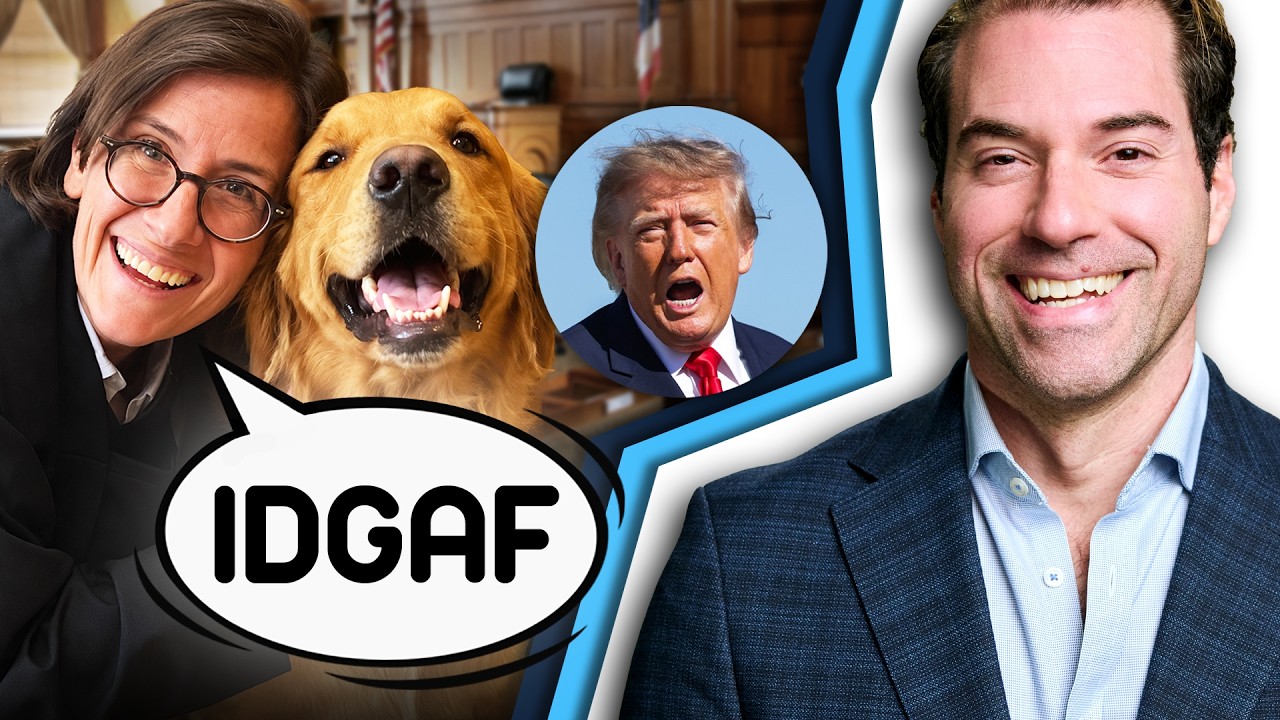
Trump Declares War On Trees
Title history
- Trump Declares War On Trees — observed on 20261024-1549 UTC (YouTube)
Keywords
Summary
125 words
Critical Evaluation
Value of the Information & Strength of the Argument
The video provides a comprehensive legal analysis, using specific court documents and direct quotes from hearings. The argument is persuasive, though clearly biased against Trump, but it effectively demonstrates potential legal overreach and the judge’s role in upholding procedural and substantive law. LegalEagle builds a strong case that the administration acted in bad faith, using evidence from the timeline of events and the judge’s explicit findings. The inclusion of Judge Reyes’ prior rulings adds depth, showing a pattern of resistance to executive overreach, and the discussion of the recusal motion illustrates the government’s tactics. The value lies in making complex legal procedures accessible and connecting them to broader constitutional concerns.
Scientific Rigor, Source Quality, Title Accuracy
The video cites specific cases (e.g., the transgender military ban case, the TPS revocation case, and the inspector general case) and legal principles, with occasional direct quotes from court opinions and hearing transcripts. While the primary sources are not hyperlinked, they are clearly identified and can be verified. The video also references historical facts, such as the 1941 desegregation of the golf course, which are well-documented. The title ‘Trump Declares War On Trees’ is catchy and accurately reflects the central incident of the tree removal, though it slightly sensationalizes the broader legal conflict. Overall, the rigor is high for a YouTube legal commentary, with careful attention to legal detail and procedural nuance.
237 words
Title / Content Match
The title is catchy and accurately highlights the tree removal aspect of the case, which is a central trigger of the legal dispute.
Quality & Reliability
8/10
The video is presented by a licensed attorney and includes specific references to court decisions, statutory law, and excerpts from hearing transcripts. Some statements are opinionated but grounded in legal analysis and documented facts. The overall reliability is high for factual assertions, though the interpretive commentary is clearly partisan.
Key Moments
Markers derived by PSI from the transcript: the creator did not define chapters.
- Introduction: Trump's actions and the golf course plan.
- History of East Potomac Golf Links and desegregation in 1941.
- Details of the planned transformation and lease termination.
- Overview of Judge Reyes' background and prior rulings.
- The tree removal incident and judge's reaction.
- Temporary restraining order and hearing.
- Government's motion to disqualify and Trump's attacks.
Cited Sources
- Hosseinzadeh v. Klein, 276 F.Supp.3d 34 (S.D.N.Y. 2017) — Cited in the video description for fair use commentary and criticism.
- Equals Three, LLC v. Jukin Media, Inc., 139 F. Supp. 3d 1094 (C.D. Cal. 2015) — Cited in the video description for fair use commentary and criticism.
External References
Contribution & Novelties
The video offers a detailed legal analysis of a specific lawsuit involving the Trump administration’s efforts to repurpose a historic golf course, highlighting the judge’s role in checking executive authority. It provides context on the judicial process, including temporary restraining orders, recusal motions, and the impact of presidential statements on judicial safety. The original contribution is the synthesis of these legal issues with historical background and rigorous citation of court proceedings.
Pour aller plus loin :
- East Potomac Golf Courses — Provides historical background and significance of the golf course.
- Ana Reyes — Background on the federal judge and her career.
- Transgender personnel in the United States military — Context for the earlier transgender military ban case referenced in the video.
- Temporary protected status — Background on the TPS revocation case mentioned in the video.
135 words
Radar Profile
The radar profile shows high scores in information quantity and reliability, with slightly lower but solid scores in technical level and overall quality. This indicates a well-researched, data-rich video that is moderately technical, making it accessible to a general audience while retaining legal substance.