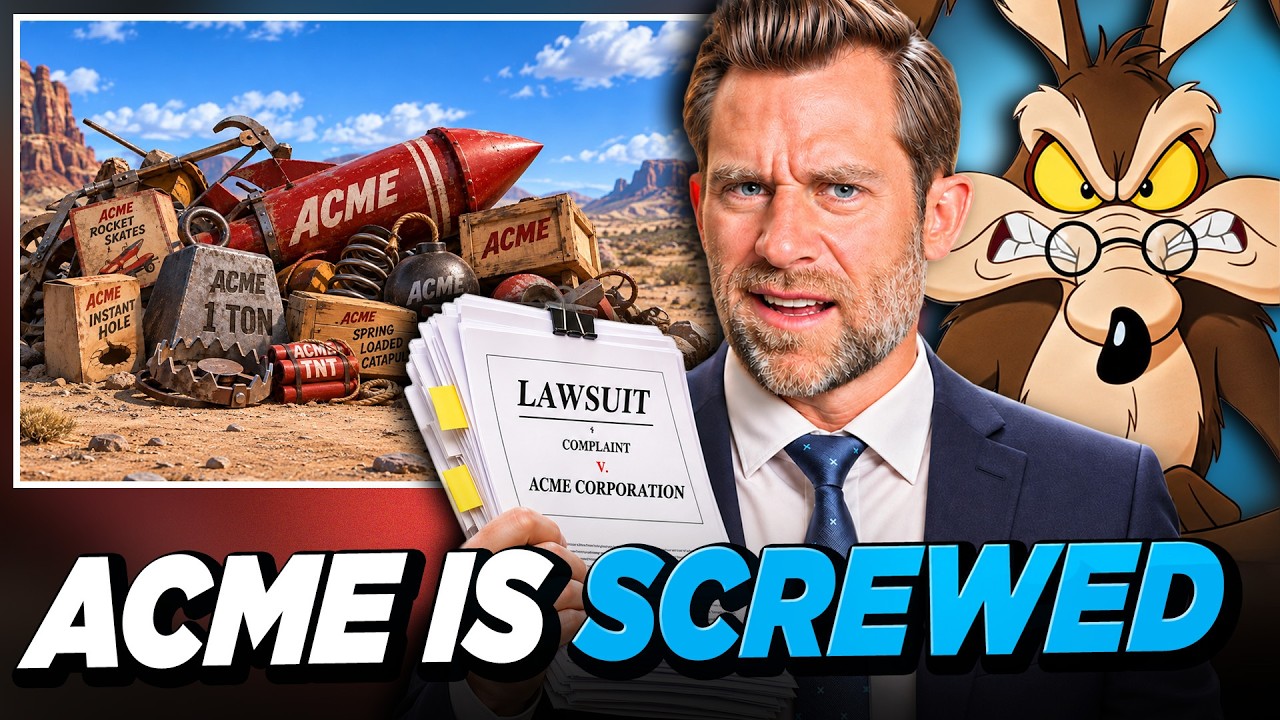
Coyote v.s. ACME is Incredible
Keywords
Summary
256 words
Critical Evaluation
Value of the Information & Strength of the Argument
The informational value lies in the density of mainstream American civil-procedure and tort doctrine that the video extracts from what is ostensibly a comedy. Rather than asserting rules in the abstract, the presenter anchors each one in a concrete illustration: an aluminium ladder with a defective weld to separate strict liability from negligence, a match-factory fire to distinguish mass torts from class actions, a signed pleading to explain a lawyer’s personal exposure for filings, and a registered agent to explain corporate service of process. This makes the reasoning easy to follow and auditable, and the recurring move of stating what the film gets right before stating what it gets wrong gives the commentary an even-handed texture. The argumentation is also honest about its own limits: several conclusions are explicitly hedged (‘probably’, ‘I guess you would argue’), particularly on the genuinely open question of how damages are assessed when the plaintiff is a cartoon character who cannot be killed, and the presenter concedes that the film’s procedural shortcuts are acceptable as plot devices. The weaker dimension is argumentative depth: no rule is traced to a statute, restatement provision or decided case, and the discussion of large-corporate litigation pressure stays at the level of general assertion about nuisance value and discovery costs rather than demonstration. A handful of tangents (cast callbacks, an Oxford law-degree aside, jokes about the presenter’s own avian persona) dilute the analytical through-line without undermining it. Two clearly delimited sponsored segments of roughly two minutes each are inserted into the body of the video.
Scientific Rigor, Source Quality, Title Accuracy
Rigueur scientifique: the legal doctrine presented is standard and accurate, but it is delivered as expert commentary rather than as documented research. Nothing is footnoted, no statute or case is cited for the doctrinal propositions, and the one legislative reference that appears (‘Chapter 15 US Code’) is dialogue from the fictional complaint being read aloud, not an actual authority invoked by the presenter. The presenter’s authority rests on professional qualification and experience, which is legitimate for this genre but not independently checkable within the video. Qualité des sources: the sources named are informal and spoken rather than linked. Ian Frazier’s 1990 New Yorker piece, which the video reads from and which originated the Coyote-sues-Acme premise, is referenced by year and outlet only; the film ‘A Civil Action’ is named as an illustration of litigation-driven insolvency, again without a link. The only formal legal authorities anywhere in the package sit in the description’s fair-use disclaimer (Hosseinzadeh v. Klein; Equals Three v. Jukin Media), which concerns copyright in the clips and has nothing to do with the substance of the analysis. Several description links are commercial or self-promotional and are not evidentiary sources. Adéquation titre/contenu: the title is a loose, click-oriented label that does not announce a legal analysis, and the content does match the named film, so the mismatch is one of framing rather than subject.
495 words
Title / Content Match
The title is an informal hook naming the film under discussion; it is vague but not misleading, since the whole video is a legal analysis of 'Coyote vs. Acme'.
Quality & Reliability
7/10
The commentary comes from a practising attorney who explains mainstream US products-liability doctrine accurately and with concrete illustrations (strict liability versus negligence, class action versus mass tort, substituted service on a registered agent, lawyer accountability for signed pleadings). Reliability is limited less by error than by format: it is an unscripted reaction video, no statutes, cases or academic sources are formally cited for the doctrinal claims, and some passages are hedged or off-the-cuff. The legal propositions themselves are standard and uncontroversial, which supports a solid but not exceptional reliability rating.
Key Moments
Markers derived by PSI from the transcript: the creator did not define chapters.
- Opening remarks on the film's surprise quality and the Peter Lorre / Looney Tunes casting callbacks, which establish the cartoon-literacy frame for the analysis.
- Reading of the fictional 1990 New Yorker complaint: Coyote as an Arizona resident suing a Delaware-incorporated manufacturer for personal injury, lost business income and mental suffering.
- Evaluation of the in-film attorney advertisement against legal-ethics norms, with the observation that clients respond to compensation framing rather than blame framing.
- Distinction between class action and mass tort, developed from the film's match-factory scenario: similar but non-identical injuries do not fit the class-action mechanism.
- Discussion of damages when the plaintiff is an apparently immortal cartoon: liability and damages are separate questions, and immortality affects quantum rather than fault.
- Core doctrinal explanation of strict products liability versus negligence, illustrated with an aluminium ladder whose factory weld failed.
- A lawyer who signs a pleading is responsible for its entire content, an argument extended to the current problem of AI-hallucinated citations in filings.
- Economics of settlement: nuisance value, the cost of defending, and the role of insurers in the decision to pay rather than litigate.
- Litigation cost asymmetry and the threat to 'bury' a small firm in paperwork, illustrated by the bankruptcy of the plaintiffs' firm in 'A Civil Action'.
- Closing assessment, where the presenter delivers the promised verdict on the film's legal realism.
Cited Sources
- 'Coyote v. Acme', Ian Frazier, The New Yorker (1990) — The 1990 humour piece that originated the Coyote-sues-Acme premise; the fictional complaint read aloud in the video derives from it.
- A Civil Action (film, 1998, adapted from Jonathan Harr's book) — Cited as a real-world illustration of a plaintiffs' firm bankrupted by the cost of litigating a meritorious case.
- Coyote vs. Acme (film) — The film under analysis throughout the video.
- Hosseinzadeh v. Klein, 276 F. Supp. 3d 34 (S.D.N.Y. 2017) — Fair-use authority cited in the video description's disclaimer regarding use of clips; unrelated to the substantive legal analysis.
- Equals Three, LLC v. Jukin Media, Inc., 139 F. Supp. 3d 1094 (C.D. Cal. 2015) — Second fair-use authority cited in the description's disclaimer, likewise unrelated to the products-liability discussion.
Concurring Sources
- Restatement (Third) of Torts: Products Liability — Standard doctrinal authority consistent with the video's account that a plaintiff must show a defect and causation rather than negligence in the chain of distribution.
- A Civil Action (Jonathan Harr, 1995; film 1998) — Independent documentation of the cost-driven failure of a plaintiffs' firm that the video invokes.
- Coyote v. Acme, The New Yorker (1990) — Primary text of the fictional complaint, corroborating the passages read aloud in the video.
External References
Contribution & Novelties
The original contribution is not new legal knowledge but a systematic transposition of ordinary products-liability and civil-procedure doctrine onto a cartoon universe whose physics break every assumption the doctrine rests on. The presenter isolates several genuinely interesting edge questions that a standard textbook treatment would not raise: how damages are quantified when the injured party is effectively immortal and can therefore never suffer a wrongful-death loss; whether a single complaint covering hundreds of distinct defective products is procedurally coherent, and how a court would manage it; and whether the uniformity of products-liability law across states defeats the film’s premise that a corporation could legislate its own immunity. A secondary contribution is the repeated translation of film choices into professional-conduct consequences, most notably the proposition that a lawyer’s signature on a pleading is an unqualified assumption of responsibility for its contents, which he connects to the contemporary problem of AI-generated fictitious citations. The discussion of settlement economics — nuisance value, insurer incentives, cost asymmetry — is delivered at a general level rather than as a documented analysis.
Pour aller plus loin :
- Product liability — Overview of the strict-liability framework and the defect categories the video describes informally.
- Class action — Background for the class-action versus mass-tort distinction drawn from the match-factory scenario.
- Service of process — Context for the explanation of substituted service on a corporation’s registered agent.
- A Civil Action — The Jonathan Harr book and its film adaptation, cited as the reference case of litigation cost destroying a meritorious plaintiffs’ firm.
- Restatement (Third) of Torts: Products Liability — the standard doctrinal reference behind the strict-liability explanations given in the video, named here without a URL.
277 words
Radar Profile
The profile is lopsided towards quality and reliability, with a moderate technical level reflecting an accessible, example-driven explanation of doctrine rather than specialised analysis. Quantity of information is capped by the reaction format, where tangents and film commentary alternate with substantive legal exposition. Overall it reads as a competent, well-calibrated expert commentary rather than a research output.