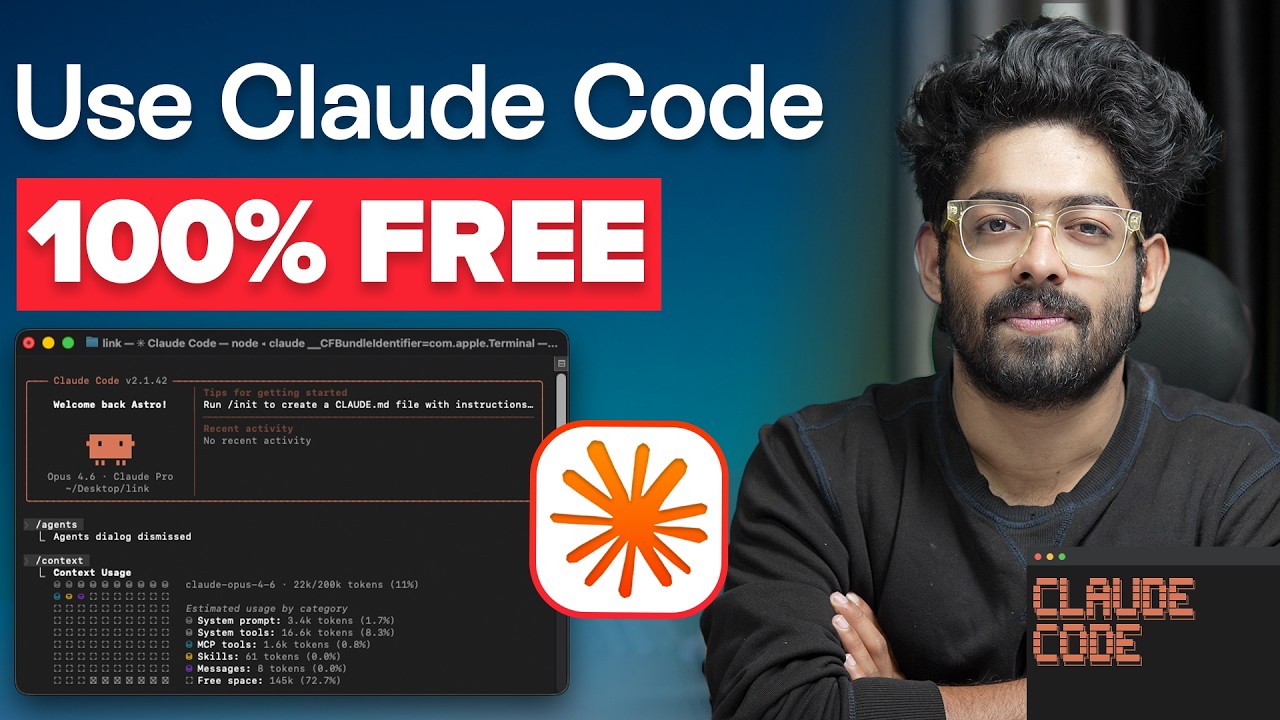
STOP Paying $200/m For Claude Code.. Here's How To Use It For FREE!
Keywords
Summary
127 words
Critical Evaluation
Value of the Information & Strength of the Argument
The value lies in providing a concrete, step-by-step workaround that many users can follow, complete with commands and visual confirmation. The argumentation is clear: it shows the pricing issue, explains the principle of running local models, and demonstrates the process with a real test. However, the presenter is upfront about the limitations, admitting that performance is disappointing compared to proprietary models. The argumentation is logical but somewhat overpromising in the title, as the ‘free’ method does not replicate the full Claude Code experience. The reasoning is solid for tech-savvy users, though the trade-offs are substantial and may not be worth it for many.
Scientific Rigor, Source Quality, Title Accuracy
The video provides links to official websites (Claude Code, Ollama) and uses a live demonstration, which adds credibility. The sources cited are primarily the official Claude Code page and Ollama’s site, both reliable. However, the method involves ’tricking’ Claude Code, which is a hack that may not be officially supported and could violate terms of service. The title is somewhat misleading as it suggests using Claude Code for free, but the actual implementation uses different models. The content is technically accurate as a tutorial, but the scientific rigor is moderate due to the lack of deep testing or comparison. Comments on the video highlight that the approach is not truly ‘Claude Code’ but rather a local interface with alternative models, aligning with this assessment.
242 words
Title / Content Match
The title promises a free method to use Claude Code, which is technically achieved but uses local models instead of Anthropic's, so there is partial mismatch between the title's implication and the actual content.
Quality & Reliability
7/10
The tutorial is practical and reproducible, but it relies on a workaround that replaces Claude's proprietary models with open-source alternatives, which may mislead viewers expecting the full Claude Code experience. The steps are clear and technically accurate, but the performance trade-offs are significant and acknowledged.
Key Moments
Markers derived by PSI from the transcript: the creator did not define chapters.
- Intro: problem of Claude Code pricing ($20-$200/mo)
- Demonstration of paid Claude Code using Opus 4.6
- Plan: install Ollama, run local open-source model, trick Claude Code
- Installation of Claude Code and Ollama steps
- Sponsor segment (Storyblocks) with no technical content
- Selecting and downloading GPT-OSS-20B model via Ollama
- Setting environment variables (ANTHROPIC_BASE_URL, ANTHROPIC_AUTH_TOKEN) to redirect to localhost
- Launching Claude Code with local model and testing with 'hi'
- Creating a to-do app example, noting 41-second response time
- Conclusion: trade-offs and performance expectations
Cited Sources
- Claude Code official page — Referenced as the official website where Claude Code can be installed
- Ollama download page — Referenced as the source to download Ollama and find open-source models
Concurring Sources
- Ollama official site — Confirms that Ollama allows running models locally, which is the basis of the free method.
Dissenting Sources
- Claude Code pricing page — The official pricing page states that Claude Code requires a paid subscription, contradicting the video's claim that it can be used for free without any subscription.
External References
Contribution & Novelties
This video offers a practical, step-by-step workaround that combines official tools (Claude Code CLI) with a local model server (Ollama) to bypass subscription fees. The novelty lies in the configuration of environment variables to redirect API calls, a method not widely documented in mainstream tutorials. It also highlights the trade-off between cost and performance, which is valuable for budget-conscious developers.
Pour aller plus loin :
- Ollama official site — Overview of running large language models locally, a key component of the method.
- Claude Code documentation — Official reference for Claude Code features and CLI usage.
- GPT-OSS model information — Details on the open-source model used in the video (if URL is uncertain, mention without URL).
- Anthropic API environment variables — Context for the ANTHROPIC_BASE_URL and ANTHROPIC_AUTH_TOKEN variables.
127 words
Radar Profile
The radar profile shows moderate scores across all dimensions, with quantity of information being the highest due to the detailed walkthrough. Quality and reliability are lower because the method has significant limitations and potential legal ambiguities. The technical level is decent but not advanced, suitable for intermediate users.
💬 Rather negative with a hint of mixed reactions. Out of 30 comments, many point out that the method is misleading because it replaces Claude's models with local ones, while some appreciate the tutorial.