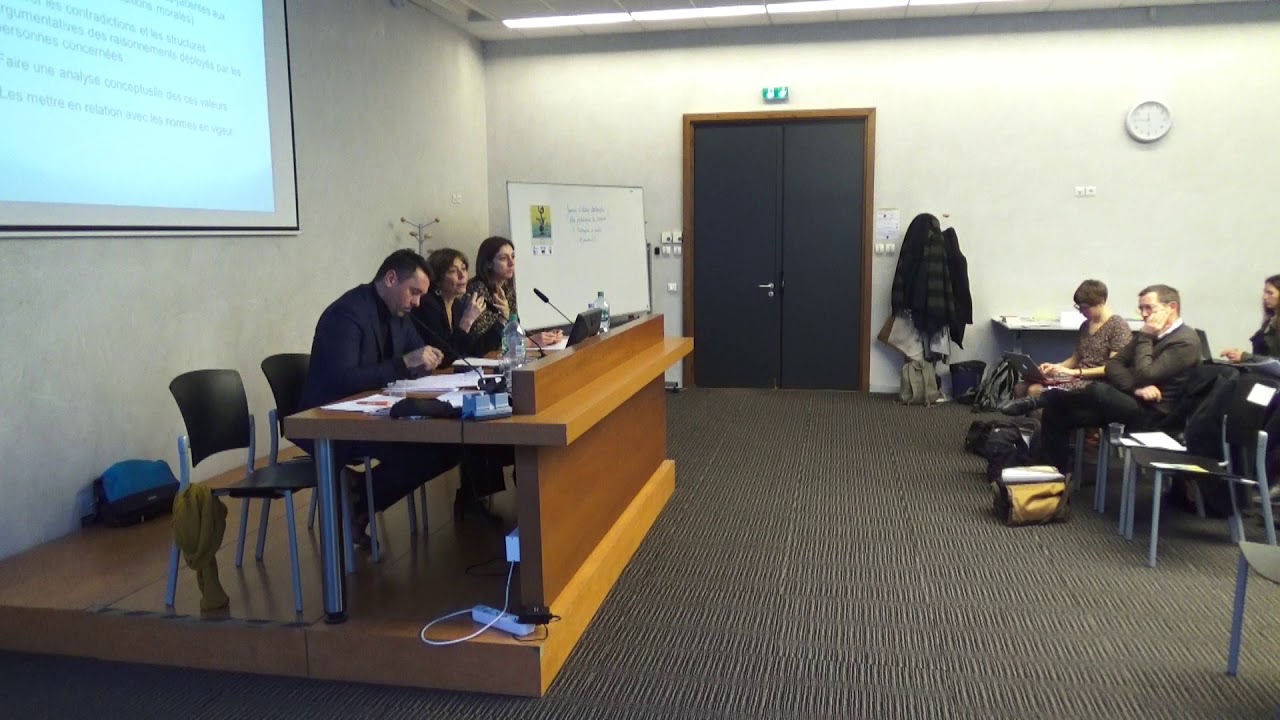
Journée d'études doctorales "Une philosophie de terrain?" - Intervention de Marta Spranzi (partie 2)
Doctoral study day "A field philosophy?" - Presentation by Marta Spranzi (part 2)
Keywords
Summary
155 words
Critical Evaluation
Value of the Information & Strength of the Argument
The talk provides valuable insights into applied ethics, particularly the heuristic approach to clinical decisions. Spranzi’s argumentation is solid and well-structured: she acknowledges the critiques of intuitionism but convincingly defends the necessity of starting from intuitions while remaining open to rational evolution. She introduces the nuanced distinction between norms and values, showing how values are more personal and flexible, and how norms often lag behind. The notion of ’normative modesty’ is thought-provoking and relevant for anyone working in ethics. Her emphasis on the philosopher’s role as a facilitator, not an authority, is both humble and practical. The argument is persuasive because it is grounded in real clinical experiences and dialogues with patients and caregivers.
Scientific Rigor, Source Quality, Title Accuracy
Scientifically, Spranzi’s reasoning is rigorous and consistent, though she does not cite specific external sources during this Q&A segment. Her claims are based on her extensive fieldwork and philosophical framework, which she presents with clarity. The quality of sources is not directly evidenced, but her position as a researcher at UVSQ and consultant at AP-HP lends credibility. The title is perfectly aligned with the content: it is a focused discussion following a formal presentation. No comments were provided in the dataset, so public reception cannot be assessed.
216 words
Title / Content Match
The title accurately reflects the session: it is the second part of a doctoral study day presentation, focusing on Q&A. No mismatch between title and content.
Quality & Reliability
8/10
The speaker is a recognized academic in clinical ethics with direct field experience. Her arguments are nuanced and coherent, though she relies primarily on her own practice rather than citing specific literature.
Key Moments
Markers derived by PSI from the transcript: the creator did not define chapters.
- First audience question about intuitionism and moral naturalism.
- Spranzi explains critical intuitionism and the role of intuitions.
- Discussion on 'natural death' and the artificial/natural dichotomy.
- Introduction of 'normative modesty' and the gap between values and norms.
- The philosopher's role as facilitator in clarifying values.
Contribution & Novelties
The talk offers a practical, field-based perspective on ethical deliberation in medicine, arguing for a heuristic approach that respects individual intuitions while subjecting them to critical refinement. It introduces the concept of ’normative modesty’ and clearly differentiates between general norms and personal values, suggesting a more flexible and context-sensitive ethical practice.
Pour aller plus loin :
- Intuitionism — Overview of ethical intuitionism, relevant to her defense of intuitions.
- Clinical ethics — Field of practiced ethics in medicine, directly related.
- Applied ethics — Broader area of philosophy applied to practical dilemmas.
90 words
Radar Profile
The radar profile shows high scores in quality and reliability, moderate in quantity and technical depth. This reflects a concise but thoughtful expert discussion that prioritizes depth over breadth.