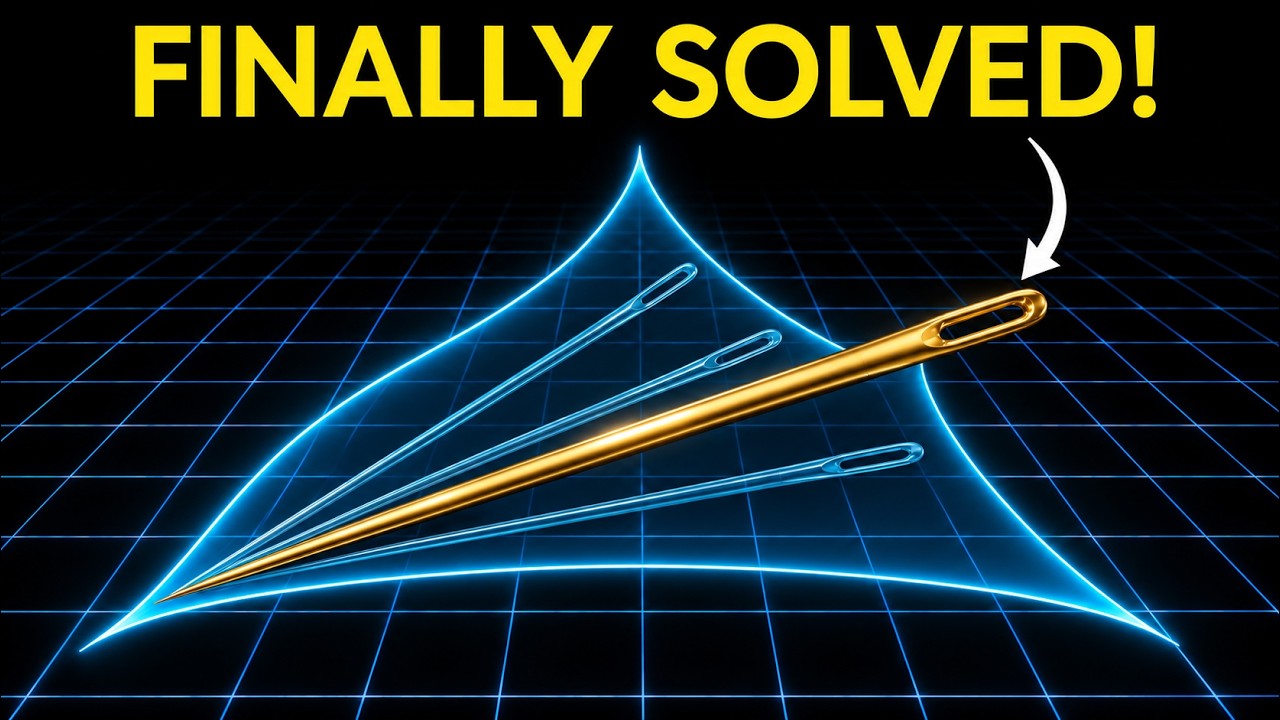
Biggest Breakthrough in Mathematics: 2026!
Keywords
Summary
121 words
Critical Evaluation
Value of the Information & Strength of the Argument
The video excels at building intuition step by step, starting from the simple pinned needle and progressively introducing the necessary mathematical tools. It clearly separates the geometric intuition from the rigorous proof, and explains why the problem was difficult. The argumentation is logical, with each concept motivated by the previous one. The use of analogy (e.g., the toy box sum) effectively communicates the key idea that dimension and volume can diverge. The video also honestly notes the limits of what is proven, such as the restriction to ordinary space and the non-settled question of exact volume bounds. The narration is precise and avoids misleading simplifications, making the content valuable for both learners and those familiar with the topic.
Scientific Rigor, Source Quality, Title Accuracy
The video cites the original arXiv papers by Wang & Zahl and the streamlined version by Guth, Wang & Zahl, as well as Wolff’s foundational paper. It also references the Quanta Magazine article and Terence Tao’s blog, which are reputable secondary sources. The Fields Medal citation is included as primary documentation. The title, while emphatic, appropriately highlights the significance of the result. The content accurately reflects the sources and does not overstate claims; it clearly distinguishes between the toy illustration and the actual proof. There are no evident discrepancies between the title and content.
227 words
Title / Content Match
The title is slightly sensational but accurately reflects the significance of the Kakeya conjecture proof and the 2026 Fields Medal. Content matches the title well.
Quality & Reliability
9/10
The video accurately presents a recent mathematical breakthrough, citing primary sources (arXiv papers, DOI links) and reputable secondary sources (Quanta, Tao's blog). The explanation is faithful to the technical content and distinguishes proven results from open questions.
Chapters
Cited Sources
- Volume estimates for unions of convex sets, and the Kakeya set conjecture in three dimensions (arXiv:2502.17655) — Original 2025 proof by Hong Wang and Joshua Zahl.
- A streamlined proof of the Kakeya set conjecture in R^3 (arXiv:2601.14411) — Shorter proof by Guth, Wang and Zahl, finalized in 2026.
- An improved bound for Kakeya type maximal functions (Wolff 1995) — Wolff's 1995 bound giving dimension at least 2.5.
- Terence Tao: The three-dimensional Kakeya conjecture, after Wang and Zahl — Blog post by Tao discussing the proof.
- Quanta Magazine: 'Once in a Century' Proof Settles Math's Kakeya Conjecture — Journalistic summary of the result.
- Fields Medal 2026: Hong Wang, short and long citation — Official citation for the Fields Medal.
- On some Problems of Maxima and Minima for the Curve of Constant Breadth and the In-revolvable Curve of the Equilateral Triangle (Kakeya 1917) — Original paper by Sōichi Kakeya formulating the problem.
Concurring Sources
- arXiv:2502.17655 — Original proof paper, fully concordant with the video's claims.
- Quanta Magazine article — Independent journalistic coverage supporting the same facts.
- Terence Tao's blog post — Mathematician's commentary confirming the result and significance.
External References
Contribution & Novelties
The video’s original contribution is its accessible visual explanation of a high-level mathematical proof, making the Kakeya conjecture and its resolution understandable to a broad audience. It emphasizes the counterintuitive separation of volume and dimension, and clarifies the role of the sticky case. The narration carefully distinguishes the proven theorem from unproven related questions.
Pour aller plus loin :
- Kakeya set - Wikipedia — Overview of the problem and generalizations.
- Hausdorff dimension - Wikipedia — Definition and context for the dimension used in the video.
- Fields Medal - Wikipedia — Background on the award and its significance.
97 words
Radar Profile
The radar profile shows high scores in information quantity, quality, technique and reliability, indicating a well-balanced, comprehensive and accurate treatment. The slightly lower technical level score reflects the video's accessible approach rather than a deficiency, making it suitable for a wide audience without sacrificing rigor.