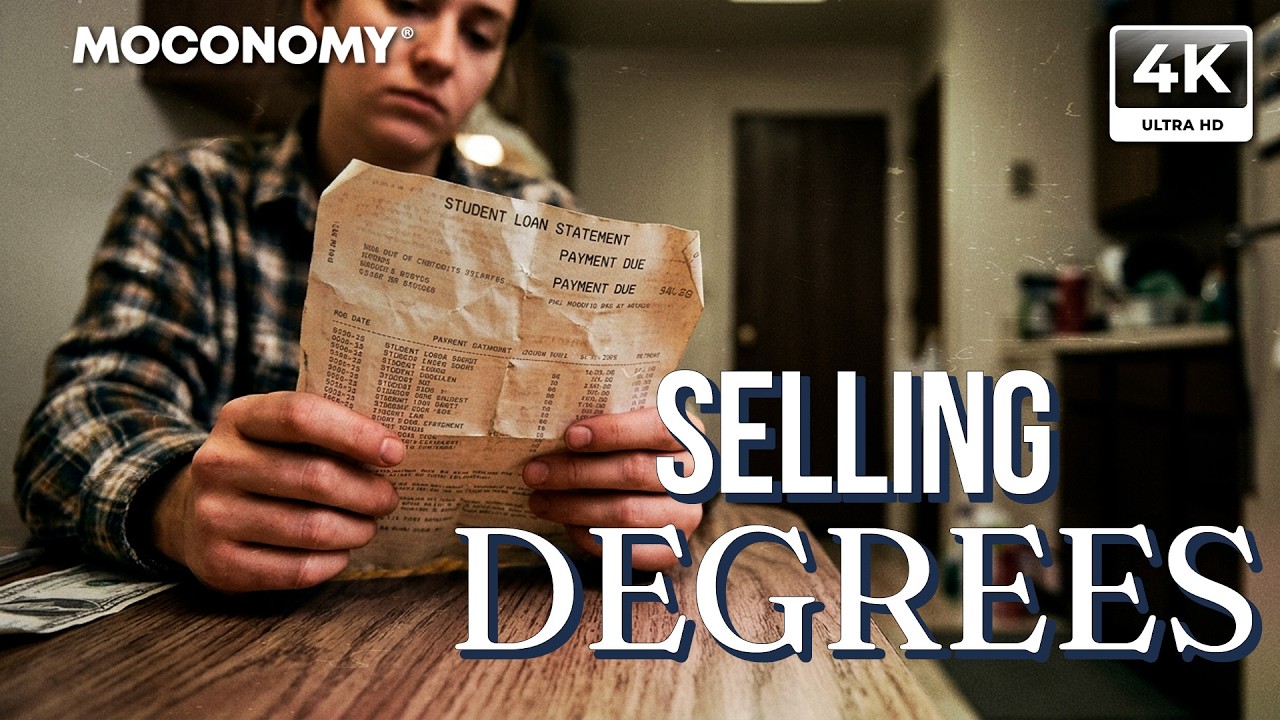
Higher Education: The New Global Economic War | From public good to private debt | 4K
Keywords
Summary
288 words
Critical Evaluation
Value of the Information & Strength of the Argument
The informational yield is high for a fifty-minute format. The film supplies a usable chronology of British fee policy with precise dates and figures, a clear explanation of the mechanics of loan-book securitisation (the sale of tranches on terms that are crystallised at purchase and cannot later be altered), and a genuinely comparative frame that sets England against Sweden’s free tuition plus universal grant, Germany’s reversal, France’s quiet introduction of selective fees and China’s mass expansion. The testimony is well chosen: a student who explains that debt is precisely what keeps her enrolled rather than what drives her out, a marketing director who states without embarrassment that universities are businesses, and Andrew Ross, who supplies the sharpest formulation in the film — that the right to education has been replaced by the right to access education loans. The figures, where checkable, are in the right order of magnitude.
The argumentation, however, is thesis-driven rather than investigative. The causal chain is asserted smoothly — underfunding, the Dearing review, fees, marketisation, debt — with little attention to the trade-offs that made each step politically defensible. The film itself reports that English enrolment rose from 800,000 in 1998 to 2.3 million today, which is the strongest counter-argument to its own thesis, and then declines to weigh it. Germany’s reversal is noted but not explained, which removes the one natural experiment that could test the causal claim. The treatment of human capital theory and of the OECD and World Bank is delivered as doctrine handed down from above, with a single short quotation and no discussion of the empirical literature on returns to education that underpins it. The rhetorical apparatus — insistent music, montage of empty lecture halls and casino imagery, verbs like ‘inflicted’ — does argumentative work that the evidence is not asked to do. The result is persuasive on mechanisms and weak on counterfactuals: excellent at showing how a debt market is built, silent on whether the alternatives it prefers would have funded the same expansion.
Scientific Rigor, Source Quality, Title Accuracy
Rigour: the film’s sourcing is oral and archival rather than documentary. Named on-camera sources (Andrew Ross, UK higher-education researchers, a university communications director, a student) make most claims traceable to a speaker, and archive footage of the 2010 Commons debate, the parliamentary Public Accounts Commission hearing and Xi Jinping’s Manchester visit grounds the political narrative in verifiable events. Against that, nothing is footnoted. Statistics appear without cohort, institution or date — ‘45% of student loans remain unpaid’ is meaningless without specifying which entry cohort and which repayment model — and the £200 billion write-off projection is stated without the discount rate or horizon that produce it. One sequence misstates the value of international students’ contribution before correcting itself mid-sentence, which suggests figures were handled loosely in production. The human capital framing and the OECD/World Bank doctrine are attributed collectively to unnamed ’expert groups’, and the Shanghai ranking is described without noting that its own producers have publicly qualified its methodological scope. The film is also visibly dated: it reports Chinese enrolment at 35 million and US student debt at $1.3 trillion, figures from the mid-2010s that have since moved substantially, yet it is published as a current 4K release with no dating of the underlying reporting.
Title and content: the match is good. The subtitle ‘from public good to private debt’ is an exact summary of the documentary’s arc, and the promised journey from London to New York to Shanghai is delivered. Only the phrase ’economic war’ overstates a phenomenon the film actually describes in terms of competition and marketisation.
609 words
Title / Content Match
The title is an accurate description of the content: the film does argue that higher education has become a global economic contest and does trace the shift from public provision to privately held student debt. The wording 'economic war' and the '4K' tag are packaging flourishes rather than claims about the material.
Quality & Reliability
7/10
A well-researched television-style documentary that leans on named interviewees (Andrew Ross of NYU, UK academics, a university marketing director), archive parliamentary footage and identifiable policy landmarks (the 1997 Dearing Report, the 1998, 2003 and 2010 fee reforms, the 2003 Shanghai ranking). Its figures are broadly consistent with the published literature, but they are almost never dated, attributed or given as ranges, and no bibliography or on-screen sourcing backs them. A few numbers are garbled in delivery (international students' contribution stated as '14 billion 10 billion'), and the data are clearly drawn from the mid-to-late 2010s while the upload is presented as current. The result is a reliable orientation piece rather than a citable reference.
Key Moments
Markers derived by PSI from the transcript: the creator did not define chapters.
- Opening framing: enrolment rising from 13 million students in the mid-1960s to 200 million in 2015, with 400 million projected within fifteen years.
- Britain as first mover: post-war grants, the sector's funding crisis, and the 1997 Dearing Report whose recommendations opened the door to tuition fees.
- Human capital theory introduced as the intellectual engine of the reform, promoted by the World Bank and the OECD.
- Manchester: universities as brands, marketing moving from a support function to a leadership role, and the pay divergence between vice-chancellors (+26%) and lecturers (−12% in real terms).
- China's expansion from 7 to 35 million students in thirteen years, and Furong, a bioengineering graduate living on odd jobs.
- The 2003 Shanghai ranking and its effects: mergers, publication drives and the French cluster built to climb the table.
- The Public Accounts Commission hearing on unpaid loans and the Treasury plan to sell tranches of the student loan book to private investors.
- The American case: $1.3 trillion of student debt, 40 million debtors, 8 million in default, as recounted by Andrew Ross and Occupy Wall Street activists.
- For-profit colleges targeting working-class and poor families, illustrated through two students from the Detroit area.
- Closing portrait: a debtor carrying roughly $104,000 in student loans.
Cited Sources
- Dearing Report — National Committee of Inquiry into Higher Education (1997) — Presented in the film as the origin of British tuition fees; its roughly one hundred recommendations, about half addressed to government, included the contested introduction of fees.
- Academic Ranking of World Universities (Shanghai ranking), Shanghai Jiao Tong University, 2003 — Described as the most mediatised and most contested global ranking, built on Nobel prizes, Fields medals and scientific publications.
- World Bank and OECD — human capital doctrine — Cited collectively as the international bodies whose theories underpinned the marketisation of higher education across Europe.
- Moconomy — World Economy playlist — Publisher's thematic playlist in which this documentary sits; not a source cited on screen.
- Moconomy — related documentary (F5TNiggsH1A) — Companion documentary listed in the description by the same distributor; contextual only.
- Moconomy — related documentary (yLZUVsmUwZY) — Companion documentary listed in the description by the same distributor; contextual only.
Concurring Sources
- Institute for Fiscal Studies — analyses of English student loan repayment and the RAB charge — Successive IFS assessments have found a large share of loan value never repaid for post-2012 cohorts, in the same range as the 45% figure reported in the film.
- OECD — Education at a Glance — Annual comparative statistics on tuition fees, enrolment and graduate outcomes that broadly support the film's account of diverging national models.
- Andrew Ross — Creditocracy and the Case for Debt Refusal — The NYU professor interviewed in the film develops at book length the argument that debt obligations have displaced social rights, including in education.
- Universities UK / parliamentary accounts on vice-chancellors' remuneration — Published remuneration reviews corroborate the direction and rough magnitude of the divergence between senior salaries and academic pay described in the Manchester sequence.
Dissenting Sources
- Critiques of the for-profit college narrative as monocausal — The film presents for-profit institutions as the engine of American student debt, whereas sector-level data attribute the bulk of outstanding debt to public and non-profit institutions and to graduate study; for-profit enrolments are a minority, albeit with disproportionate default rates.
- Analyses finding that English fee reform did not deter participation — The documentary itself reports enrolment rising from 800,000 to 2.3 million after fees were introduced, which contradicts a straightforward causal story from price to exclusion; the access debate turns on composition and graduate repayments rather than on aggregate numbers.
- Defences of human capital theory as empirically grounded — The film treats human capital as an ideology imposed by international bodies, whereas a large econometric literature on private and social returns to education treats it as a testable framework, with contested but substantial supporting evidence.
- German states' reversal of tuition fees — Germany's abandonment of fees is reported as an oddity without explanation; it was driven by constitutional challenges, regional politics and low revenue yield, which weakens its use as a simple counter-example.
External References
Contribution & Novelties
The film’s distinctive contribution is to treat the marketisation of higher education as a single connected system rather than as a set of national stories. By following the money across four countries it makes visible a mechanism that is usually discussed in fragments: a funding crisis produces a review, the review produces a fee, the fee produces a loan book, and the loan book becomes an asset that can be sold to investors on terms the borrower cannot renegotiate. The parliamentary sequence on the sale of loan tranches is the clearest illustration, and it anticipates, years before it became a general debate, the analogy with subprime securitisation. A second contribution is the pairing of the student experience with the institutional one: the same £9,000 that keeps Aneta enrolled is the revenue line that funds a marketing division and a vice-chancellor’s salary. The weakest link is conceptual: the film borrows the vocabulary of human capital and of rankings without examining how those instruments actually function, so the critique lands on their effects rather than on their logic.
Pour aller plus loin :
- Human capital — the economic framework the film names as the intellectual engine of the reforms, but never sets out.
- Academic Ranking of World Universities — the Shanghai ranking whose criteria (Nobel prizes, Fields medals, publications) drive the competition described in the film.
- Occupy Wall Street — the movement through which the American debt section is framed, and the origin of the Debt Resistors’ Operations Manual discussed on screen.
- Andrew Ross, ‘Creditocracy and the Case for Debt Refusal’ — the book-length argument of the NYU professor interviewed, on debt as a substitute for social provision; cited by name, no stable URL given here.
- OECD, ‘Education at a Glance’ — the comparative annual statistics on fees, enrolment and graduate outcomes that underlie any cross-country claim of this kind.
- The Dearing Report (1997), National Committee of Inquiry into Higher Education — the review identified in the film as the point of origin of British tuition fees.
335 words
Radar Profile
The profile is that of a dense, well-narrated documentary: information quantity and overall reliability are strong, carried by first-hand testimony and a clear policy chronology, while technical depth stays moderate because the economic arguments are sketched rather than modelled. Quality sits just below quantity, reflecting unattributed statistics and an unexamined counterfactual. The shape is a broad, flat plateau rather than a spike, typical of serious broadcast journalism rather than of research synthesis.