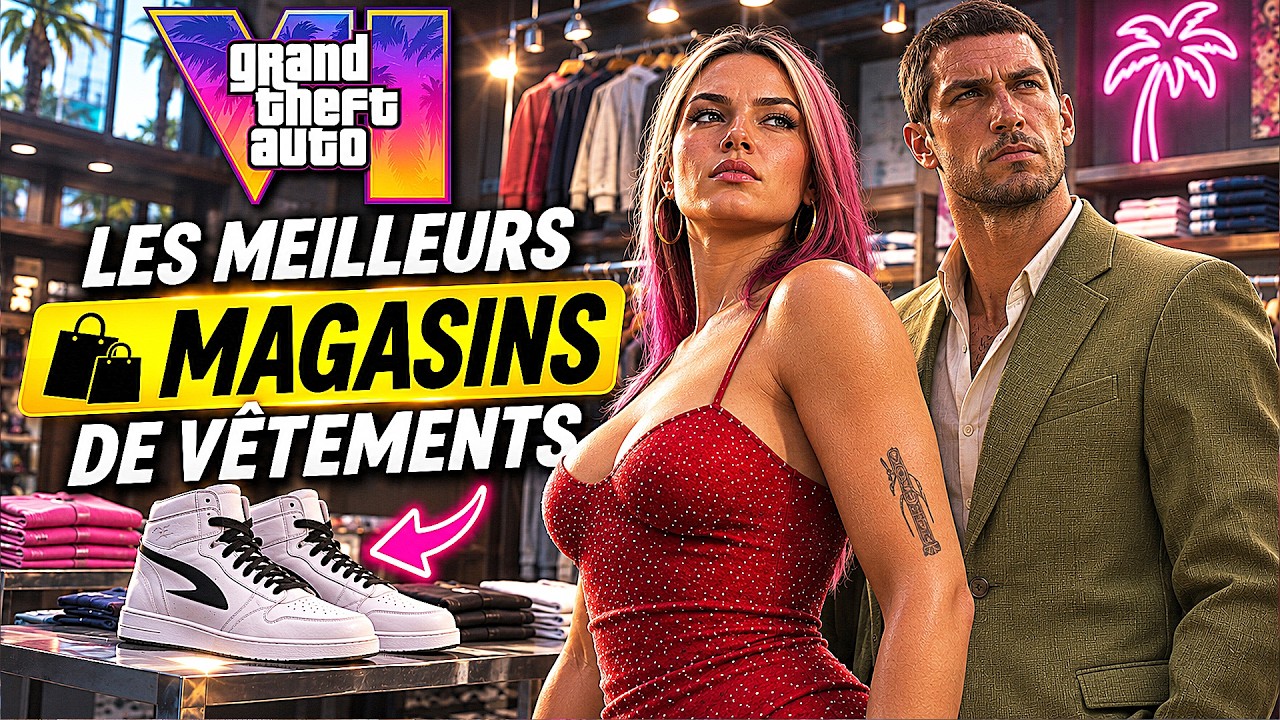
GTA 6 : 11 Magasins de Vêtements à Visiter ABSOLUMENT (Nike, Bikini, Coiffeurs…)
GTA 6: 11 Clothing Stores You ABSOLUTELY MUST Visit (Nike, Bikini, Hair Salons…)
Keywords
Summary
223 words
Critical Evaluation
Value of the Information & Strength of the Argument
The informational value lies in the granularity of the inventory: rather than a vague overview, the video enumerates concrete garment categories per store, specifies which protagonist they suit, mentions colour ranges (fluorescent pink, electric blue, grey, salmon, green, burgundy) and indicates relative price levels (‘a few hundred dollars’ for a vintage pair, an explicitly expensive luxury store, expensive jewellery in Miami Beach). It also communicates structural information about the game’s economy of appearance: the existence of ‘signature’ outfits unique to each shop, an Ultimate Edition-exclusive concept store, customisable sneaker variants, masks and balaclavas sold alongside clothing, and barbershops with distinct hairstyle pools. That makes the video genuinely usable as a shopping map for a player who already owns the game. The argumentation, however, is weak in the strict sense: there is no thesis to defend, no comparison protocol, no measurement, and no attempt to separate observation from preference. Judgements such as ’this is one of the prettiest stores’, ’the signature outfit is not the most impressive’, ’the python-skin loafers are perhaps not in the best taste’, or ‘we can do much better ourselves’ are laid out as self-evident, without criteria. Claims about location are asserted from memory of play rather than demonstrated on screen with a map overlay described verbally. The reasoning is also circular on value: items are recommended because they look good, and they look good because they are recommended. Repetition is significant, with the same formula (’the signature outfit’, ‘you will find several colours’) recycled across nine shops, and the closing barbershop section trails off mid-sentence, suggesting the list was longer than what was actually covered. The video’s real added value is therefore curatorial rather than analytical: it is a stylist’s shortlist, not an evidence-based review.
Scientific Rigor, Source Quality, Title Accuracy
On scientific rigour, the video makes no claim to it and provides none of its markers: no reference to official Rockstar communication, no patch notes, no build number, no date of capture, no distinction between what is confirmed and what is inferred. Statements about availability (’this store is exclusive to the Ultimate Edition’) and about prices are presented flatly, without hedge, even though pre-release and early-access game content is notoriously subject to change. The only links offered are self-referential, pointing to the creator’s own playlist and to another of his videos, plus a commercial affiliate link; none of them constitutes a documentary source for the claims made on screen. There is consequently no traceability: a viewer cannot verify a single assertion about a store’s location or stock without launching the game. On source quality, the material is therefore autoproduced testimony, homogeneous in nature, with no corroboration and no counter-check. On title/content adequacy, the announced ‘11 clothing stores’ is not what the viewer counts: the description claims 16, the chapter list contains 9 locations including barbershops, and the Nike, bikini and barber hooks of the title are indeed all addressed, so the subject is faithful even though the number is not.
504 words
Title / Content Match
The title announces '11 clothing stores' and the content delivers a store-by-store tour that includes Nike-like footwear, swimwear and barbers, so the theme matches; however the count is inconsistent (11 in the title, 16 in the description, 9 chaptered locations) and several promised items are only briefly touched.
Quality & Reliability
3/10
Content is a purely descriptive walkthrough of in-game shops in Grand Theft Auto VI, presented without any cited reference, official document or verifiable data point. Store names, stock lists and rough prices are asserted as fact but cannot be checked from the video itself, and the creator openly mixes observation with personal aesthetic judgement ('I would have preferred', 'this one works really well'). No methodology, no source, no date of capture, and internal inconsistencies (11 stores in the title, 16 in the description, 9 chapters) further weaken documentary reliability. The material is nonetheless coherent and specific enough to be informative about the game's customization system, hence a mid-low score rather than the lowest.
Chapters
Cited Sources
- SNIR — GTA 6 playlist (all of the channel's GTA 6 videos) — Self-referential link promoted twice in the video as the place to find the channel's other GTA 6 content; not a documentary source for any claim made on screen.
- SNIR — related video ('the Bugatti video') — Cross-promotion link at the top of the description to another of the creator's own videos; no external documentation.
Concurring Sources
- Grand Theft Auto VI — Wikipedia — General reference confirming the game's existence, its Vice City/Leonida setting and its dual-protagonist structure, which underpins the video's framing.
External References
Contribution & Novelties
The video’s originality is narrow but real: instead of a general overview of GTA 6, it isolates one subsystem — appearance and clothing — and organises it geographically, effectively building a shopping itinerary across Vice City, Miami Beach and the outlying areas. It also documents the way the game transposes real brands into fictional ones (Eris/Nike, Brightness/Adidas, Nagasaki/Kawasaki, a Versace-flavoured luxury tailor), which is a useful observation for anyone interested in how open-world games handle brand parody and product placement. Finally, it distinguishes between shop-exclusive ‘signature’ outfits, edition-locked content and ordinary stock, which is the most structurally interesting point raised and the one a viewer could actually reuse.
Pour aller plus loin :
- Grand Theft Auto VI — Wikipedia — Reference entry for release information, platforms and setting; useful to confront the video’s unverified assertions with documented facts.
- Grand Theft Auto — Wikipedia — Series overview situating the fictional state of Leonida and the franchise’s tradition of satirical brand parodies.
- Parody — Wikipedia — Conceptual frame for understanding fictional stand-ins such as Eris/Nike or Nagasaki/Kawasaki in games.
- Concept of in-game product placement and virtual brand licensing — relevant to interpreting why GTA uses near-copies of real sportswear brands; cited by name only, as no single canonical reference is certain.
- Concept of cosmetic customization economy in open-world games (unlockable outfits, edition-exclusive cosmetics) — directly connected to the video’s discussion of ‘signature’ outfits and Ultimate Edition content.
235 words
Radar Profile
The profile is flat and low: modest information density paired with low technical depth and low reliability, with quality slightly above reliability because the descriptions are concrete even when unverifiable. This is the signature of descriptive, experience-based content rather than analytical content — rich in catalogue detail, poor in method.