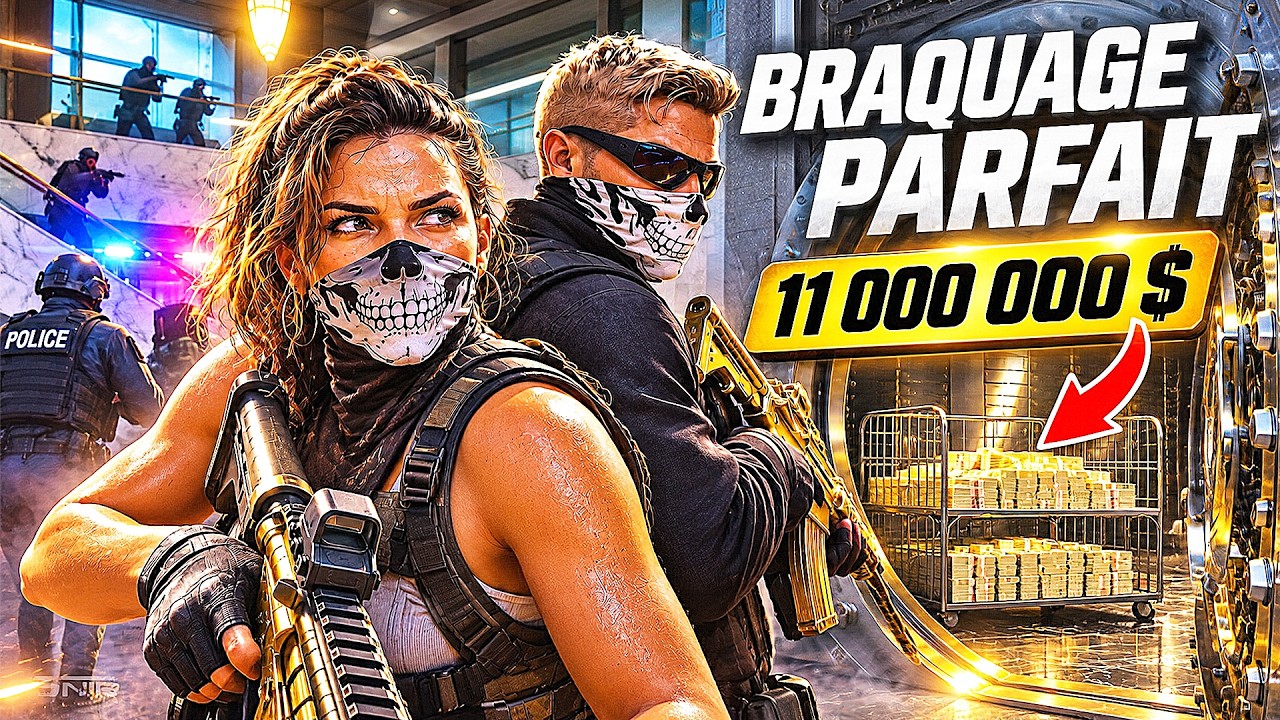
GTA 6: Comment Réussir le Braquage du Chapitre 3 (11 Millions, Meilleur Choix, Sauver Tout le Monde)
GTA 6: How to Ace the Chapter 3 Heist ($11 Million, Best Choices, Save Everyone)
Keywords
Summary
The video is a full walkthrough of what the creator presents as the final and largest heist of GTA 6’s third chapter, the ‘cartel job’ at the Sinfrontera National Bank. The creator’s framing is that the outcome of the heist is decided long before the heist itself, during a chain of preparation missions, and that each mistake made in preparation degrades the final result.
The guide walks through scouting the bank, retrieving four weapon crates from an airstrip (insisting the mission be played with both protagonists so all four can be loaded before the IAA attack), and protecting the pickup during the escape, where a single crate lost costs resources later. It then covers stealing and repeatedly practising on a training vault, recommending the simplified mini-game setting as a safety net, and warns that the drill mini-game inside the real heist is identical.
A unique golden pistol held by the character Monty is flagged as missable during the infiltration mission. The interrogation of Monty is treated as a hard gate: the player must extract three pieces of bank information by repeatedly raising and lowering him, and must not kill him early or hand him to the crocodile.
Sabotaging three relay antennas is presented as the single most consequential preparation: done fully, it lets the crew leave without police response; missed, it triggers a police alert. The creator details the route to each antenna for both protagonists, including the optional benefit of doing the mission at night.
The heist itself runs on an 11-minute timer started by the explosives. The creator gives concrete time budgets: roughly 50 to 60 seconds left on the clock when the vault opens is workable, under 50 seconds is not enough to collect everything, and over 60 seconds is comfortable. Time is gained by threatening hostages quickly, not waiting for prompts, fighting close to the elevators, and using an adrenaline syringe on the roof.
Loot is concentrated in the centre of the vault at roughly one million per bundle, with marginal extra cash on the sides. The creator closes by contrasting this clean run with a careless one that brings a six-star wanted level and can cost a crew member’s life.
365 words
Critical Evaluation
Value of the Information & Strength of the Argument
The informational value is high for anyone executing this specific sequence: the guide is dense, ordered, and almost entirely composed of actionable constraints rather than commentary. It names the failure points that matter (losing a crate, skipping the antenna, killing the interrogation target too early, missing the missable weapon, waiting for in-game prompts instead of acting), and it quantifies the one variable that governs the payout, the residual vault timer, with explicit thresholds. The recommendation to keep a manual save before launching the heist and to reload checkpoints on preparation errors is a genuinely useful risk-management instruction.
The argumentation, however, is entirely assertive rather than demonstrated. Every causal claim takes the form ‘do this or you lose money / a character dies’, but the video never shows the failure state it is warning about: no footage of the six-star escape, no comparison run with an incomplete prep, no payout screen contrasting a bad run with the good one. The thresholds are given as if measured (‘under 50 seconds you will never have time’), yet nothing indicates whether they come from repeated testing or from a single playthrough impression. The claim that the mission ‘must’ be played with both characters is stated twice with emphasis but supported only by an assertion about timing, not by a shown solo attempt.
There is also a factual slip that weakens confidence in the numbers: the payout is described as 11 million, then as 10.5 million when most of the loot is collected, and once as ‘over 100 million’. Those cannot all be right, and in a guide whose entire selling point is maximising a precise sum, this is a meaningful defect. The practice recommendation, by contrast, is well argued: the creator explains that the training vault uses the identical mini-game as the heist, so rehearsal transfers directly, and reports replaying it three times before getting the ‘perfect run’ confirmation, which is a concrete, checkable criterion rather than a vague exhortation.
Overall the reasoning is coherent and practically oriented, but it is a single practitioner’s testimony dressed as a protocol. It tells you what worked once, with confidence calibrated to a much stronger evidentiary base than is actually shown.
Scientific Rigor, Source Quality, Title Accuracy
No source of any kind is cited in the spoken content or in the usable description links: no reference to official patch notes, developer communication, guide documentation, community testing or another creator’s run. The only links provided are the creator’s own playlist and a commercial partner link. A sponsor presence is signalled only by that description link, with no advertising segment audible in the spoken transcript, so it has no bearing on the assessment.
The guide’s authority is therefore purely experiential: it is the record of one player’s successful run, presented as a normative method. Nothing distinguishes, within the video, what was verified by deliberate testing from what is inference about how the systems behave. Claims about consequences the creator did not experience, such as the six-star wanted level and the possible death of a crew member, appear to be extrapolations from the game’s stated rules rather than observed outcomes.
The named entities used throughout (the bank, the city of Peacock Bay, the characters Monty, Raul, Bryan, Andrea, Nicole and Felipe) could not be corroborated by any element furnished in the video or its description, and no frame of reference is offered that would let a viewer check them independently. That does not make them false, but it means the guide’s factual base is unverifiable from within the material itself and would require outside confirmation.
On title versus content, the fit is good: the video announces the Chapter 3 heist, the 11 million target, the best choices and the goal of losing nobody, and it addresses each of those points in order, with the payout and the survival of the crew explicitly revisited in the conclusion. The only gap is rhetorical rather than substantive, in that the ‘perfect heist’ is asserted as achieved without displaying the final payout screen.
678 words
Title / Content Match
The title announces a Chapter 3 heist guide with 11 million payout, best choices and saving everyone; the content delivers exactly that, chapter by chapter, including prep missions, interrogation, antenna sabotage and the vault timer. Match is strong, with only minor overselling of the 'perfect run' framing.
Quality & Reliability
4/10
Step-by-step walkthrough of a game mission, internally coherent and detailed, but entirely self-referential: no external source, no official material cited, no demonstration of the alternative outcomes it claims (six-star wanted level, character death, reduced payout), and at least one internal numeric inconsistency in the payout figures (11 million, 10.5 million, and a slip to 'over 100 million'). The named locations and supporting characters (Sinfrontera National Bank, Monty, Raul, Bryan, Andrea, Nicole, Peacock Bay, Hamelette) could not be cross-checked against any reference provided in the video or description. Reliability therefore rests solely on the creator's own playthrough.
Chapters
- Repairage de la Banque (Sinfrontera)
- Sauver les 4 caisses (En bonne compagnie)
- S'entrainer au Coffre (Un plan bien monté)
- Armure Unique de Monty (Le chaînon manquant)
- Interrogatoire de Monty
- Détruire les 3 antennes (Charges subtiles)
- Braquage & Prise d'otages (Le coup du cartel)
- Affrontement (attention au TEMPS !)
- Ouverture du Coffre et Argent (11 millions)
Cited Sources
- Creator's GTA 6 playlist — Link from the description pointing to the creator's own ordered series of GTA 6 videos; self-referential, not an external reference for any claim made in the video.
External References
Contribution & Novelties
The video’s contribution is consolidating an entire multi-mission preparation chain into a single causal narrative, rather than treating the heist as an isolated mission. Its main original framing is that the payout is decided upstream: the four crates, the interrogation, the three antennas and the vault rehearsal are presented as levers that set the ceiling on the final result, well before the timer starts. The explicit time budget for the vault (what 50, 60 or more residual seconds buys you in collectable bundles) is the most concrete and reusable element, and the observation that the drill, hook and pressure mini-games inside the heist are identical to the training versions is a genuinely useful transfer insight. The recommendation to keep a manual save outside the checkpoint system, and to exploit the fact that enemies dropped behind you despawn, are practical details rarely stated so plainly. The guide does not, however, introduce any independently verifiable data, and its central numbers are not internally consistent.
Pour aller plus loin :
- Grand Theft Auto VI — Reference entry for the game itself, useful to situate the video’s claims about setting, characters and release context.
- Grand Theft Auto V — The predecessor whose heist structure (preparation, crew choice, approach) the video explicitly compares itself to.
- Speedrun — Conceptual frame for the timer-driven, route-optimisation logic that underpins the guide’s advice on saving seconds.
- Rockstar Games — Studio context for the mission design conventions being described.
- Level design and mission-gating in open-world games (“game design” / “quest” literature) — relevant to the video’s core idea that missable choices made in preparation missions permanently cap later rewards.
269 words
Radar Profile
The profile is dominated by information quantity and practical density, with technical depth and reliability sitting low: the guide is rich in procedural detail but shallow in underlying systems analysis and unsupported by any external verification. The spread reflects a single-source, experience-based tutorial rather than a documented investigation.