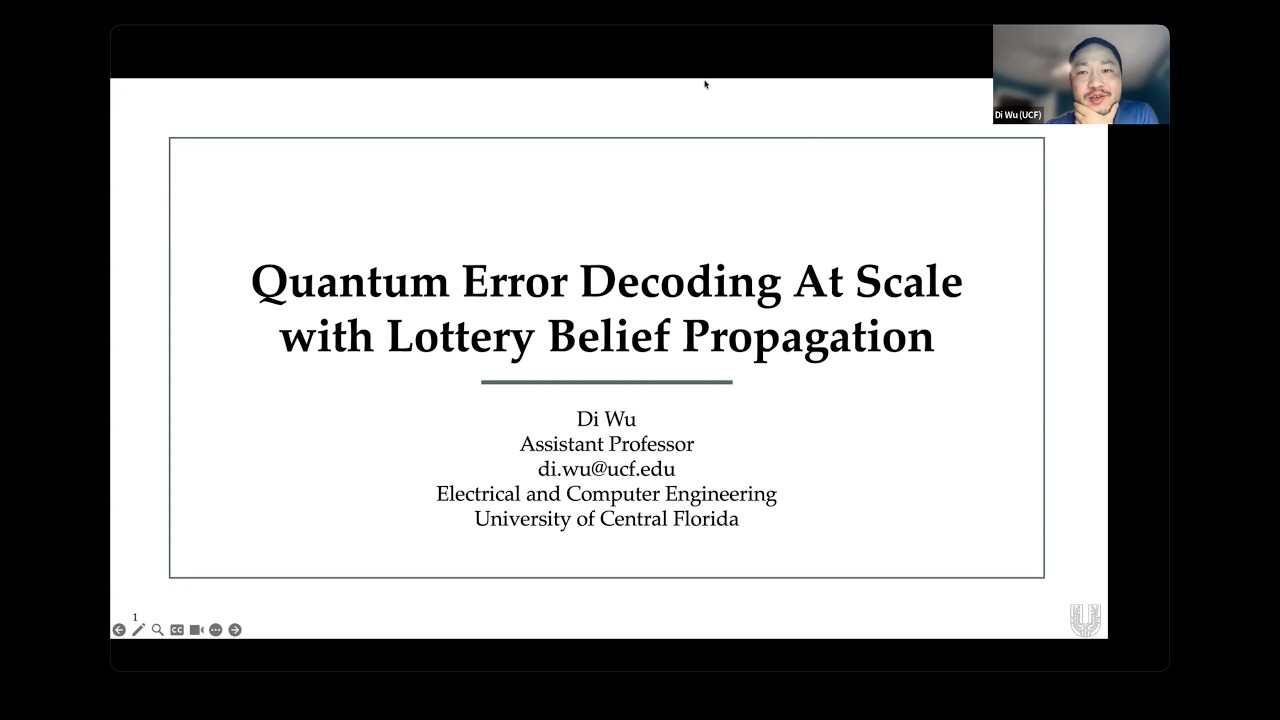
QuCS Lecture 86: Prof. Di Wu(UCF) | Quantum Error Decoding At Scale with Lottery Belief Propagation
Keywords
Summary
192 words
Critical Evaluation
Value of the Information & Strength of the Argument
The lecture offers significant value by addressing a critical bottleneck in quantum computing: the scalability of error decoding. The argumentation is logical and well-structured: it starts with the necessity of efficient decoding, explains the limitations of existing methods, and presents a plausible mechanism (random perturbation) to overcome quantum degeneracy. The speaker uses concrete examples to illustrate the degeneracy problem and how randomness might resolve it. However, the presentation is primarily conceptual; details of the simulation results and quantitative improvements are not deeply explored in this talk, which limits the strength of the empirical argument. The proposed Lottery BP is positioned as a promising approach, but its validation relies on future publications. Overall, the reasoning is sound, but the lack of experimental data in this lecture tempers its immediate persuasiveness.
Scientific Rigor, Source Quality, Title Accuracy
The lecture demonstrates scientific rigor by grounding the discussion in prior work on quantum error correction, reference decoding algorithms (BPSF, relay BP, etc.), and industry roadmaps. The speaker correctly identifies the trade-offs and limitations of BP for surface codes. The title faithfully reflects the content: it focuses on error decoding at scale and introduces Lottery BP as the central innovation. No comments were provided, so no public reception analysis is possible. The reliance on unpublished work (the lottery BP paper is under submission) is transparently stated, and other citations are to published literature. The absence of URLs in the talk itself is compensated by the lecture description links, which are included in the sources.
258 words
Title / Content Match
The title accurately describes the lecture content: quantum error decoding at scale using lottery belief propagation. The lecture covers the concept, motivation, and scalability aspects.
Quality & Reliability
8/10
The lecture presents original research (lottery BP) that is under submission, but the speaker provides thorough context and references to published work. The technical content appears sound, though not peer-reviewed at this stage.
Key Moments
Markers derived by PSI from the transcript: the creator did not define chapters.
Cited Sources
- QuCS Lecture Series Signup — Signup for future weekly Zoom lectures
- QuCS Lecture Website — Lecture website with details and slides
Concurring Sources
- Belief propagation — Provides theoretical framework for BP, corroborating the lecture's description of message passing and iteration
- Surface code — Supports the lecture's claim that surface codes are the dominant QEC code and that BP underperforms on them
Contribution & Novelties
The lecture’s original contribution is the introduction of Lottery Belief Propagation, a method to introduce randomness into the BP decoding process to break quantum degeneracy and improve convergence without sacrificing accuracy significantly. This addresses a known limitation of BP on surface codes and offers a path to more scalable decoding by enabling hierarchical decoder architectures. The lecture effectively synthesizes existing ideas and proposes a novel twist.
Pour aller plus loin :
- Quantum error correction — Foundational overview of QEC and its challenges.
- Belief propagation — The base algorithm, its applications, and limitations.
- Surface code — The specific quantum code where BP degeneracy is problematic, and the context for the proposed method.
111 words
Radar Profile
The radar profile shows a lecture with high technical level (9) and moderate overall reliability (7), reflecting the balance between a sophisticated algorithm presentation and its unpublished status. The information quantity and quality are both rated 8, indicating a dense and generally accurate talk, while the global note of 4/5 suggests strong content with some reservations about validation.