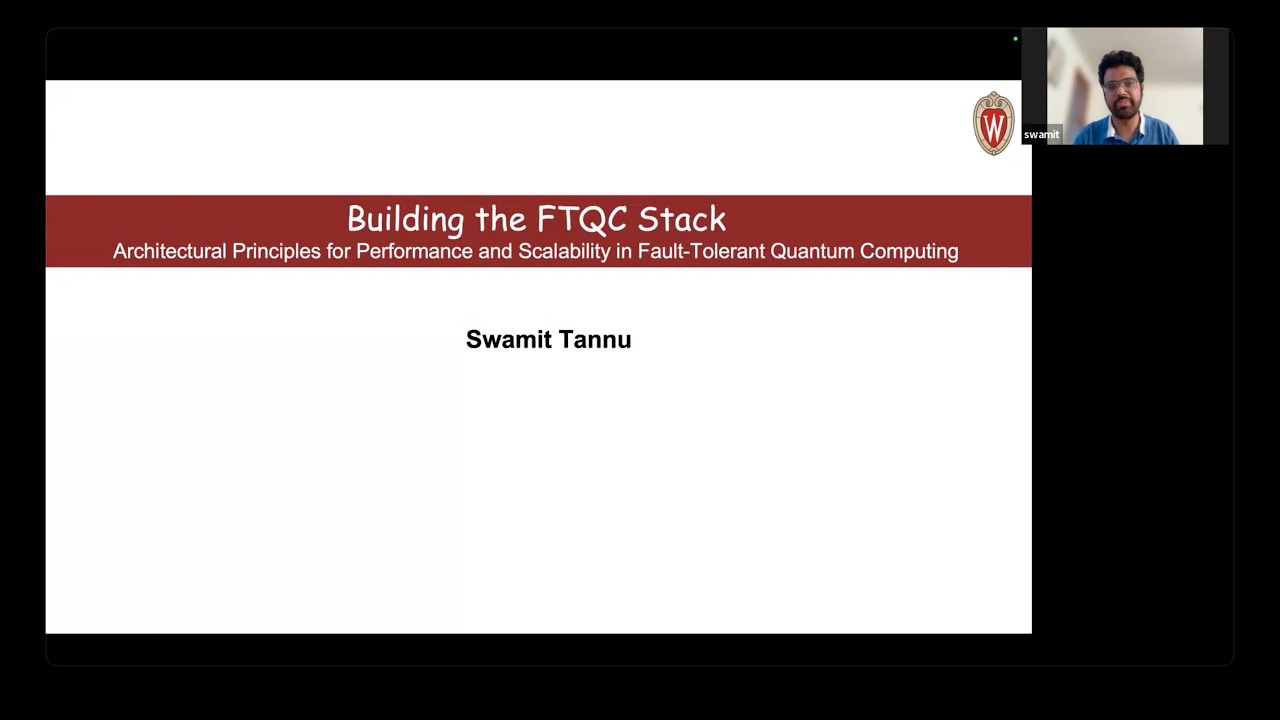
QuCS Lecture 83: Prof. Swamit Tannu (UW-Madison) | FTQC Architecture: Performance & Scalability
Keywords
Summary
185 words
Critical Evaluation
Value of the Information & Strength of the Argument
The lecture provides a high-value overview of the current state and challenges in fault-tolerant quantum computing architectures, grounded in recent research from the speaker’s group and collaborators. The argumentation is well-structured, logically progressing from the need for error correction to the identification of readout as a bottleneck, and then presenting concrete solutions with experimental validation. Tannu supports his claims with performance data from specific systems (IBM, Google, and academic labs) and compares his approaches against baselines such as neural networks and traditional classifiers. The argument that readout is a critical bottleneck is persuasive, and the proposed methods (matched filters, denoising GANs, pipelining) are presented with clear reasoning about their trade-offs in accuracy, latency, and resource cost.
Scientific Rigor, Source Quality, Title Accuracy
The speaker is a well-established researcher with a PhD in ECE and has published in top venues (e.g., MICRO, ISCA). He references his own peer-reviewed papers (e.g., the Hercules and Falcon designs) and also cites other groups’ work (Will Oliver’s group at MIT, Mark Saffman’s group at UW-Madison/Ohio State). The presentation is rigorous, with quantitative results and clear methodology. The title accurately reflects the content, which is specifically about architectural performance and scalability in FTQC. The link between the title and content is direct, and the talk covers both superconducting and neutral atom platforms, making it comprehensive.
228 words
Title / Content Match
The title accurately describes the content, which focuses on architectural principles for performance and scalability in fault-tolerant quantum computing.
Quality & Reliability
8/10
The speaker is a recognized researcher with peer-reviewed publications; the lecture presents established findings and references external works, providing a reliable overview of current research.
Key Moments
Markers derived by PSI from the transcript: the creator did not define chapters.
- Introduction by moderator and speaker's background.
- The need for quantum error correction and its overhead.
- Discussion of the three factors affecting execution time.
- Explanation of the quantum error correction cycle and readout as the slowest step.
- Hercules: hardware-efficient readout using matched filters for superconducting qubits.
- Introduction to neutral atom architectures and their specific readout challenges.
- Falcon: denoiser for short-exposure images to enable fast readout.
- Pipelining and reduction of integration time, with results.
Cited Sources
- QuCS Lecture Series signup — Sign up for future weekly Zoom lectures.
- QuCS website — Lecture website for the Quantum Computer Systems series.
- Discord Channel — Community discussion channel.
Contribution & Novelties
This lecture contributes to the field by addressing the readout bottleneck in fault-tolerant quantum computing, proposing efficient classifiers and denoising techniques for both superconducting and neutral atom platforms. The work emphasizes the importance of architectural optimization to accelerate quantum computation, moving beyond simple qubit counts to consider clock speed and integration times.
Pour aller plus loin :
- Quantum error correction — Fundamental concept behind fault-tolerant quantum computation.
- Surface code — A leading error correction code used in many FTQC architectures.
- Neutral atom quantum computer — Overview of this platform and its challenges.
92 words
Radar Profile
The profile shows high scores across all dimensions, with fiabilité_globale being the highest, indicating a technically dense and reliable lecture. The balanced scores suggest a well-rounded presentation with substantial information, high technical depth, and solid factual grounding.