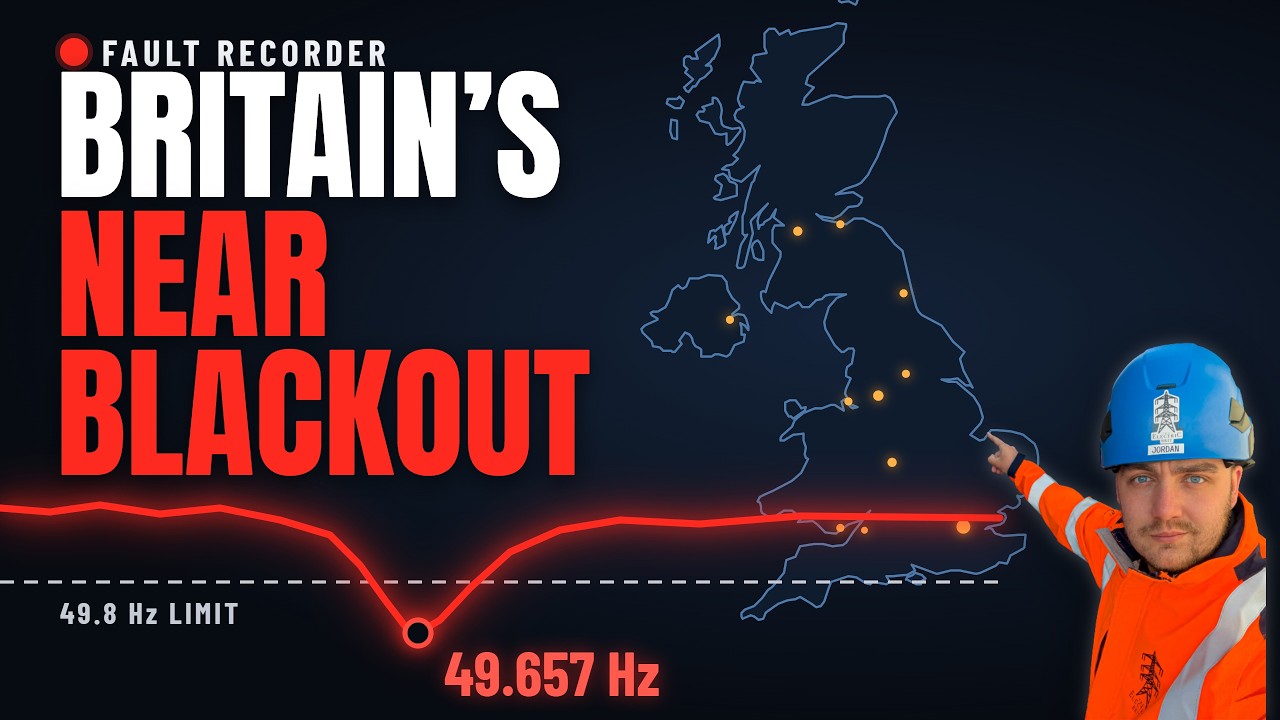
How France saved Britain from a Blackout
Title history
- How France saved Britain from a Blackout — observed on 20261028-1707 UTC (YouTube)
Keywords
Summary
178 words
Critical Evaluation
Value of the Information & Strength of the Argument
The video delivers substantial informational value by deconstructing a complex grid event with precise figures and clear explanations. It convincingly argues that the blackout was not imminent, using frequency data and statutory limits, while acknowledging the severity of margin depletion. The argumentation is methodical: it systematically addresses each factor—maintenance, heat, solar, storage, interconnectors, and network constraints—and supports claims with referenced data (e.g., 2.25 GW gas derating, 1.6 GW demand forecast error). It also challenges simplistic narratives, such as blaming renewables, by showing solar outperformed forecasts. The reasoning is coherent and well-structured, though some estimates (like the 8% dynamic line rating benefit) are presented as indicative rather than definitive. The reliance on one primary source (a Substack article) is acceptable given the depth of analysis, but a broader set of official data would strengthen the argument.
Scientific Rigor, Source Quality, Title Accuracy
The video demonstrates strong scientific rigor by grounding its analysis in technical engineering principles, quoting specific operational figures, and referencing a detailed external analysis (Ben Watts’ Substack). The use of frequency trajectories, power flow diagrams, and timeline reconstructions reflects careful research. The title is somewhat sensationalized—it implies a heroic French rescue—but the content explicitly clarifies that France helped but was not the sole preventer of a collapse. The title is therefore partially adequate; it attracts attention but the video corrects the oversimplification. The video also shows intellectual honesty by flagging uncertain reconstructions (e.g., phantom capacity) and noting that dynamic line rating is not a complete solution. Overall, the source quality is high, the methodology is transparent, and the title–content alignment is acceptable with minor caveats.
275 words
Title / Content Match
The title is attention-grabbing but the content convincingly argues that France's role was significant yet not a last-minute save from imminent collapse; it provides a nuanced view that mostly aligns with the title's implication.
Quality & Reliability
8/10
The video draws on a cited Substack analysis, provides quantitative data (e.g., 21.2 GW unavailable, 49.657 Hz minimum, 2 GW French swing), and explains engineering principles clearly. While some reconstructions (e.g., phantom capacity) are flagged as estimates, the overall reasoning is sound and grounded in publicly available grid data.
Key Moments
Markers derived by PSI from the transcript: the creator did not define chapters.
- Introduction: The 23 June 2026 event, frequency drop to 49.657 Hz, and the question of French assistance.
- Definition of blackout and explanation of grid frequency operation.
- Unavailable capacity details: 21.2 GW out, including maintenance and outages.
- Heat effects on gas and nuclear generation: derating and technical limits.
- Solar performance and visibility issues: actual output vs forecast, grid operator challenges.
- Interconnector flows and the export conundrum during the evening ramp.
- Transmission constraints: spare generation trapped in Scotland, dynamic line rating explanation.
- Detailed timeline of events: frequency excursions, emergency instruction to BritNed, and French assistance.
- Conclusions: lessons learned, future mitigations (HVDC, dynamic line rating), and the nature of near-miss.
Cited Sources
- A Midsummer Night's Near Miss — Primary source article by Ben Watts, referenced as the basis for the video's analysis.
Contribution & Novelties
The video contributes a rigorous, multi-factor reconstruction of a grid incident that was publicly reported with sensational headlines. It clarifies that renewable energy was not the culprit, quantifies the heat derating of conventional plants, and highlights the role of interconnector flows and transmission constraints. For a technically inclined audience, it offers a clear case study of grid balancing and the limitations of the current infrastructure.
Pour aller plus loin :
- Grid frequency — Fundamental concept explaining the importance of frequency stability in large power systems.
- High-voltage direct current — Technology used in interconnectors and new UK transmission links (e.g., Eastern Green Link).
- Dynamic line rating — Technique for real-time assessment of transmission conductor capacity, discussed as a mitigation.
- Pumped-storage hydroelectricity — Key flexibility resource; Dinorwig’s role is central to the event.
131 words
Radar Profile
The radar profile shows very high scores in 'quantity of information' (9) and 'technical level' (9), indicating a data-dense, engineering-focused production. The 'quality of information' (8) and 'overall reliability' (8) are slightly lower, reflecting reliance on a single primary source and some estimated figures, but the analysis remains well-founded. The overall balance suggests a highly informative but not universally verified account.