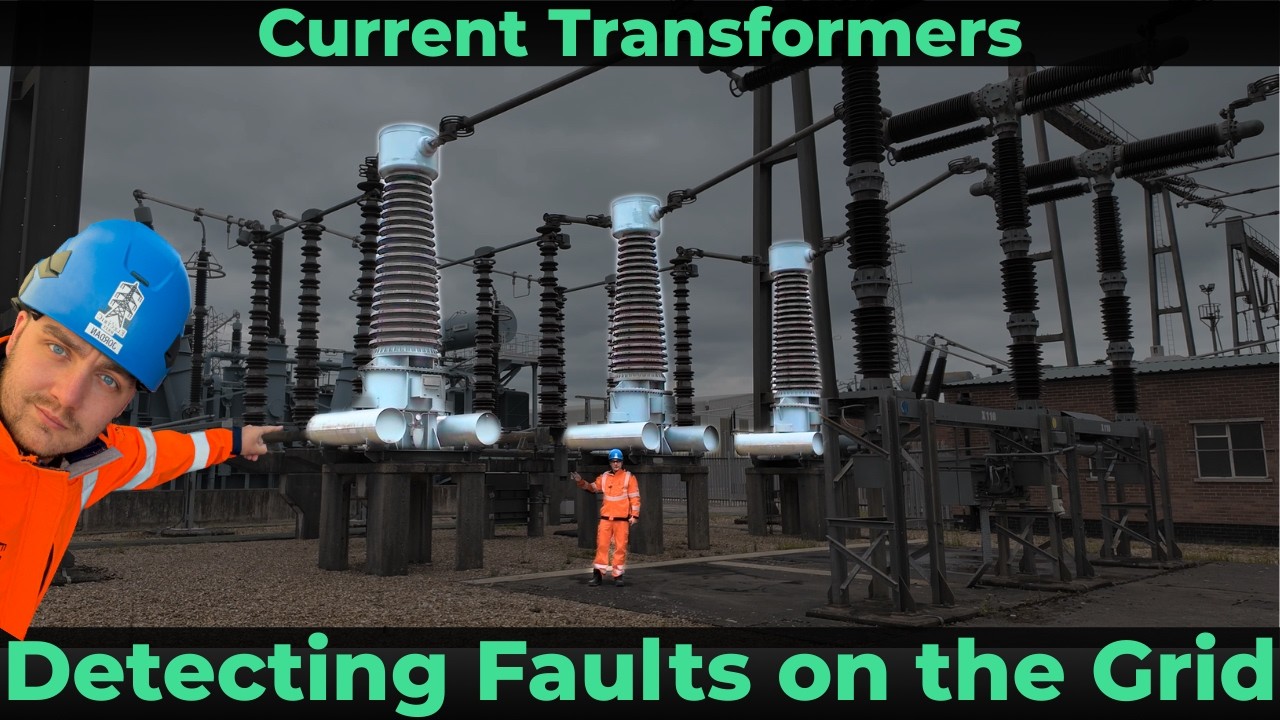
The Grid is BLIND without CTs
Keywords
Summary
265 words
Critical Evaluation
Value of the Information & Strength of the Argument
The video provides valuable, practical insights for protection engineers and electrical engineering students. Its main strength lies in combining theoretical concepts with field experience: the presenter shares anecdotes (mislabeled CTs, blast walls) that illustrate real-world challenges and reinforce the importance of proper testing. The argumentation is clear and logical, progressing from basic operation to advanced specifications and testing. The use of examples, such as the 5000 A primary and the 2500:1 ratio, helps ground the explanation. However, the content is mostly descriptive and does not delve into mathematical derivations or complex fault analysis, so it serves as an excellent introduction rather than a deep theoretical treatment. The presenter’s stance is that CTs are indispensable and that meticulous testing is non-negotiable, a point convincingly supported throughout.
Scientific Rigor, Source Quality, Title Accuracy
The video demonstrates solid technical rigor. The presenter references IEC standards (IEC 60044-1 for composite error, IEC 60044-6 for anti-remanence CTs) and mentions tools like Omicron CT analyzers and primary injection sets (Omicron CPC 100, Megger). He also notes the importance of verifying CT polarity through testing rather than trusting labels. The title ‘The Grid is BLIND without CTs’ is catchy and accurate, effectively summarizing the essential role of CTs in grid protection. While the content is not formally peer-reviewed, it is consistent with established electrical engineering principles. A minor commercial mention of Refoss energy monitoring equipment is made, with transparent disclosure that it is an affiliate link, but this does not affect the technical content. Overall, the title and content align well, and the technical information appears reliable.
269 words
Title / Content Match
The title accurately reflects the core message that CTs are essential for grid protection; without them the protection system is blind. It effectively captures the video's focus.
Quality & Reliability
8/10
The author is a UK transmission engineer with practical commissioning experience. The content aligns with IEC standards (IEC 60044-1, 60044-6) and covers both theory and real-world testing procedures. No obvious factual errors, though it is an informal educational video rather than a peer-reviewed source.
Key Moments
Markers derived by PSI from the transcript: the creator did not define chapters.
- Introduction to CTs and explanation of ratio calculation (2500:1 example).
- Metering vs protection CTs and accuracy classes (0.5, 5P, PX).
- Discussion of saturation, burden, and knee point.
- Construction types: toroidal, bar, bushing, split-core, core balance, summation, and special types.
- Testing methods: polarity test, CT analyzer, secondary and primary injection.
Cited Sources
- Refoss Smart Energy Monitor EM06P — Mentioned as an example of a split-core CT application for home energy monitoring; affiliate link disclosed.
Contribution & Novelties
The video’s novelty lies in its practical, field-oriented perspective on CT testing and commissioning, which is rarely covered in academic texts. It bridges the gap between theoretical standards and actual substation work, sharing experiences like factory polarity mislabels and the use of blast walls around failing CTs. This fills a niche for engineers seeking realistic insights. The presentation of various CT types—including less common ones like transactors and anti-remanence CTs—provides a broad survey that is both instructive and engaging.
Pour aller plus loin :
- Current transformer - Wikipedia — Overview of CT basics, types, and theory.
- Differential protection - Wikipedia — Explanation of the protection scheme that relies on accurate CT measurements.
- Power system protection - Wikipedia — Broader context of protection systems and CT’s role.
126 words
Radar Profile
The radar profile shows high scores across all dimensions, indicating a well-rounded educational resource. The strongest points are the quantity and quality of information, with slightly lower but still respectable scores for technical level and reliability, reflecting the informal yet expert nature of the content.