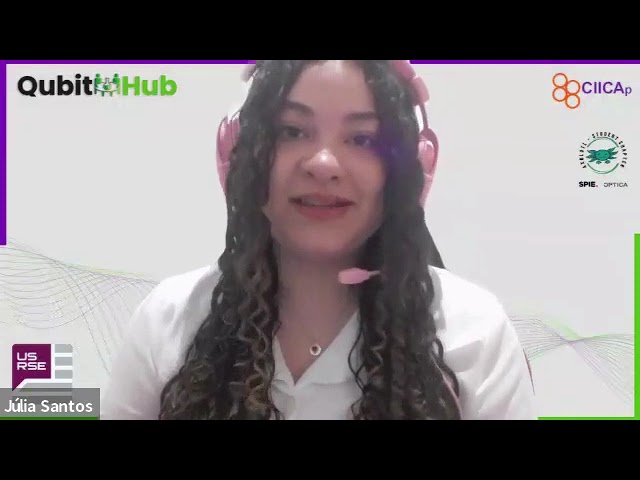
Women in Science & Quantum Technologies | Conversation with Júlia Santos
Keywords
Summary
182 words
Critical Evaluation
Value of the Information & Strength of the Argument
The value of the information lies in its practical perspective from a practitioner actively working in quantum computing software. Júlia provides concrete advice on software engineering practices (branching, testing, environment management) and explains why they matter for transitioning quantum computing from research to industry. Her argumentation is coherent, though largely based on personal experience and anecdotal reasoning rather than empirical evidence or detailed technical case studies. The discussion about reproducibility touches on common pain points but does not offer deep technical solutions. Overall, the interview offers useful high-level insights for students and developers, but it lacks depth and rigorous backing for more advanced audiences.
Scientific Rigor, Source Quality, Title Accuracy
The video is an informal conversation with no explicit citations or references to external sources. The description provides no links beyond a general overview. The title accurately matches the content, as it is an interview with Júlia Santos about quantum technologies and her role. The absence of sources limits the scientific rigor, but the guest’s credibility as a Qiskit Advocate lends some authority to the statements. The title does not overpromise, keeping expectations aligned with the conversational format. No community comments were provided for analysis.
204 words
Title / Content Match
The title accurately reflects the content: an interview with Júlia Santos about her work in quantum technologies and software engineering.
Quality & Reliability
6/10
The conversation offers insightful but general advice from a practitioner with no specific sources cited; reliability is moderate.
Key Moments
Markers derived by PSI from the transcript: the creator did not define chapters.
- Introduction of Júlia Santos and the episode's purpose
- Júlia shares her journey into quantum computing beginning in 2024
- Importance of software engineering practices for quantum software
- Differences between research code and product code
- Reproducibility and environment management in quantum research
- Quantum machine learning and hybrid coding challenges
- Recommendations for learning paths in quantum computing
- Future of quantum hardware and her excitement for coming developments
Contribution & Novelties
The interview contributes a first-hand perspective on how software engineering principles can be adapted to quantum computing, a relatively young field. It highlights the growing need for robust practices as quantum technology moves toward commercial applications. The discussion on hybrid quantum-classical workflows and the emphasis on reproducibility offer practical guidance for practitioners.
Pour aller plus loin :
- Qiskit — Official quantum computing framework and resources, directly relevant to the tools mentioned.
- Quantum computing - Wikipedia — Provides foundational knowledge of quantum algorithms and concepts.
- Software engineering - Wikipedia — General principles of software engineering, relevant to the practices discussed.
99 words
Radar Profile
The radar profile shows moderate scores across all dimensions, indicating a balanced but not deep treatment of the subject. The fiabilite_globale score slightly exceeds the others, reflecting the guest's credibility, but the low quantite_information and qualite_information suggest the content is more conversational than informative. The niveau_technique is moderate, fitting an introductory-level discussion.