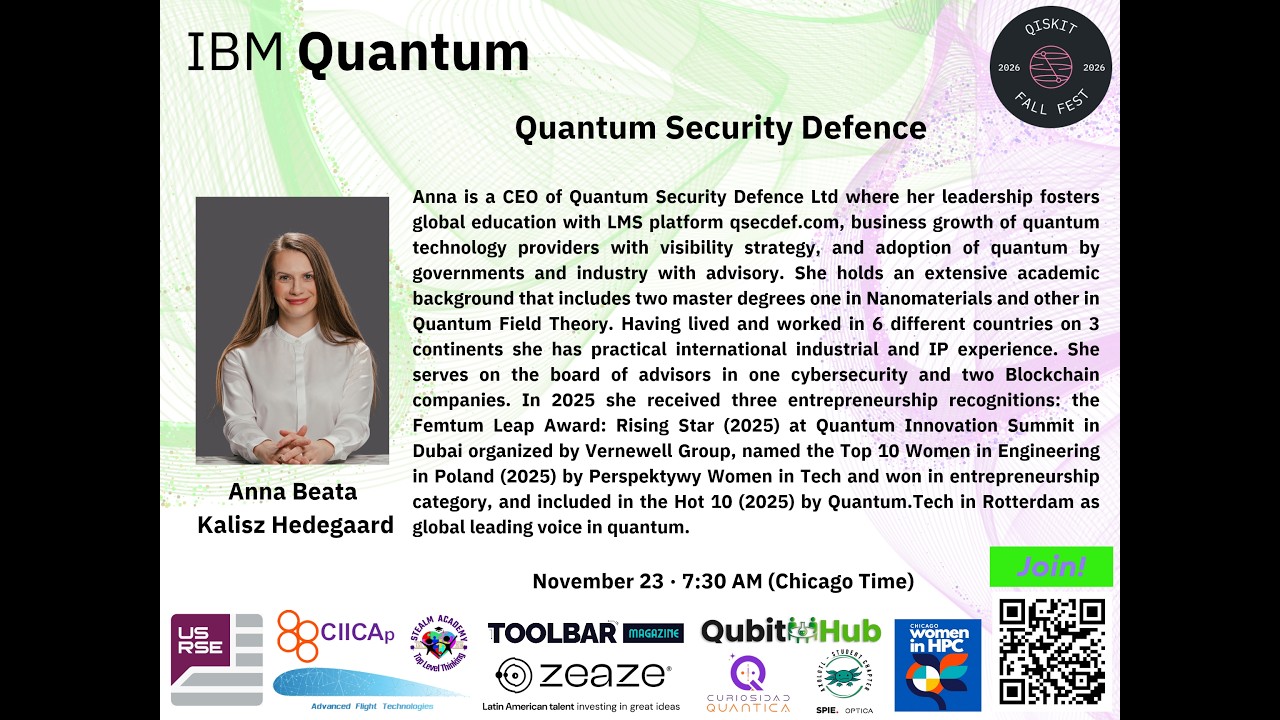
Anna Beata Kalisz Hedegaard
Keywords
Summary
212 words
Critical Evaluation
Value of the Information & Strength of the Argument
The main value lies in synthesis: the talk connects quantum-computing risk, AI-accelerated cyberattacks, post-quantum migration and policy lag into a single accessible narrative. It is especially useful for explaining why harvest-now-decrypt-later makes cryptographic migration urgent before large-scale quantum computers exist, and for showing how AI lowers the skill threshold for attackers while increasing the speed and scope of attacks. The argument is structured around a clear threat model: Shor’s algorithm against RSA and ECC, the exposure of confidentiality and identity signatures, then the migration to post-quantum cryptography. Its weaker point is evidentiary solidity. Several quantitative claims, such as the rise in phishing volume, growth in criminal specialization and a 29-minute breakout time, are asserted without visible sourcing or methodology. Timelines and vendor claims are treated as strong signals of near-term risk, which is plausible but not demonstrated in the talk. The Q&A is candid and useful but remains opinion-based, particularly on entrepreneurship and career advice.
Scientific Rigor, Source Quality, Title Accuracy
Scientific rigor is limited by the format: the video is an expert presentation and Q&A, not a research seminar with a bibliography. The transcript mentions NIST, ML-KEM, ML-DSA, SLH-DSA, QKD and Shor’s algorithm, but it does not cite specific papers, standards documents, datasets or studies. The description provides a company URL but no academic references. As a result, the source quality is that of informed industry expertise rather than traceable peer-reviewed evidence. The title, simply the speaker’s name, is accurate as an identifier but gives no topical information; it is not misleading, only minimally informative about the actual quantum-cybersecurity content.
270 words
Title / Content Match
The title is only the speaker's name. It accurately identifies the guest but gives no indication of the quantum-cybersecurity topic; it is not misleading but minimally informative.
Quality & Reliability
6/10
The speaker has relevant academic and industry background, and the talk covers recognized concepts such as Shor's algorithm, harvest-now-decrypt-later and NIST post-quantum standards. However, it is an expert overview with no formal citations, several unsourced quantitative claims and simplified timelines, so reliability is moderate rather than high.
Key Moments
Markers derived by PSI from the transcript: the creator did not define chapters.
- Host introduces Anna Beata Kalisz Hedegaard and outlines her background, awards and company.
- Speaker explains her path from theoretical physics and nanomaterials to entrepreneurship and quantum security.
- Presentation of Quantum Security Defence: community, webinars, courses, certifications and free AI-security sessions.
- Discussion of telecommunications, digital dependence and why connectivity infrastructure is strategically important.
- Explanation of Shor's algorithm and the threat to RSA and ECC-based cryptography.
- Introduction of harvest-now-decrypt-later and trust-now-forge-later attacks.
- AI-enabled attack scaling: profiling, phishing, prompt injection, credential markets and breakout time.
- Post-quantum cryptography, ML-KEM, ML-DSA, SLH-DSA, QKD and migration deadlines versus vendor timelines.
- Policy discussion: cybersecurity as sovereignty, hybrid warfare and uneven national roadmaps.
- Q&A on career choices, quantum chip engineering, social-engineering training and the company's founding.
Cited Sources
- Quantum Security Defence (QSECDEF) — Company website given in the video description; presented as the platform for quantum-security education, webinars and certifications.
- NIST Post-Quantum Cryptography project — NIST is mentioned in the talk as running standardization and competition processes for post-quantum cryptographic algorithms.
Concurring Sources
- NIST Post-Quantum Cryptography project — Corroborates the talk's point that post-quantum standards exist and that migration is a recognized process.
Contribution & Novelties
The video’s main contribution is not new research but an integrative framing: it links quantum-computing risk, AI-accelerated cyberattacks, post-quantum migration and policy lag into one narrative. It is particularly useful for showing why harvest-now-decrypt-later makes cryptographic migration urgent before large-scale quantum computers exist. It also adds an entrepreneurial and ecosystem perspective through the speaker’s account of building an education and advisory company.
Further reading:
- Shor’s algorithm — Background on the quantum algorithm at the center of the RSA and ECC threat discussed in the talk.
- NIST Post-Quantum Cryptography project — Official context for ML-KEM, ML-DSA, SLH-DSA and the standardization process mentioned.
- Quantum key distribution — Overview of QKD, which the speaker mentions as complementary but not a standalone replacement for post-quantum cryptography.
- Harvest now, decrypt later / store now, decrypt later — Concept named in the talk; no URL given because the exact reference page is not cited.
- Prompt injection — AI-security risk mentioned in the presentation and Q&A; relevant to agentic AI threats but not sourced in the video.
170 words
Radar Profile
The profile is high on information quantity and moderate on technical depth, reflecting a broad tour of quantum and AI security rather than a specialist lecture. Quality and reliability are held back by unsourced statistics and a lack of documented methodology. The strongest dimension is the ability to connect technical risk, policy and business implications.