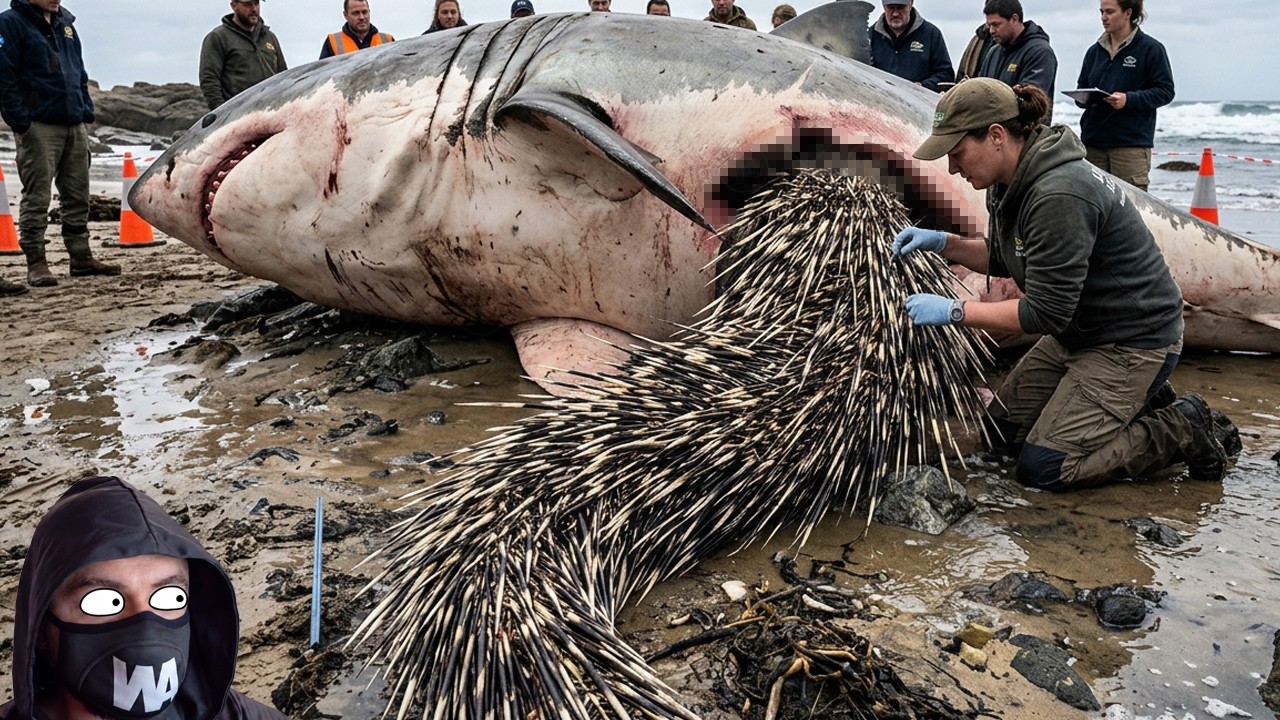
Land Animals Started Killing Giant Sharks in the Ocean, but Only Autopsies Revealed How
Title history
- Land Animals Started Killing Giant Sharks in the Ocean, but Only Autopsies Revealed How — observed on 20261120-1642 UTC (YouTube)
- Scientists Tested Sharks and Found Something in Their Bodies Nobody Expected to See — observed on 20261119-1555 UTC (YouTube)
Keywords
Summary
123 words
Critical Evaluation
Value of the Information & Strength of the Argument
The video provides valuable information about tiger shark diet and behavior, supported by a real scientific dataset. It effectively communicates the diversity of items found in shark stomachs and offers plausible explanations (scavenging, rivers carrying land animals) for the presence of non-marine prey. However, the argumentation sometimes leans on speculation, especially regarding the human remains, and the narrative is structured to maximize surprise rather than scientific depth. The core value lies in the synthesis of the 2017 study, but the presentation does not critically evaluate the methodologies or limitations beyond surface-level.
Scientific Rigor, Source Quality, Title Accuracy
The video references a 2017 scientific paper but does not provide its title or authors, making it hard to verify directly. It relies heavily on a single study and does not mention any corroborating or contradicting research. The title is misleading, as it implies land animals are attacking sharks, which is not the case. The content is generally accurate in describing the study’s findings, but the sensational framing reduces its scientific rigor. No external sources beyond the study are cited, and there are no links in the description. The video does not discuss peer-review or potential biases in the data collection.
207 words
Title / Content Match
The title is misleading: it suggests land animals are killing sharks, but the video actually documents sharks consuming land animals. The title does not match the content.
Quality & Reliability
7/10
The video presents findings from a legitimate scientific study on tiger shark stomach contents, but uses sensationalist framing and includes some speculative commentary. The core data and study details are accurate, but the presentation prioritizes engagement over rigorous scientific discussion.
Key Moments
Markers derived by PSI from the transcript: the creator did not define chapters.
- Introduction to the study: 778 tiger sharks examined from 1983 to 2014.
- Breakdown of prey types: 192 different prey items found, primarily fish.
- Discovery of whale and dolphin remains in shark stomachs.
- Seabirds like Cape gannets and African penguins found in 27% of identifiable stomachs.
- Unexpected land animal finds: Cape porcupine in a shark stomach.
- Common mole rat, a burrowing rodent, found inside a tiger shark.
- Blue duiker antelope remains discovered in a shark's stomach.
- Human remains (tibia, fibula, pelvis fragments) found in two sharks.
Cited Sources
- Scientific paper on tiger shark diet (2017) mentioned in video — The video refers to a 2017 study examining stomach contents of tiger sharks off KwaZulu-Natal coast, but does not provide the exact title or authors.
Contribution & Novelties
The video synthesizes a comprehensive study to highlight the unexpected dietary breadth of tiger sharks, including land animals and human remains, and connects these findings to broader ecological and pollution issues. It emphasizes the role of scavenging behavior and river transport in cross-ecosystem interactions.
Pour aller plus loin :
- Tiger shark — Overview of tiger shark biology and known diet.
- Marine debris — Explains how trash enters oceans and affects marine life.
- Whale fall — Discusses decomposition of whale carcasses and scavenging communities, relevant to shark scavenging behavior.
88 words
Radar Profile
The profile shows moderate to high scores in information quantity and reliability, with lower technical depth. This indicates a content that is rich in factual data but presented in an accessible, non-expert manner, with a slight bias toward engaging storytelling over stringent scientific analysis.