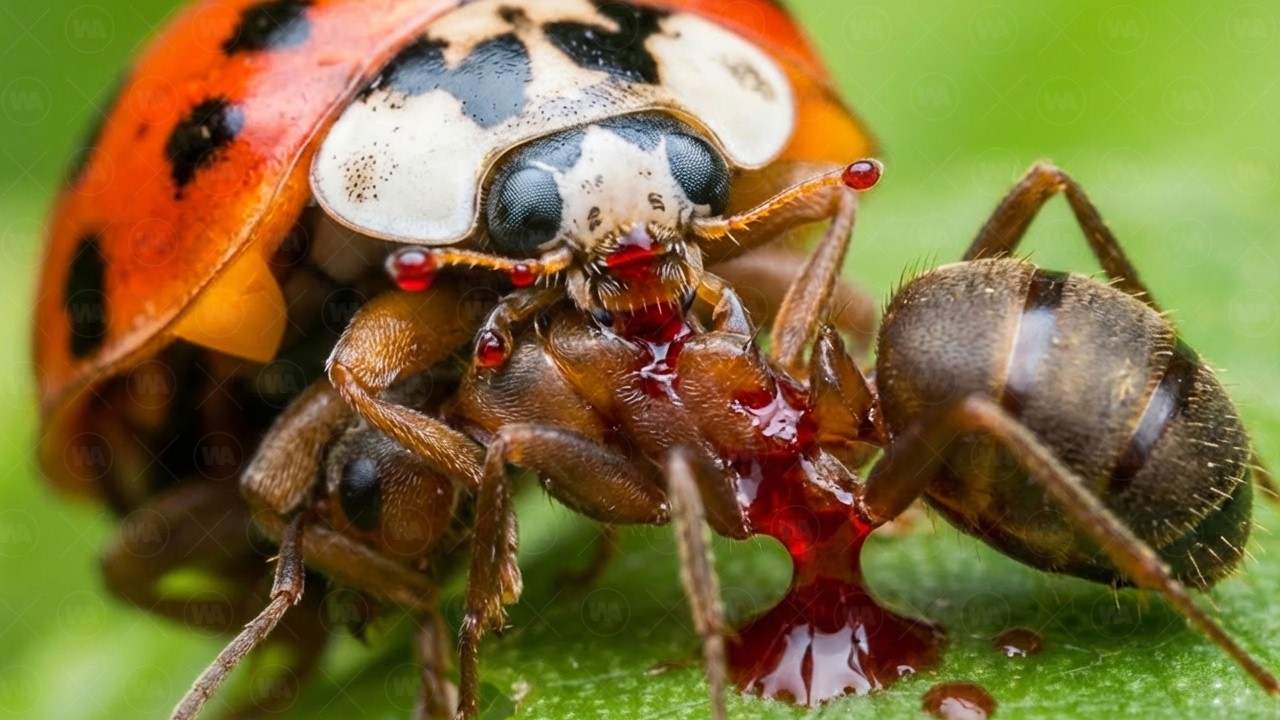
How Did Ladybugs Learn to Kill?
Title history
- How Did Ladybugs Learn to Kill? — observed on 20261101-0140 UTC (YouTube)
Keywords
Summary
163 words
Critical Evaluation
Value of the Information & Strength of the Argument
The video provides valuable insights into the practical and ecological aspects of biological control using ladybugs. It argues convincingly that ladybugs are effective predators due to their innate hunting behavior and voracious appetite, particularly at the larval stage. The explanation of tritrophic interactions and the role of plant volatiles in attracting predators is well articulated. The argumentation is solid, presenting both the advantages and limitations of biocontrol, such as the risk of invasive species and the influence of temperature on predation rates. The use of historical examples and specific species names adds credibility. However, the video could have cited scientific studies to strengthen its claims, but overall, it presents a coherent and informative case.
Scientific Rigor, Source Quality, Title Accuracy
The scientific rigor is generally high, with accurate references to species like Harmonia axyridis and Adalia bipunctata, and a correct description of aphid biology and pest management. The video relies on established knowledge in entomology, though it does not provide direct citations. The title is somewhat sensationalized but the content clarifies that ladybugs do not learn to kill; they are born predators. The title-content mismatch is minor and does not detract significantly from the educational value. The video could benefit from including references to primary literature, but as a science communication piece, it maintains a reasonable level of accuracy.
228 words
Title / Content Match
The title is slightly misleading as it suggests ladybugs learn to kill, while the video clarifies that their predatory behavior is innate. Still, it serves as an engaging hook.
Quality & Reliability
8/10
The video accurately describes key concepts of biological control and ladybug biology, referencing well-known examples like the vedalia beetle. However, it lacks explicit citations and may oversimplify some complexities.
Key Moments
Markers derived by PSI from the transcript: the creator did not define chapters.
- Introduction to ladybugs as aggressive predators and their introduction in Italy.
- Explanation of aphids as agricultural pests and their rapid reproduction.
- Discussion on why farmers use biological control instead of chemicals.
- Details on ladybug larvae as the most effective stage for aphid control.
- Explanation of tritrophic interactions and how plants attract predators.
- Risks of biocontrol: intraguild predation, cannibalism, and invasive species.
- Historical example of vedalia beetle controlling cottony cushion scale in California.
- Influence of temperature on ladybug activity and hunting efficiency.
- Conclusion: ladybugs are innate predators and biocontrol requires careful management.
Contribution & Novelties
The video’s contribution lies in synthesizing existing knowledge about ladybug biology and biological control in an accessible format. It clarifies misconceptions about learned behavior and emphasizes the innate predatory nature, while highlighting the complexities of using them in agriculture. The section on tritrophic interactions and the risks of invasive species adds depth.
Pour aller plus loin :
- Biological pest control — Overview of using natural enemies in agriculture.
- Tritrophic interaction — The role of plant signals in recruiting predators.
- Harmonia axyridis — Invasive Asian lady beetle, a cautionary tale in biocontrol.
- Coccinellidae — Family of ladybugs, their ecology and diversity.
100 words
Radar Profile
The radar profile shows a high quantity of information (9) and good quality (8), with a moderate technical level (7) and strong reliability (8). This indicates a content-rich video that is technically accessible but grounded in established science, making it useful for general audiences and students.
💬 Positive. On the 30 comments analyzed, the audience shows enthusiasm and shares personal anecdotes, with no significant negative feedback.