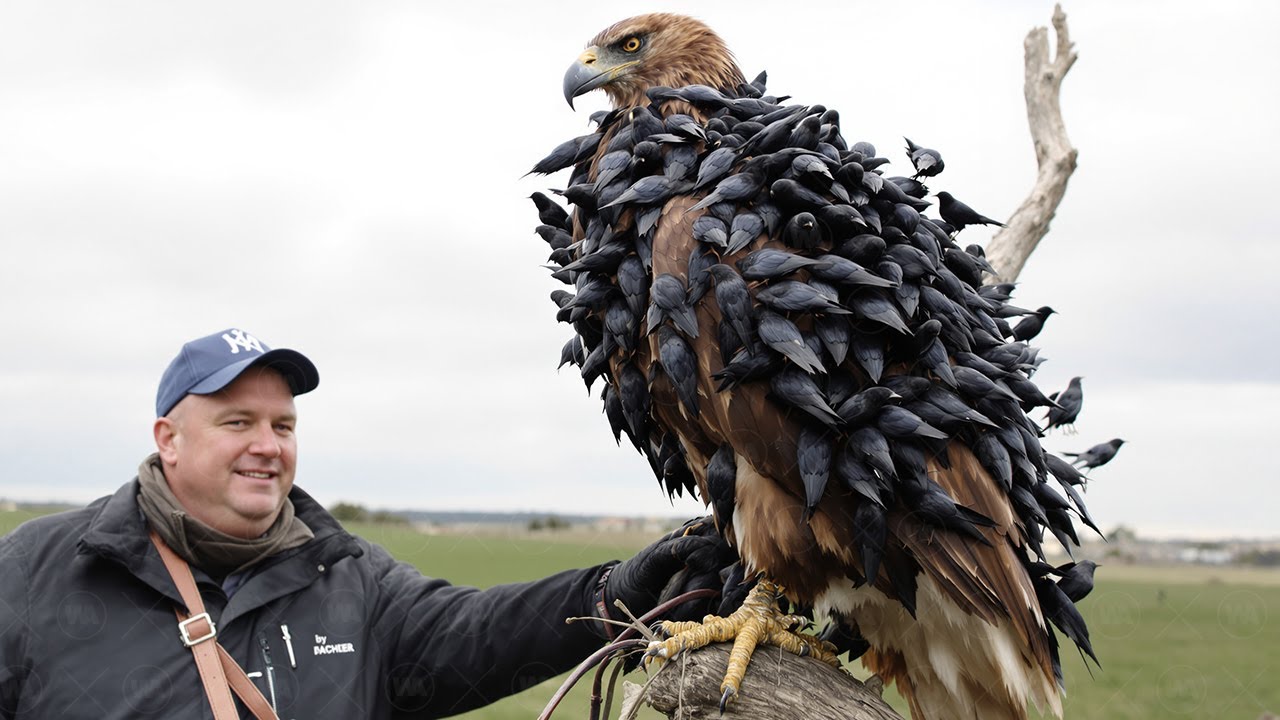
Releasing Thousands of Predators to Fight High-IQ Crows — Then It Got Worse
Title history
- Releasing Thousands of Predators to Fight High-IQ Crows — Then It Got Worse — observed on 20261101-0204 UTC (YouTube)
Keywords
Summary
146 words
Critical Evaluation
Value of the Information & Strength of the Argument
The video provides a rich collection of examples and studies illustrating crow intelligence and the complexity of managing invasive species. The argumentation is structured logically: first establishing the severity of the crow problem, then exploring potential solutions and their drawbacks. The discussion of crow memory experiments (e.g., nut-dropping, face recognition) adds scientific weight, but the connection between these studies and the proposed eagle release is sometimes speculative. The strongest point is the critique of using wild eagles, supported by documented attacks on humans and livestock, and the comparison with successful trained-falcon programs strengthens the argument for non-lethal, controlled methods. However, some claims, such as the exact numbers of crows or disease prevalence, are presented without specific sources, reducing overall argumentative solidity.
130 words
Title / Content Match
The title accurately captures the narrative: the idea of releasing predators (eagles) to control crows, and the unexpected complications that arise. It matches the content well without exaggeration.
Quality & Reliability
7/10
The video references several scientific studies and expert opinions, but lacks direct citations and often blends factual research with anecdotal stories in a sensationalist manner. The core facts about crow intelligence and the inefficacy of traditional control methods are credible, but specific claims about eagle attacks and control programs are not fully verified.
Cited Sources
- Study of 100 house crows for Salmonella — Mentioned in the video as a scientific investigation that found antibiotic-resistant strains in crows.
- University of Washington research on crow face recognition — Cited as evidence that crows can remember and communicate about specific people who harmed them.
- Clark's Nutcracker seed-caching study — Referenced to illustrate exceptional memory and spatial recall in corvids.
- Portland Downtown Clean and Safe falconry program — Presented as a successful example of using trained birds to control crow populations in an urban setting.
Contribution & Novelties
The video’s original contribution lies in contrasting the risky idea of releasing wild predators (eagles) with the safer, proven method of trained falconry. It synthesizes scattered research on crow cognition and behavior to argue that lethal control methods are ineffective and that non-lethal, learned deterrents offer a better pathway. The narrative also highlights a real-world case (Portland) and an emerging Indian police eagle unit, bridging ecological concepts with practical urban management.
Pour aller plus loin :
- Corvid intelligence - Wikipedia — Provides a comprehensive overview of crow cognitive abilities, complementing the video’s examples.
- Biological pest control - Wikipedia — Discusses the broader context of using predators for pest management, including risks and benefits.
- House crow - Wikipedia — Details the biology and invasive status of the species central to the video’s topic.
- Falconry - Wikipedia — Explains the history and techniques of using trained raptors, relevant to the proposed solution.
150 words
Radar Profile
The radar profile shows high quantity of information and moderate quality, with technical level slightly above average. This indicates a content-rich video that explains scientific concepts in an accessible way, but relies more on breadth than on deep verification. Reliability is moderate, reflecting the blend of credible research and anecdotal narration.
💬 The overall sentiment is balanced, with many viewers expressing appreciation for crows and sharing personal positive experiences, while also criticizing the idea of introducing predators. On the 30 comments analyzed, viewers highlight crow intelligence and memory, and one comment warns against invasive species control. No negative or hostile threads were found.