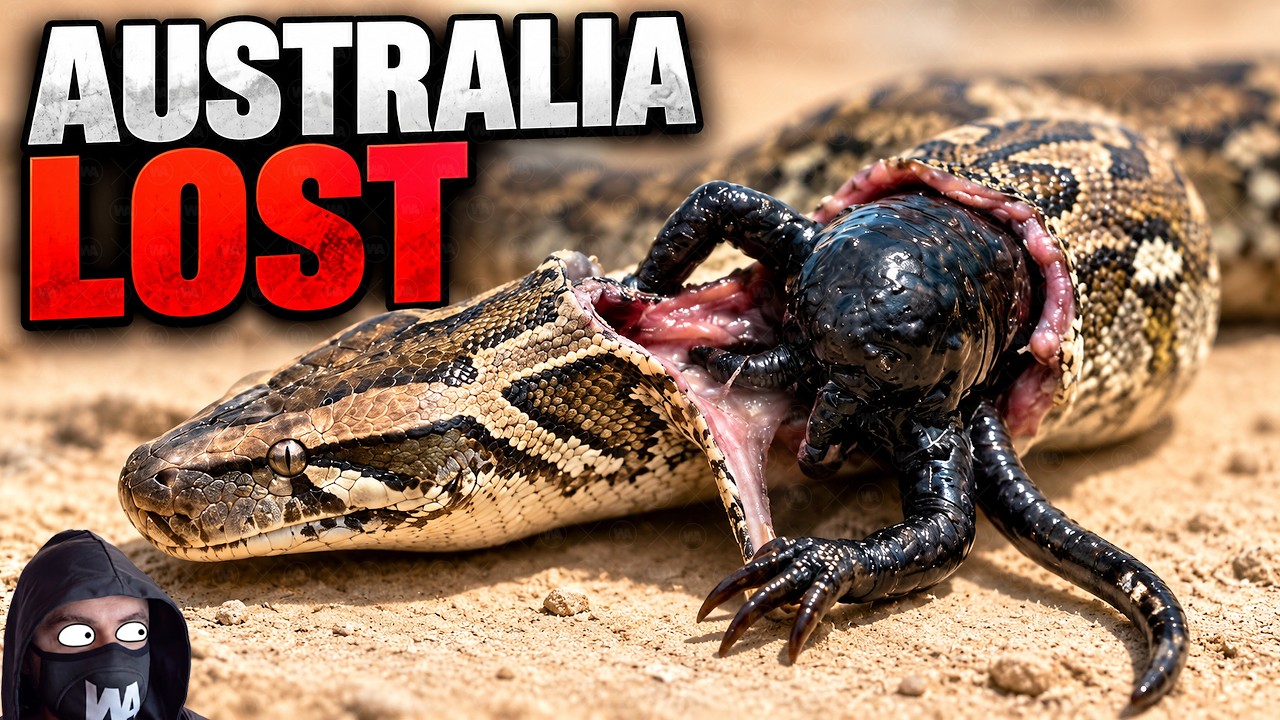
These Australian Animal Killers Have Now Spread Throughout Australia
Title history
- These Australian Animal Killers Have Now Spread Throughout Australia — observed on 20261031-2308 UTC (YouTube)
Keywords
Summary
147 words
Critical Evaluation
Value of the Information & Strength of the Argument
The video offers substantial value by synthesizing multiple well-documented case studies of invasive species in Australia, making complex ecological interactions accessible to a broad audience. The argumentation is logically structured, moving from specific examples to broader systemic effects, and is supported by quantitative data (e.g., population declines, spread rates). The strength lies in its use of concrete incidents and measured impacts, which gives the narrative a factual grounding. However, the lack of direct citations or links to original studies weakens the ability to independently verify the claims, and some causal chains are presented without explicitly acknowledging uncertainties. Overall, the information is valuable for raising awareness and providing a coherent overview, but the argumentation would benefit from citing primary sources.
Scientific Rigor, Source Quality, Title Accuracy
The video demonstrates moderate scientific rigor. While the content appears factually accurate based on general knowledge of invasive species in Australia, the absence of explicit references or a bibliography limits its credibility. The title ‘These Australian Animal Killers Have Now Spread Throughout Australia’ is somewhat sensationalist but accurately captures the theme of invasive predators expanding across the continent. The title-content alignment is good, as all examples indeed involve introduced species causing harm to native fauna. The video does not provide any source links in the description, and the narration does not name specific researchers or publications, instead referring to ‘researchers’ and ‘studies’ generically. This lack of source transparency is a notable weakness. No comments were available to analyze public reception, but the video’s popularity (93k views) suggests it reaches a wide audience.
266 words
Title / Content Match
The title accurately reflects the content, which discusses various invasive predators that have spread across Australia and their impacts.
Quality & Reliability
7/10
The video provides detailed information on several invasive species in Australia, including specific numbers and studies, but does not cite primary sources or provide references for verification.
Key Moments
Markers derived by PSI from the transcript: the creator did not define chapters.
- Introduction to invasive species in Australia and the giant centipede preying on snakes.
- Redfin perch introduction, breeding, and impact on native fish populations.
- European wasp invasion in Tasmania and spread to mainland Australia.
- Northern Pacific seastar's arrival via ballast water and its effect on shellfish.
- Yellow crazy ants supercolonies and the decline of red crabs on Christmas Island.
- Cane toads' cascading effects on monitor lizards and ecosystem functioning, plus fires exacerbating predation.
Contribution & Novelties
This video synthesizes a wide range of invasive species cases in Australia into a single narrative, providing a comprehensive overview that is not easily found in one source. It highlights how different pathways (ballast water, deliberate introduction, accidental cargo transport) lead to invasions and emphasizes the cascading ecological consequences, such as altered soil nutrient cycling and slowed carcass decomposition. The inclusion of recent biocontrol efforts (e.g., parasitic wasps for scale insects) offers a forward-looking perspective.
Pour aller plus loin :
- Invasive species in Australia — Comprehensive list and details of invasive species and their management.
- Cane toad — Specific information on the cane toad’s impact in Australia, including population effects.
- Yellow crazy ant — Details on the ant’s invasive behavior and the Christmas Island case study.
126 words
Radar Profile
The radar profile shows high scores in information quantity and overall reliability, moderate in information quality and technical level, indicating a content that is rich in facts but not overly technical, and reasonably reliable though lacking formal citations.