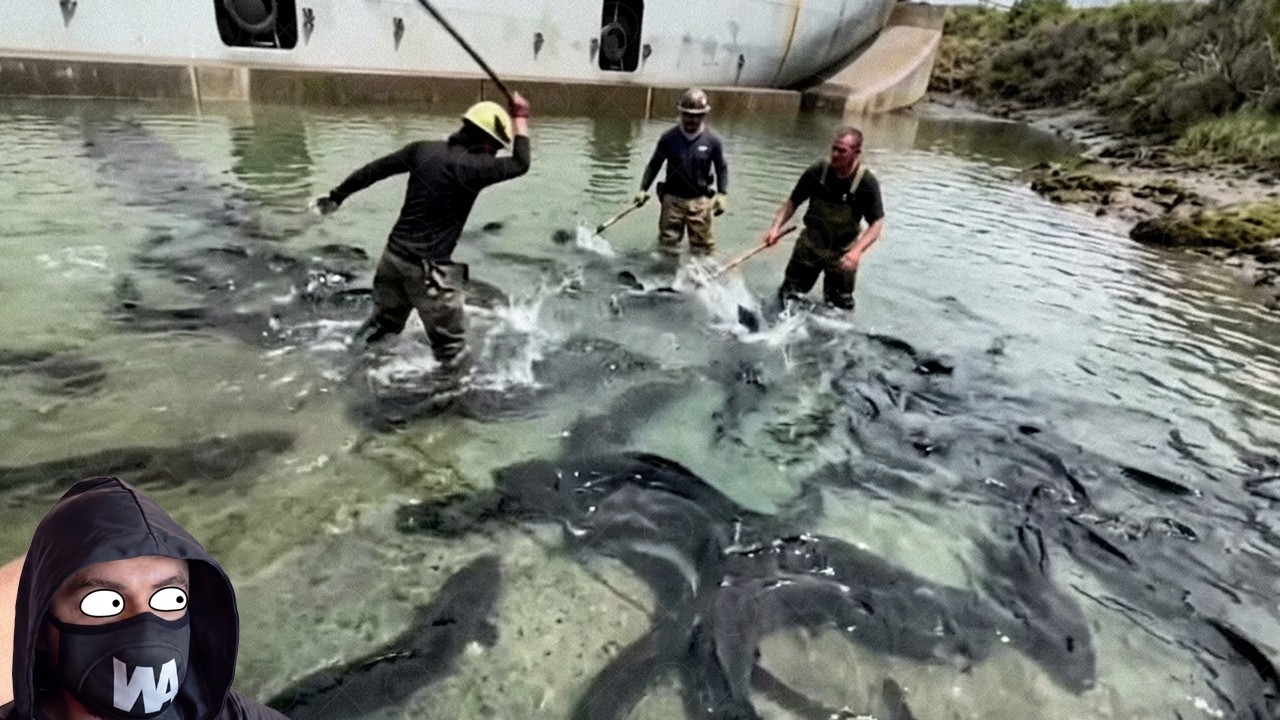
Australia Is Urgently Releasing These Predators to Kill Cane Toads, But They Started Doing THIS
Title history
- Australia Is Urgently Releasing These Predators to Kill Cane Toads, But They Started Doing THIS — observed on 20261031-2254 UTC (YouTube)
Keywords
Summary
150 words
Critical Evaluation
Value of the Information & Strength of the Argument
The video provides substantial information about cane toad biology, invasion dynamics, and the adaptive responses of native predators. It synthesizes findings from multiple studies, such as the 2020 analysis of sugarcane yields, the experiments on conditioned taste aversion in lizards and crocodiles, and the field observations of rakali feeding behavior. The argumentation is coherent: it builds a narrative from introduction to impact to adaptation, supported by specific data (e.g., 31% reduction in animal numbers, 95% reduction in crocodile mortality after training). However, it sometimes extrapolates or dramatizes for effect, and the lack of direct citations weakens the evidentiary chain. The strength lies in the clear explanation of ecological and evolutionary concepts, making them accessible to a general audience.
Scientific Rigor, Source Quality, Title Accuracy
The video references numerous scientific studies (e.g., 2020 sugar yield comparison, 2013 rainbowfish learning, 2011 goanna training) but provides no formal citations or links. The absence of a bibliography significantly reduces its scientific rigor. The title is highly clickbaity and misleading, as it implies deliberate predator release, whereas the content is about natural predation and adaptation. This discrepancy is a notable flaw. No user comments were provided, so audience trends cannot be assessed. Overall, while the content is informative, the lack of traceable sources and the sensationalized title compromise its trustworthiness.
224 words
Title / Content Match
The title suggests that humans are releasing predators to control cane toads, but the video actually focuses on natural adaptation and the discovery of water rats hunting them. It is somewhat misleading and sensationalized.
Quality & Reliability
7/10
The video presents numerous scientific findings and studies, but without direct citations or references. The narrative is engaging and generally accurate, yet some claims are presented without detailed methodology. The lack of explicit sources reduces the overall score.
Key Moments
Markers derived by PSI from the transcript: the creator did not define chapters.
- Discovery of dead cane toads with identical chest wounds; mystery introduced.
- History of cane toad introduction in 1935 and early spread.
- Ecological impacts: decline of native predators and loss of biodiversity (31% drop).
- Adaptations: planigales, snakes, and quolls developing toxin resistance or avoidance behaviors.
- Crocodile training programs and reduction in mortality; introduction of rakali as the mysterious hunter.
- Discovery of rakali's precise dissection techniques and preference for large toads.
Cited Sources
- 2020 study on sugarcane production — Compared sugarcane yields before and after cane toad arrival, finding no significant increase.
- 2011 goanna training study — Showed that conditioned taste aversion can teach goannas to avoid cane toads before wild exposure.
- 2013 rainbowfish learning study — Demonstrated that crimson-spotted rainbowfish from toad-invaded waters learn faster to avoid toxic prey.
Contribution & Novelties
The video’s primary novelty is the documentation of water rats (rakali) as the predators responsible for the mysterious cane toad carcases, and their sophisticated surgical feeding behavior. This adds a new chapter to the ecological arms race between invasive species and native fauna, showing that some predators can not only survive but thrive on the toxic invaders by selectively consuming safe organs. The video also synthesizes multiple research findings on rapid evolutionary adaptations, providing a compelling overview of how ecosystems respond to invasion.
Pour aller plus loin :
- Cane toad — Comprehensive background on the species and its invasive status.
- Rakali — Details on the Australian water rat, its ecology and distribution.
- Conditioned taste aversion — The learning mechanism used to train predators like crocodiles and goannas.
- Rhinella marina — Alternative link to the cane toad species page for deeper taxonomic information.
142 words
Radar Profile
The radar profile shows high scores in information quantity and global reliability, moderate in information quality and technical level. This indicates a content-rich video that is accessible but lacks rigorous sourcing, resulting in a balanced but not exceptional profile.