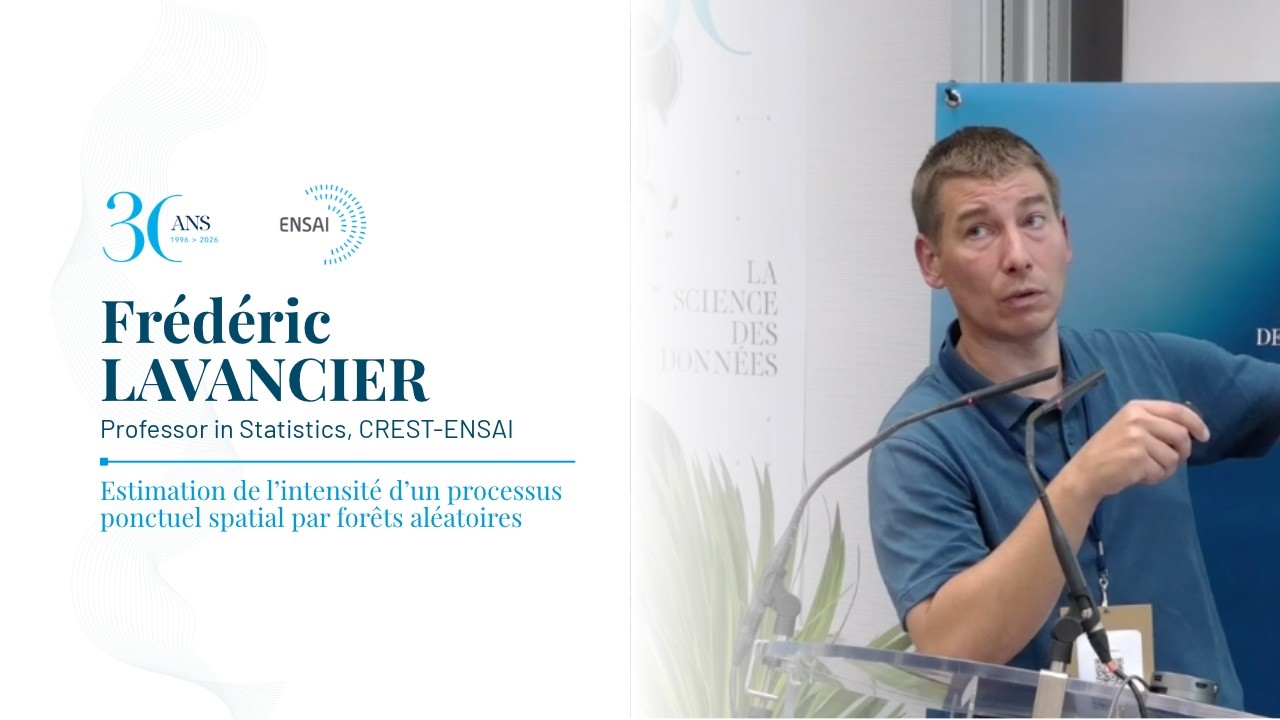
Frédéric Lavancier, Estimation de l’intensité d’un processus ponctuel spatial par forêts aléatoires
Title history
- Frédéric Lavancier, Estimation de l’intensité d’un processus ponctuel spatial par forêts aléatoires — observed on 20261110-0712 UTC (YouTube)
Keywords
Summary
160 words
Critical Evaluation
Value of the Information & Strength of the Argument
The presentation is rich in both methodological value and argumentative strength. The speaker clearly motivates the problem, contrasts with existing approaches, and systematically supports each design choice with reasoning. The argumentation is solid: he identifies well-known deficiencies of kernel smoothing, proposes a simple yet effective alternative, and demonstrates its advantages through concrete examples. The theoretical grounding, though not fully developed in the excerpt, is hinted at, showing a structured approach to validation. The talk does not shy away from limitations, discussing practical choices and the need for cross-validation, which strengthens its credibility.
Scientific Rigor, Source Quality, Title Accuracy
The scientific rigor is high: the speaker is a researcher in statistics, and the content aligns with established literature on point processes and machine learning. However, specific source citations are scarce; he mentions Adrian Baddeley and collaborations but provides no explicit bibliographic references in the excerpt. The title is perfectly consistent with the content. No audience comments were provided, so no sentiment analysis is possible.
172 words
Title / Content Match
The title matches the content exactly: it announces the method and the subject; the talk indeed focuses on estimating intensity using random forests.
Quality & Reliability
8/10
Presentation by an academic researcher clearly structured, with concrete examples, a methodological contribution, and a theoretical sketch. The partial transcript limits assessment, but the scientific rigor appears high.
Key Moments
Markers derived by PSI from the transcript: the creator did not define chapters.
- Introduction and objective: estimate intensity of a spatial point process via random forests.
- Definition of point processes and intensity using the example of air bubbles in concrete.
- Formal definition of intensity as the expected number of points per unit volume.
- Presentation of the covariate case: estimating intensity conditional on environmental variables.
- Introduction of the random forest approach for point processes, emphasizing its supervised learning background.
- Description of the proposed method for no-covariate case: averaging over random tessellations (e.g., Voronoi).
- Different types of spatial partitions: Voronoi, Delaunay, Poisson hyperplanes, and Mondrian processes.
- Advantages of the method: no boundary bias, adaptivity to complex geometries, and occlusion handling.
Cited Sources
- ENSAI LinkedIn — Link to the school's official page, providing context about the institution.
Concurring Sources
- Baddeley, A., Rubak, E., Turner, R. (2015). Spatial Point Patterns: Methodology and Applications with R — Foundational text on spatial point pattern analysis, supporting the theoretical context of intensity estimation.
- Breiman, L. (2001). Random Forests — Original paper introducing random forests, the basis of the proposed method.
Contribution & Novelties
The talk presents an original contribution by adapting random forests to the unsupervised problem of intensity estimation for spatial point processes. It offers a simple, interpretable, and flexible method that naturally handles boundary effects, occlusions, and manifold geometry, while allowing covariate integration and variable importance quantification. The approach is well-grounded in existing tessellation theory and machine learning practice.
Pour aller plus loin :
- Point process — Provides a comprehensive overview of point processes, including intensity and related concepts.
- Random forest — Background on the ensemble learning method adapted in this talk.
- Voronoi diagram — Explanation of the tessellation used to partition the spatial domain.
104 words
Radar Profile
The radar profile shows high technical level and fiability, with moderate to high scores in information quantity and quality. The high technical score reflects the mathematically dense content, while the fiability is supported by the academic setting. The balanced moderate-high values suggest a solid, specialized presentation accessible to a technical audience.