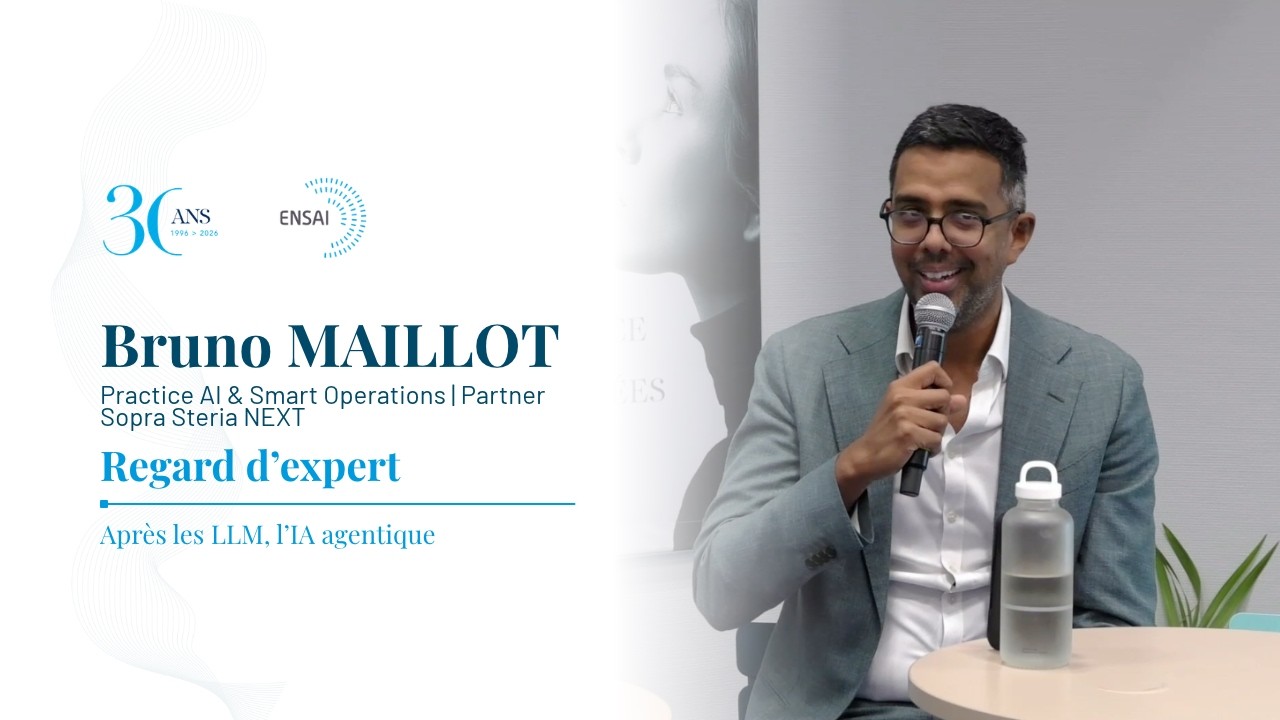
Bruno Maillot, "Après les LLM, l’IA agentique"
Title history
- Bruno Maillot, "Après les LLM, l’IA agentique" — observed on 20261110-0712 UTC (YouTube)
Keywords
Summary
221 words
Critical Evaluation
Value of the Information & Strength of the Argument
The talk offers valuable insights into the practical deployment of agentic AI, backed by real-world examples and cautionary tales. Maillot argues convincingly that success hinges on measuring errors and maintaining human oversight, as illustrated by the Air Canada liability case and Klarna’s quality issues. His pragmatic approach is grounded in his consulting experience and directly addresses implementation challenges. However, some claims are presented broadly without detailed evidence or statistical support, and the tone remains rather optimistic about the technology’s potential.
Scientific Rigor, Source Quality, Title Accuracy
The video is not a formal scientific presentation but an expert practitioner’s talk. The speaker cites real companies and incidents (Air Canada, Klarna, Sosh, Canal Plus) without providing academic references or links to primary sources. The title is accurate and matches the content well. The description includes only institutional links (ENSAI’s website and social media) rather than sources for the cited examples, reducing traceability. Nevertheless, the reasoning is coherent and the examples are relevant.
169 words
Title / Content Match
The title accurately reflects the content, focusing on the evolution from LLMs towards agentic AI with definitions, practical use cases, and challenges.
Quality & Reliability
7/10
The speaker is an industry expert with substantial practical experience in AI deployment and provides concrete examples and lessons learned. However, the presentation is opinion-based and lacks citations to peer-reviewed research or formal sources.
Key Moments
Markers derived by PSI from the transcript: the creator did not define chapters.
- Introduction on 'agent washing' and the need to clarify terms.
- Definition of agent vs assistant with the CAF example.
- Value pyramid: models are commoditized, value lies in proprietary data and decision-making.
- Importance of measuring errors and having fallback mechanisms before production.
- Cybersecurity dimension in agentic AI and the differential between attackers and defenders.
- Example of Sosh's Charlie: a real-time speech-to-speech agent acting on information systems.
Cited Sources
- ENSAI official website — Institutional site of the school hosting the event.
- ENSAI LinkedIn — Institutional LinkedIn page provided in the description.
- ENSAI Instagram — Institutional Instagram page given in the description.
- ENSAI Facebook — Institutional Facebook page from the description.
Concurring Sources
- Large language model — Background reference on LLMs, the foundational technology discussed.
- Intelligent agent — General concept of intelligent agents, consistent with the definition provided in the talk.
Contribution & Novelties
The video provides a practitioner’s view on how to select and deploy agentic AI in enterprises, emphasizing the necessity of evaluation and human control. It offers a clear framework for judging whether a process is suitable for an agent, using frequency, data access, and error measurement. The speaker’s distinction between the ‘wow’ effect and long-term reliability is a practical contribution often overlooked in academic debates.
Pour aller plus loin :
- Model Context Protocol (MCP) — Official protocol for connecting AI to data sources and tools; directly relevant to the ‘USB’ mentioned in the talk.
- Retrieval-Augmented Generation — Technique combining retrieval with generation, used in the Canal Plus example and key for grounding agents.
- AI governance — Discusses frameworks for responsible AI, aligning with the talk’s emphasis on oversight and accountability.
130 words
Radar Profile
The radar profile shows a high quantity of information with moderate technical depth and a decent reliability score for an expert opinion. This suggests a broad, accessible overview rather than a deep technical or highly rigorous analysis.