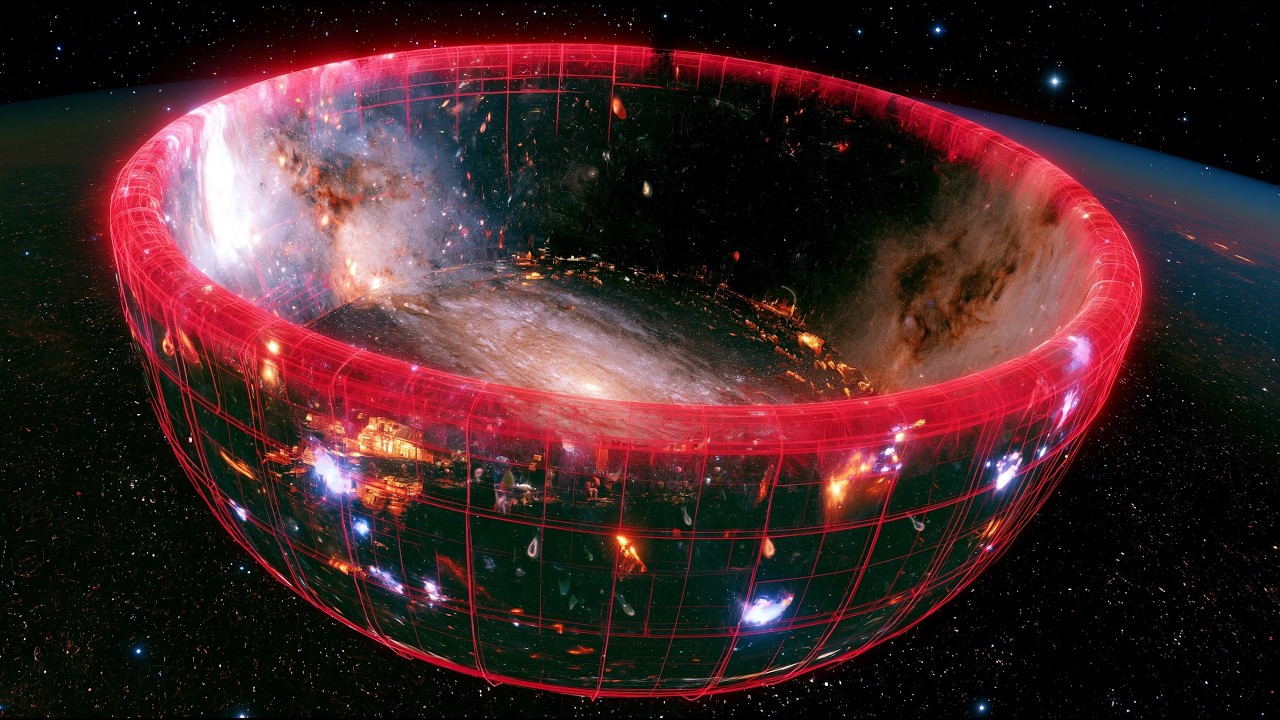
Que s’est-il passé en détail au début de l’Univers ?
What Happened in Detail at the Beginning of the Universe?
Title history
- Que s’est-il passé en détail au début de l’Univers ? — observed on 20261015-2306 UTC (PSI archive)
Keywords
Summary
197 words
Critical Evaluation
Value of the Information & Strength of the Argument
The video excels in delivering high-value scientific content in an engaging, accessible manner. It systematically builds an argument for cosmic inflation, presenting the paradoxes of homogeneity and flatness as logical problems with the standard Big Bang, then showing how inflation elegantly resolves them. The explanation of quantum fluctuations as seeds for large-scale structure is particularly well articulated, linking particle physics to cosmology. The narrative structure is coherent, moving from the initial conditions to observational evidence, and the argumentation is solid throughout. It also transparently mentions unresolved issues, such as the need for a quantum gravity theory, which strengthens its intellectual honesty. The use of analogies (balloon expansion, sheet of paper) effectively clarifies abstract concepts without oversimplifying the underlying physics.
Scientific Rigor, Source Quality, Title Accuracy
The scientific rigor is high for a popular science production. The video accurately describes the standard model of cosmology and the empirical support from space missions, and it correctly attributes the discovery of the CMB to Penzias and Wilson, and the inflation theory to Alan Guth. It distinguishes between well-established facts (e.g., the existence of the CMB) and hypotheses (e.g., inflation, though widely accepted, remains a theoretical construct). The title is perfectly aligned with the content, which indeed provides a detailed account of the early universe. While the video does not cite specific peer-reviewed papers, it references the key observational probes (COBE, WMAP, Planck) and prominent scientists, which grounds its claims in credible science. The absence of sensationalism and the balanced treatment of alternative theories (e.g., loop quantum gravity) further enhance its trustworthiness.
267 words
Title / Content Match
The title accurately mirrors the content: the video details the chronological early history of the Universe, from the Planck epoch through cosmic inflation to the formation of large-scale structures, all grounded in observational evidence.
Quality & Reliability
8/10
The video presents a comprehensive and accurate overview of modern cosmology, referencing established missions (COBE, WMAP, Planck) and theories (inflation). It acknowledges uncertainties and hypothetical frameworks, such as loop quantum gravity, while staying aligned with mainstream scientific consensus. Some simplifications are made for accessibility, but no major factual errors were identified.
Key Moments
Markers derived by PSI from the transcript: the creator did not define chapters.
- Introduction to the video's scope: recounting the history of the universe and the questions it raises.
- Discussion of the Planck epoch: extreme conditions, unification of forces, and the limits of current physics.
- Explanation of cosmic inflation: Alan Guth's theory, rapid expansion, and how it solves the homogeneity and flatness problems.
- Quantum fluctuations during inflation and their role in seeding large-scale cosmological structures.
- The cosmic microwave background: its origin, significance, and discovery by Penzias and Wilson.
- Space missions that studied the CMB: COBE, WMAP, and Planck, and their key findings on anisotropy and cosmological parameters.
- Composition of the universe: baryonic matter, dark matter, and dark energy, with percentages derived from CMB data.
Cited Sources
- SIRIUS App — Download link for a mobile application, presumably related to astronomy or education.
- Form for Teachers — A Google Form intended for teachers to provide feedback or request resources.
- Spotify Podcast — Link to the audio version of the video on Spotify, offered as a podcast.
- Facebook Channel — Link to the channel's Facebook page for community engagement.
- Instagram Channel — Link to the channel's Instagram page, mirroring Facebook content.
- Join the Channel — Membership link to support the channel and get exclusive benefits.
Concurring Sources
- NASA COBE Mission — NASA's page on the COBE mission, confirming its role in measuring CMB anisotropies.
- WMAP Mission (NASA) — Official WMAP website with detailed results on the age of the universe and composition.
- ESA Planck Mission — ESA's overview of Planck, highlighting its high-resolution CMB maps and cosmological findings.
Contribution & Novelties
This video brings originality through its synthetic narrative that weaves together the Planck epoch, cosmic inflation, and the CMB into a single story, providing a clear visual and verbal framework for understanding how the early universe shaped the present cosmos. Its strength lies in making complex theoretical physics accessible without dumbing it down, using detailed explanations of how inflation resolves classic dilemmas. The documentary format with animations and expert interviews (if any, as implied) adds value over standard lectures.
Pour aller plus loin :
- Cosmic inflation (Wikipedia) — Provides an in-depth technical treatment of the inflationary theory, including its history and variants.
- Cosmic microwave background (Wikipedia) — Details the properties, discovery, and significance of the CMB, including the missions COBE, WMAP, and Planck.
- Planck (spacecraft) (Wikipedia) — Official overview of the Planck mission, its objectives, and key results.
- Lambda-CDM model (Wikipedia) — The standard model of cosmology that incorporates inflation, dark matter, and dark energy, offering a framework for the universe’s evolution.
162 words
Radar Profile
The radar profile shows a high quantity of information (9) and strong reliability (8), with slightly lower quality (8) and technical level (6). This indicates the video is exceptionally comprehensive and trustworthy, but does not demand advanced prior knowledge, making it ideal for a general audience interested in cosmology.