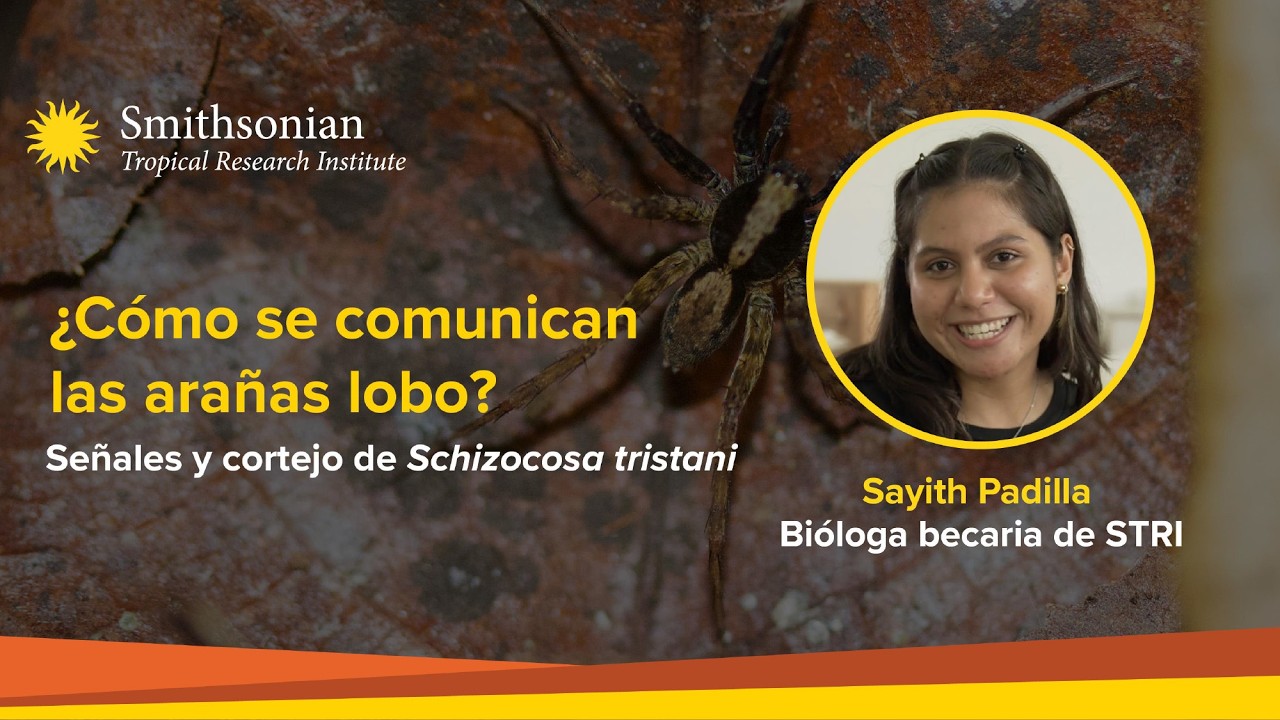
¿Cómo se comunican las arañas lobo? Señales y cortejo de Schizocosa tristani
Keywords
Summary
254 words
Critical Evaluation
Value of the Information & Strength of the Argument
The talk offers a clear, well-structured introduction to multimodal animal communication and then walks through a small set of manipulative experiments rather than only reviewing natural history. Its main value lies in showing how a visual signal can be experimentally isolated: painting male ornaments, adding chemical and placement controls, repeating trials by day and night, and using a dark room to remove visual cues. The eye-occlusion design is also informative because it moves from the signal to the receiver and asks which sensory structures are necessary for the behaviour. The argumentation is generally logical and the speaker distinguishes observed results from speculative interpretations, notably the UV hypothesis. However, the presentation remains preliminary: results are described largely qualitatively, with few sample sizes, effect sizes or statistical details, so the strength of the causal claims cannot be fully judged. The dark-room and granite experiments are useful but do not completely eliminate alternative channels, and null results are interpreted cautiously rather than overclaimed. Overall the value is high as a transparent account of ongoing experimental work, but the argument would be stronger with quantitative reporting and peer-reviewed follow-up.
Scientific Rigor, Source Quality, Title Accuracy
Scientific rigor: the work uses controlled manipulations, multiple controls, naturalistic and laboratory conditions, and explicit attention to animal welfare; these are positive signs. The speaker acknowledges limits and presents the UV interpretation as a hypothesis rather than a settled result. Source quality: the talk does not display a reference list, and the transcript names few specific publications; key literature on lycosid eye function and spectral sensitivity is referred to generically. The hosting institution and the speaker’s affiliation lend credibility, but the results have not been presented here as a peer-reviewed publication, so the note should be treated as a research seminar rather than a validated consensus. Title/content fit: the title accurately describes the subject, namely communication signals and courtship in Schizocosa tristani, and the talk delivers on that promise without major divergence.
332 words
Title / Content Match
The title accurately announces a talk on communication signals and courtship in Schizocosa tristani, and the content follows that focus closely.
Quality & Reliability
6/10
Clear methods and controlled manipulations from a credible research institution, but the results are presented as ongoing work without peer-reviewed citation or quantitative detail; reliability is therefore moderate.
Key Moments
Markers derived by PSI from the transcript: the creator did not define chapters.
- Introduction of the speaker, her background in zoology and arachnology, and the context of the Smithsonian fellowship.
- Definition of animal communication and overview of chemical, vibrational, visual and multimodal signals.
- How spiders perceive chemical, vibrational and visual cues through silk, sensilla, trichobothria and eyes.
- Presentation of Schizocosa tristani, including sexual dimorphism and the male white leg ornaments.
- First experiment: paint manipulation of male ornaments, controls, and day/night naturalistic trials.
- Results of the ornament manipulation: white paint reduced copulation in light, while dark-room trials removed the effect.
- Spectrophotometry measurements and the hypothesis that ultraviolet reflectance may contribute to the visual signal.
- Second experiment: eye occlusion to test which pair of female eyes detects the male courtship ornamentation.
- Vibration-blocking granite trials and interpretation of visual, vibrational and chemical channels.
- Summary of main findings and planned follow-up work on colour, UV cues and natural conditions.
Cited Sources
- Smithsonian Tropical Research Institute public webinar series — Host institution and webinar series mentioned at the start of the talk.
- Rowan McGinley — Communication of spiders in a changing world — Research project in which the speaker conducted part of the work.
- Jornadas Aracnológicas Argentinas 2025 — Conference where the project received a best oral presentation award.
- Literature on lycosid eye morphology and UV/green sensitivity — Referenced conceptually for eye function and spectral sensitivity; no specific paper is named in the talk.
- Schizocosa tristani — Focal wolf spider species studied in the experiments.
Concurring Sources
- Wolf spider — General reference on Lycosidae, consistent with the talk's description of ground-dwelling wolf spiders and their sensory ecology.
- Ultraviolet vision — General background on UV sensitivity, relevant to the speaker's hypothesis about ornament reflectance.
- Animal communication — General framework for signal production, reception and multimodal communication.
- Spectrophotometry — Methodological background for the reflectance measurements described in the talk.
Contribution & Novelties
The original contribution is the direct experimental manipulation of both sender and receiver in Schizocosa tristani: male white leg ornaments are altered with paint, and female eyes are selectively occluded, in order to separate visual from vibrational and chemical channels. The combination of naturalistic trials, day/night comparisons, a dark-room condition and spectrophotometric measurements gives the project a coherent multi-level design. The UV-reflectance hypothesis is presented as a next step rather than a settled finding, which is appropriate.
Further reading:
- Wolf spider — Background on Lycosidae, the family discussed in the talk.
- Ultraviolet vision — Context for the hypothesis that UV reflectance may affect courtship signalling.
- Animal communication — General framework for signals, receivers and multimodal communication.
- Spectrophotometry — Method used in the talk to compare the reflectance of natural ornaments and paint treatments.
- Rowan McGinley’s work on Schizocosa courtship and spider communication, without a specific URL — directly related to the research programme mentioned by the speaker.
157 words
Radar Profile
The profile is strongest in technical specificity, reflecting a detailed methods-oriented seminar, and in information quantity, since the talk covers sensory physiology, experimental design and results. Reliability and information quality are solid but not maximal because the findings are preliminary and lack quantitative and bibliographic detail. Overall, the radar suggests a specialised research talk with good methodological transparency rather than a definitive review.