Smart reforestation from principle to practice - Katherine Sinacore, STRI
Title history
- Smart reforestation from principle to practice - Katherine Sinacore, STRI — observed on 20261030-1154 UTC (YouTube)
Keywords
Summary
136 words
Critical Evaluation
Value of the Information & Strength of the Argument
The talk provides valuable quantitative data from a long-term tropical reforestation experiment, addressing both ecological productivity and financial viability. The argumentation is solid: the speaker systematically compares different scenarios, uses Bayesian statistics to project growth, and calculates net present value under varying interest rates. She is careful to acknowledge uncertainties and nuances, such as the dependency of overall yield on species selection and the limitations of allometric equations. The economic analysis is particularly instructive, showing that high-growth species like Terminalia may not be financially optimal due to lower timber value, while slower-growing Cocobolo can be more profitable. The inclusion of enrichment planting and comparison with cattle provides a realistic view of restoration options.
Scientific Rigor, Source Quality, Title Accuracy
The scientific rigor is high: the data come from a well-instrumented research site (Agua Salud), with replicated plots and long-term monitoring. The speaker cites peer-reviewed work and uses established methodologies like allometric equations and net present value. She is transparent about assumptions, such as using a 7% interest rate and conservative timber price ranges. The title accurately reflects the content, moving from principles (right species, right place, etc.) to practice (field results and economic analysis). No external sources were provided in the video description, so the talk relies on the speaker’s expertise and the project’s published works, which adds credibility.
228 words
Title / Content Match
The title accurately reflects the content: the speaker moves from theoretical principles of 'smart reforestation' to practical applications and economic analyses.
Quality & Reliability
8/10
The talk presents data from a long-term research project (Agua Salud) with transparent methodology, peer-reviewed work, and clear reasoning.
Key Moments
Markers derived by PSI from the transcript: the creator did not define chapters.
- Personal story of failed tree planting
- Introduction of the 'right species, right place, right time, right reasons' tagline
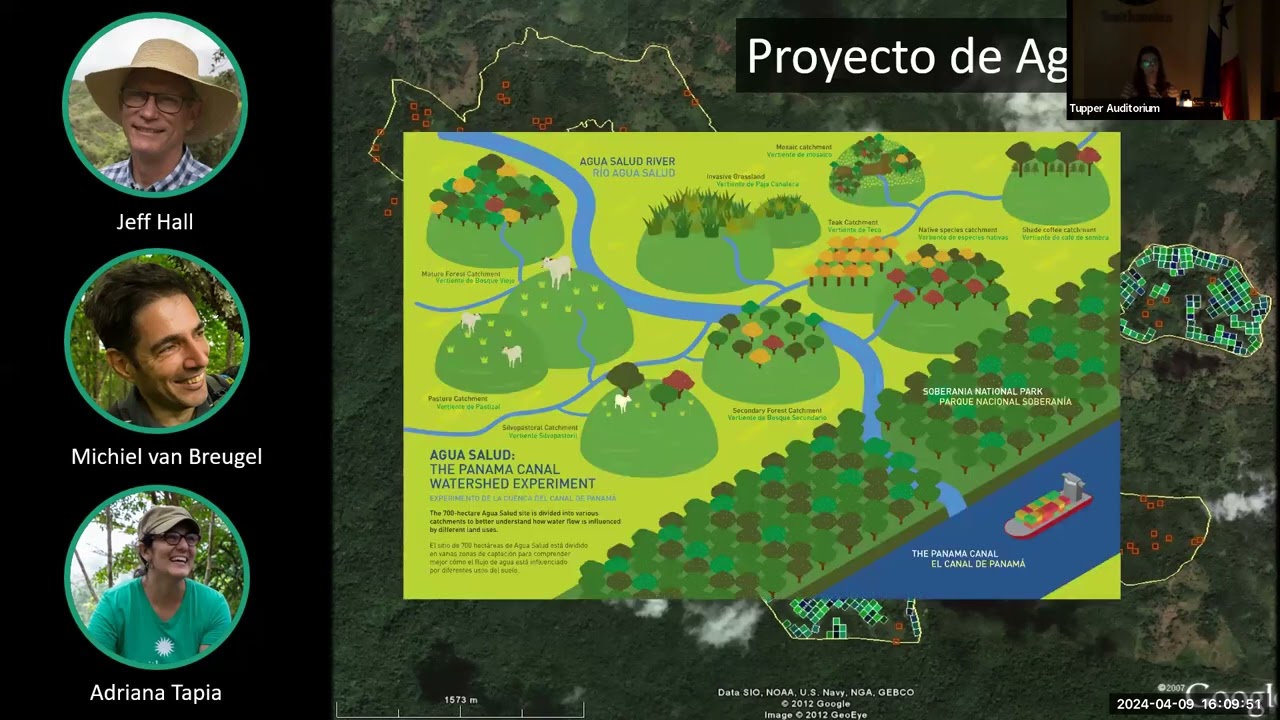
- Overview of the Agua Salud project and experimental design
- Biomass results and overyielding discussion
- Allometric equations and their limitations
- Timber volume and net present value analysis
- Comparison with teak and enrichment planting
Contribution & Novelties
The talk contributes original research on tropical reforestation, integrating ecological and economic perspectives. It challenges the assumption that mixed-species plantations always overyield, and provides empirical data on biomass and financial returns.
Pour aller plus loin :
- Reforestation — Background on reforestation and its importance.
- Allometry — Mathematical relationships used in biomass estimation.
- Net present value — Financial metric for evaluating investment in timber.
- Overyielding — Concept of mixtures outperforming monocultures.
70 words
Radar Profile
The radar shows high and balanced scores across all dimensions, indicating a technically rich and reliable presentation with substantial quantitative information.