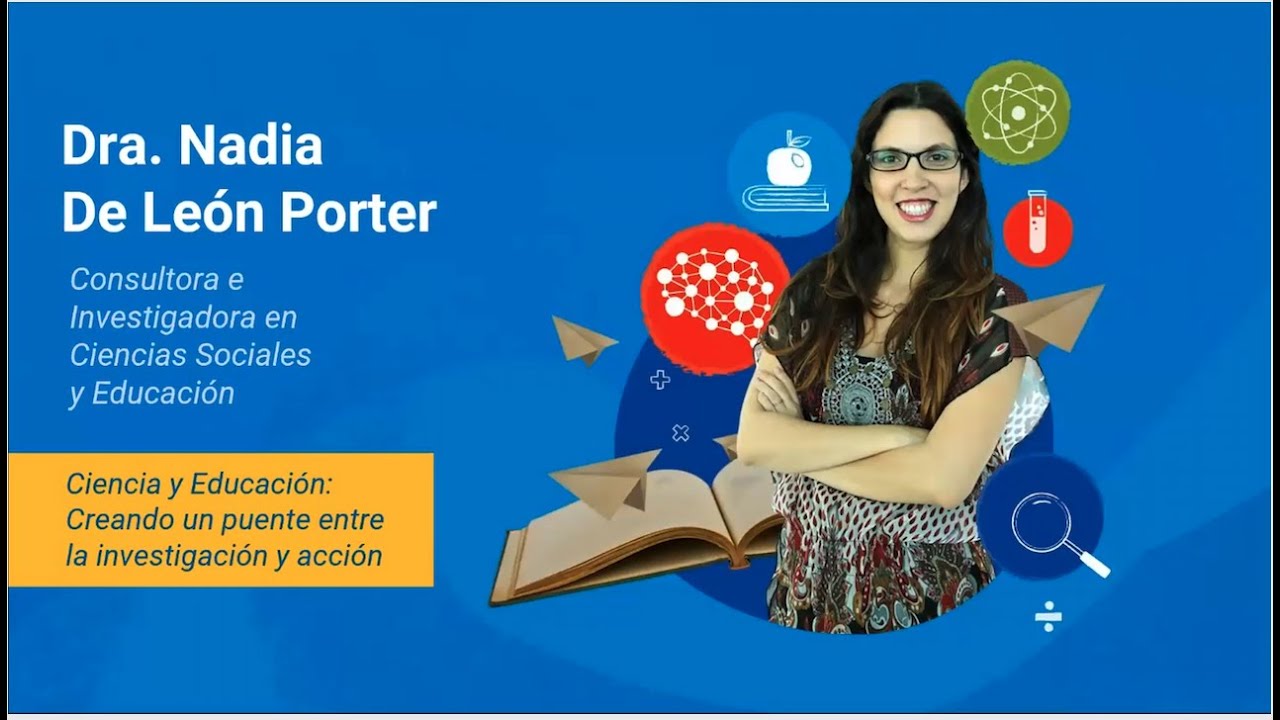
Historias de Científicos: Nadia De León Porter
Title history
- Historias de Científicos: Nadia De León Porter — observed on 20261026-0320 UTC (YouTube)
Keywords
Summary
157 words
Critical Evaluation
Value of the Information & Strength of the Argument
The value of this presentation lies in its authentic and personal perspective on a scientific career, particularly within the Panamanian context. The speaker’s argumentation is coherent and well-supported by her own experiences, which she uses to illustrate broader points about education, mentorship, and the crossover between arts and sciences. She provides concrete examples of her research projects and how they aim to influence educational policy, lending credibility to her claims about bridging research and action. The argumentation is persuasive in advocating for interdisciplinary approaches and the importance of social engagement, though it relies heavily on anecdotal evidence and less on systematic data. The breadth of her career trajectory adds richness, but the lack of specific statistical evidence or comparison with other systems weakens the overall scientific rigor of the discourse.
Scientific Rigor, Source Quality, Title Accuracy
The scientific rigor of the talk is moderate. While the speaker references her own research and institutional affiliations, she does not cite specific peer-reviewed publications or external sources during the presentation. The reliance on personal narrative and general assertions, such as the existence of evidence for STEAM education, limits the verifiability of her claims. The title appropriately matches the content, as it is indeed a story of a scientist’s journey. The lack of detailed references is a notable shortcoming for a scientific audience, although the talk seems primarily aimed at inspiration and career guidance rather than contributing new empirical findings. The credibility of the speaker is enhanced by her position at reputable institutions, but the informal format and the absence of citations reduce the overall scientific rigor.
272 words
Title / Content Match
The title accurately reflects the content, which is a personal career story of a scientist.
Quality & Reliability
7/10
Presentation by a credentialed education researcher at a Smithsonian institution, but primarily anecdotal and based on personal experience rather than rigorous data analysis.
Key Moments
Markers derived by PSI from the transcript: the creator did not define chapters.
- Introduction and welcome by Jimena Pití
- Nadia begins her presentation, mentioning her early love for teaching and dancing
- Discussion of her undergraduate thesis on dance therapy and teaching experiences
- Her time at Stanford University and decision to return to Panama
- Overview of her research at INDICASAT and Praxia Educational Consultants
- Q&A session: answer about profitability of research in Panama and women in science
- Final advice and closing remarks
Contribution & Novelties
This talk offers a unique personal narrative that humanizes scientific careers, particularly within Panama, an underrepresented region in science communication. It underscores the importance of interdisciplinary paths and the need to connect research with public policy. The speaker’s emphasis on mentorship, resilience, and the artistic dimensions of scientific thinking provides an original perspective that goes beyond typical technical discussions.
Pour aller plus loin :
- STEAM education — Related to the speaker’s advocacy for integrating arts into science education.
- Women in science — Relevant to her research on female participation in science.
- Educational research — Background on the field she practices and promotes.
102 words
Radar Profile
The profile shows a balanced but moderate scoring across all dimensions, with slightly lower technical level due to the accessible nature of the talk. The information quantity and quality are solid, reflecting the speaker's broad experience, while the rigorousness is adequate for an expert opinion format.