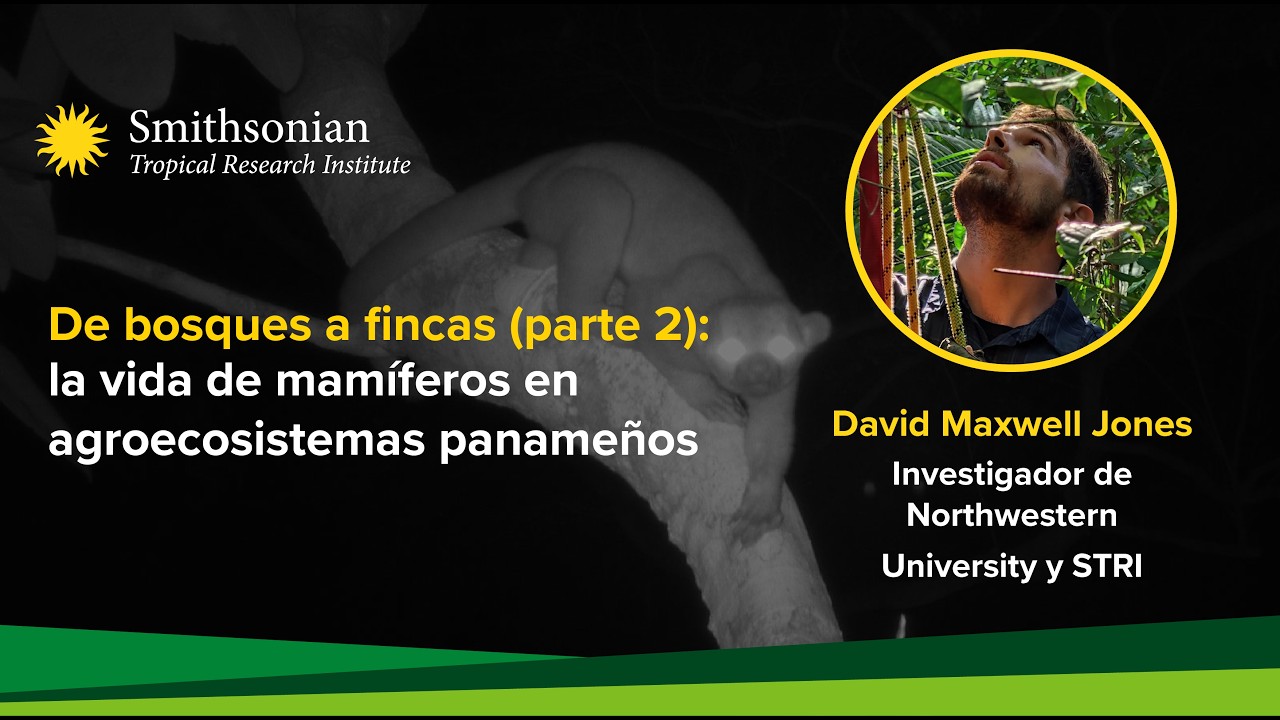
De bosques a fincas (parte 2): la vida de mamíferos en agroecosistemas panameños
Title history
- De bosques a fincas (parte 2): la vida de mamíferos en agroecosistemas panameños — observed on 20261030-1746 UTC (YouTube)
Keywords
Summary
124 words
Critical Evaluation
Value of the Information & Strength of the Argument
The value of this presentation lies in its original data and the methodological innovation of combining canopy and ground camera traps, addressing a critical gap in tropical mammal surveys. The argumentation is solid: the presenter systematically addresses hypotheses (e.g., that arboreal species are more vulnerable) and uses appropriate statistical models (rarefaction curves, ordination) to support conclusions. He also discusses alternative explanations for observed patterns, such as competitive release for nocturnal monkeys and behavioral shifts in tamanduas, demonstrating scientific rigor.
Scientific Rigor, Source Quality, Title Accuracy
The scientific rigor is high: the study is based on a well-designed field protocol with a clear sampling design, and the analysis follows ecological best practices. The presenter acknowledges limitations and cites prior work by colleagues (e.g., the first part of the series). However, no external sources are explicitly referenced, and the results are presented as part of a thesis rather than a peer-reviewed publication. The title accurately reflects the content, which is focused on the life of mammals in agricultural ecosystems, and the ‘part 2’ designation is consistent with the series.
186 words
Title / Content Match
Le titre reflète précisément le contenu : la seconde partie d'une série sur les mammifères des agroécosystèmes panaméens, avec un focus sur les communautés arboricoles et terrestres.
Quality & Reliability
8/10
The presentation is based on original field data from a master's thesis, using rigorous camera trap methodology and statistical analyses. The presenter is a trained biologist with institutional backing, and the results are presented with appropriate caution and contextualization.
Key Moments
Markers derived by PSI from the transcript: the creator did not define chapters.
- Introduction de Max et annonce du sujet : la vie des mammifères arboricoles dans les agroécosystèmes.
- Explication de la méthodologie : caméras pièges placées au sol et dans la canopée, avec escalade d'arbres.
- Présentation des espèces détectées, notamment les paresseux et leurs comportements.
- Discussion sur les singes nocturnes, leur absence dans les forêts protégées et leur présence dans les fermes.
- Analyses de richesse et de composition des communautés, comparaison entre types de forêts.
- Conclusion et remarques finales sur les implications pour la conservation.
Contribution & Novelties
Cette étude apporte une contribution originale en élargissant les inventaires de mammifères aux strates arboricoles dans des paysages agricoles tropicaux, montrant que les communautés de canopée peuvent être aussi riches que celles du sol, mais avec des compositions différentes. Elle remet en question l’hypothèse d’une vulnérabilité accrue des espèces arboricoles et révèle des ségrégations d’habitat marquées (écureuils).
Pour aller plus loin :
- Camera trap — Méthode clé utilisée dans l’étude, description complète.
- Forest fragmentation — Contexte écologique des taches forestières au sein de matrices agricoles.
- Agroecology — Cadre général des systèmes agricoles et de leur biodiversité.
96 words
Radar Profile
Les scores uniformément élevés (8/10) indiquent une présentation bien équilibrée, avec un contenu riche, une qualité scientifique solide, un niveau technique avancé et une fiabilité globale élevée, sans point faible majeur.