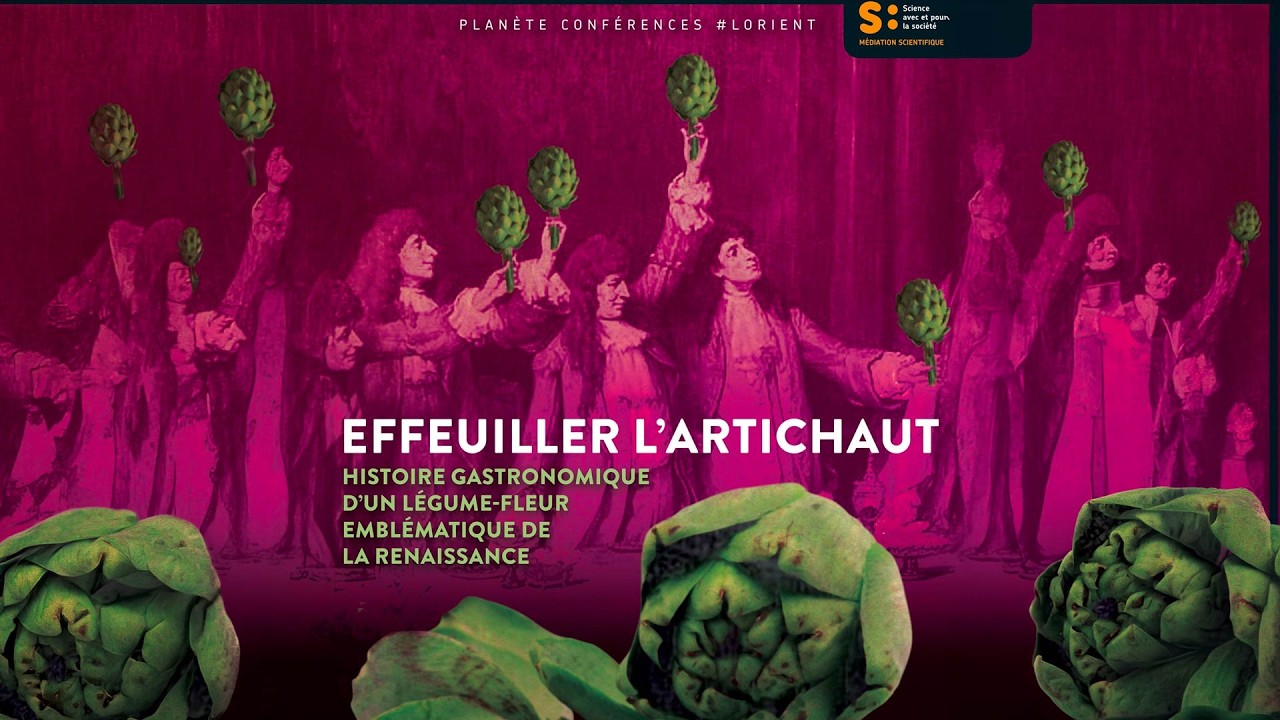
Planète Conférence - Effeuiller l’artichaut : une histoire gastronomique
Planet Conference - Peeling the artichoke: a gastronomic history
Keywords
Summary
239 words
Critical Evaluation
Value of the Information & Strength of the Argument
The main value of this presentation lies in its interdisciplinary approach, bridging botany, philology, archaeology, art history, and dietetics to build a robust and original narrative. The argumentation is solid and well-sequenced, moving from establishing factual origins to interpreting cultural representations and practices. Quellier argues convincingly that the artichoke’s popularity at the Renaissance was not solely due to taste but was driven by an intellectual curiosity for its botanical singularity and the rich symbolic meanings attached to it. The lecturer carefully supports his claims by referencing primary sources (cookbooks, archival records like a 1439 Sicilian lease, and humanist letters) and by presenting opposing viewpoints (e.g., the debate over Roman knowledge) before offering a synthesis based on available evidence. The demonstration of how dietary theory (humoralism) directly influenced whether the artichoke was served at the start or the end of a meal, and the analysis of artistic representations linking the artichoke to anatomical plates, are particularly compelling and provide deep insight into historical mentalities.
Scientific Rigor, Source Quality, Title Accuracy
The scientific rigor is excellent. The speaker consistently grounds his presentation in specific historical records and tangible evidence, citing medieval manuscripts, cookbooks, and archaeological discoveries. He also explicitly mentions where sources are accessible, such as the 1555 edition of ‘Le livre fort excellent de cuisine’ available on Gallica, and the manuscript at the Morgan Library. While he presents the academic debate between Latinists and botanists, he makes it clear that archaeological findings have settled the matter, showcasing a careful and balanced handling of divergent scholarly opinions. The title is perfectly suited to the content; it accurately reflects the lecture’s thematic focus on a gastronomic history, which is exactly what is delivered. The presentation has a clear and logical structure, systematic use of evidence, and a high level of scholarly rigor, albeit adapted for a conference public audience.
315 words
Title / Content Match
The title perfectly matches the content: the lecture thoroughly explores the cultural and gastronomic history of the artichoke, focusing on the Renaissance while tracing its origins and later evolution.
Quality & Reliability
9/10
The lecture is delivered by Florent Quellier, a recognized academic historian and specialist in food history. The reasoning is anchored in archival sources, iconographic analysis, and archaeological finds, with a clear presentation of academic debates (e.g., Latinists vs. botanists on Roman origin). The arguments are coherent and methodologically sound, reflecting solid academic rigor.
Key Moments
Markers derived by PSI from the transcript: the creator did not define chapters.
- Introduction by Florent Quellier on the artichoke's presence in Brittany and his research scope
- Botanical origin: the wild thistle, the debate between Latinists and botanists about Antiquity, and archaeological proof from Egypt
- Propagation through the Arab-Muslim world to Spain, then to Italy (Palermo in 1439, Florence, Venice) and the linguistic traces of this itinerary
- Arrival in France and Brittany, with the earliest references (Nantes in 1554, Rennes in 1562) and the association of the artichoke with Italian culture
- The 'double nature' of the plant and its characterization in Renaissance texts: its scales and thorns, and its representation as a curiosity (e.g., Singulier Traité)
- Analysis of still-life paintings (Clara Peeters) linking the artichoke to anatomy, the humoral dietetic theory, and the aphrodisiac 'hairy' symbolism
- Culinary history: consumption of raw artichokes at the end of the meal, the association with cheese, and the emergence of cooked artichoke dishes
- Conclusion on the artichoke as a symbol of both gourmet delight and eroticism, and its iconic status in the gastronomic culture of the Renaissance
Cited Sources
- Le livre fort excellent de cuisine (1555 edition) — Mentioned as the first French cookbook reference to the artichoke, indicating the presence of 'pâtés d'artichaut' and 'artichauts à la poivrade'.
- The Napolitan Cookbook (Manuscript at the Morgan Library) — Mentioned as the earliest known Christian cookbook reference to artichokes, dated to the early 16th century.
- Arte Cisoria by Enrique de Villena — Mentioned as the first Christian text describing the artichoke in the 15th century, written in Castilian.
Concurring Sources
- Archaeological evidence of artichoke bracts in Egypt — Internally consistent with the botanists' interpretation and cited by the lecturer to resolve the debate on Roman knowledge of the artichoke.
Dissenting Sources
- Latinists' viewpoint on Roman knowledge of the artichoke — Latinists historically argued the artichoke was unknown to the Romans, translating 'cardus' as 'chardon' or 'cardon' and rejecting the interpretation of Mosaics. The lecturer presents this perspective as a scholarly opposition to the botanists' views, which he ultimately endorses.
Contribution & Novelties
The lecture provides a unique synthetic perspective on a specific food item by integrating diverse historical methodologies—botanical archaeology, philology, art history, and dietary theory—to explain its cultural significance. It successfully challenges the notion that the artichoke is merely an Italian/French vegetable by tracing its roots through the Arab-Hispanic world, and it highlights the crucial role of mental representations (such as the ‘carapace’ and ‘hairy’ symbolism) in shaping culinary adoption. This goes beyond simple food history to offer a model for understanding how a plant moves through cultures and acquires a complex set of symbolic meanings.
Pour aller plus loin :
- Food history — Relevant for understanding the broader academic field in which this research is situated.
- Humorism — Directly relevant to the dietary theories of the Renaissance that influenced how the artichoke was prepared and consumed.
- Doctrine of signatures — Explains the logic behind the attribution of aphrodisiac properties based on the artichoke’s appearance.
- Artichoke — Provides a baseline on the plant’s botanical and botanical history as mentioned in the lecture.
171 words
Radar Profile
The radar profile shows very high scores in quality and reliability, reflecting the authoritative and well-supported nature of the presentation. Information quantity is also high due to the extensive temporal and thematic scope, while the technical level is moderate-high, making it accessible yet intellectually stimulating.