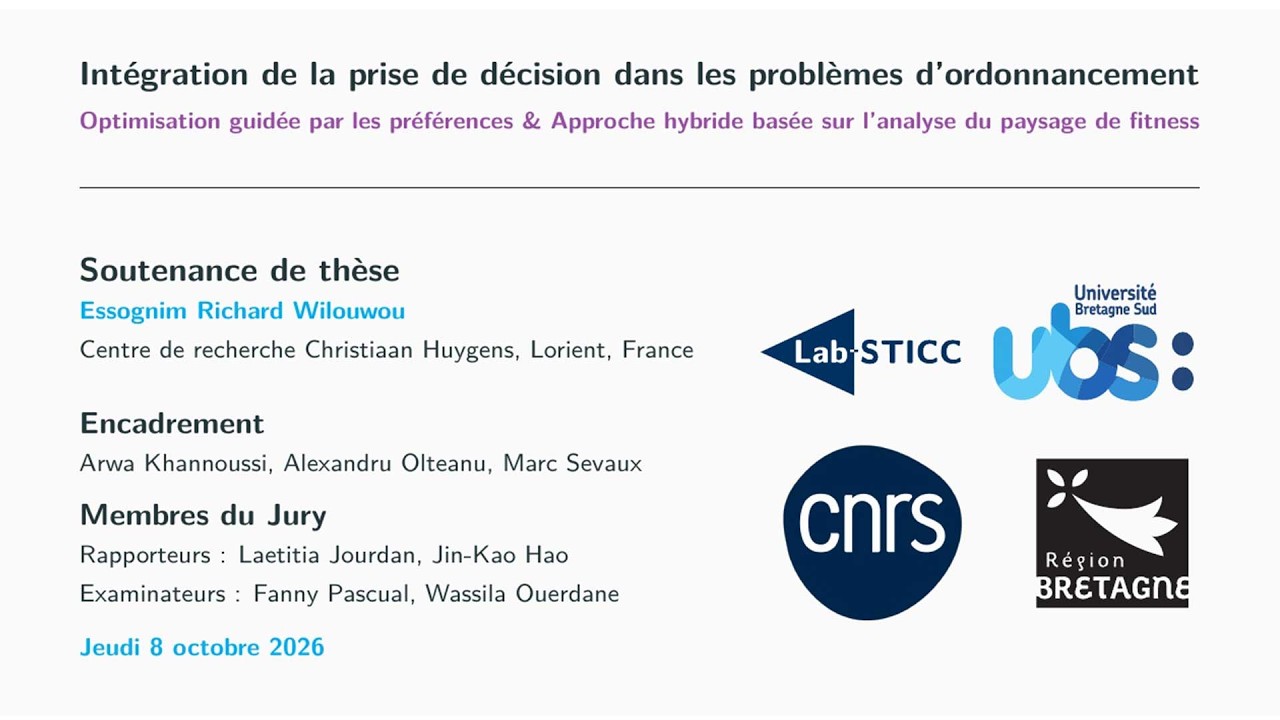
Soutenance de thèse de Essognim Richard WILOUWOU
Thesis Defense of Essognim Richard WILOUWOU
Keywords
Summary
198 words
Critical Evaluation
Value of the Information & Strength of the Argument
The thesis brings valuable methodological contributions: it explicitly tackles the compensation problem in multi-criteria stability aggregation by adopting a non-compensatory MR-Sort model, a meaningful improvement over common weighted-sum approaches. The argumentation is well-structured, moving from industrial motivation to formulation, modeling, integration, and experimental validation. The proposed interactive approach with iterative rejection feedback and constraint injection is pragmatic and responds to real operational constraints. The proximity concept—measuring how close a solution lies to the next preference category boundary—is an original idea that elegantly smooths the integration of qualitative preferences into gradient-free optimization. The a priori variant offers a more flexible lexicographic mechanism, balancing stability class and efficiency. However, the defense does not explicitly position these approaches against existing preference-guided optimization methods (e.g., interactive evolutionary algorithms) — an explicit baseline comparison would have strengthened the claimed novelty. The presentation of results is aggregated, and individual instance-level insights are not visible in the recording.
Scientific Rigor, Source Quality, Title Accuracy
The defense follows strict academic process: two rapporteurs (L. Jourdan, J. Koh) and two examiners (F. Pascal, W. Him) constitute the jury, and the candidate mentions funding from Bretagne region. The research is anchored in prior work — the thesis explicitly builds on a predecessor thesis on intelligent scheduling for the industry of the future. One conference paper from the author is cited (presented at an international metaheuristics conference). No external sources or URLs are provided in the YouTube description, which limits the verification of specific claims. The title is perfectly adequate: it accurately reflects the content of the defense, without exaggeration. The thesis’s originality and academic standards are evidenced by the jury’s engagement and the structured presentation, though the visible portion does not expose the full experimental analysis or potential limitations.
298 words
Title / Content Match
The title accurately reflects the content: the video is indeed the recorded thesis defense of the named candidate, focusing on integrating decision-making in scheduling problems.
Quality & Reliability
8/10
PhD defense presented before a jury of four experts with one rapporteur online, following academic protocols (rapporteurs, examiners, a 45-minute presentation, and a Q&A session). The research is methodologically rigorous: it builds on established operations research frameworks (multi-criteria decision analysis, metaheuristics, fitness landscape analysis) and validates claims through experiments on 81 instances with three decision-maker profiles. Minor limitations include truncated experimental details in the recording and the absence of explicit comparison with existing preference-integration baselines in the visible portion of the defense.
Key Moments
Markers derived by PSI from the transcript: the creator did not define chapters.
- Jury introduction and formal start of the defense
- Context: Industry 5.0, human-centered manufacturing, and research questions
- Problem definition: flexible job shop scheduling and rescheduling
- Stability indicators and justification of non-compensatory aggregation
- MR-Sort preference model for qualitative stability assessment
- Interactive integration approach with rejection feedback and constraint computation
- A priori integration approach and proximity measure
- Experimental validation on 81 instances with 3 decision-maker profiles
Cited Sources
- Thesis manuscript — Integration of decision-making in scheduling problems — The defended doctoral thesis, carried out at LAPSIC laboratory (Université Bretagne Sud), jointly supervised by three advisors, funded by the Bretagne region.
- Conference paper presented at an international metaheuristics conference — Prior work by the candidate on rescheduling with total penalty aggregation, presented during the defense as the first model for stability measurement.
- Q. Perchoné — intelligent scheduling for the industry of the future — Prior thesis mentioned as the academic lineage for this dissertation.
- MR-Sort — non-compensatory sorting model — Multi-criteria decision aid model used to represent decision-maker preferences on solution stability.
Concurring Sources
- Université Bretagne Sud — LAPSIC laboratory — Research laboratory where the thesis was conducted.
Contribution & Novelties
Original contributions include: (1) the reformulation of stability indicators in terms of percentage of remaining time, interpretable by decision-makers; (2) the use of MR-Sort, a non-compensatory sorting model, to capture qualitative stability judgments; (3) two integration mechanisms for interactive optimization based on rejection feedback, using graph-based similarity encoding; (4) an a priori integration approach with a proximity measure that ranks solutions within a stability category based on their nearness to the next category boundary. The thesis bridges multi-criteria decision analysis and fitness landscape analysis, a combination rarely addressed. The two-part structure (industrial, then research-oriented) offers both practical and theoretical value.
Pour aller plus loin :
- Job shop scheduling — Core problem underlying the flexible job shop variant addressed in the thesis.
- Fitness landscape — Landscape analysis, combined with machine learning, used in the second part of the thesis.
- Multi-criteria decision analysis — Methodological framework of the MR-Sort preference model.
- Variable neighborhood search — Metaheuristic chosen as resolution method for the scheduling problem.
- Industry 5.0 — Industrial paradigm motivating the human-in-the-loop decision integration.
172 words
Radar Profile
The radar shows high technical level and reliable information, with a well-balanced quantitative/qualitative profile consistent with an academic defense. The weaker lower score on fiabilite_globale relative to the technical level suggests that a portion of the lower-quality meta-feature reflects the noisy recording (logistical chatter, audio issues). Overall, this is a technically demanding presentation for a specialized audience.