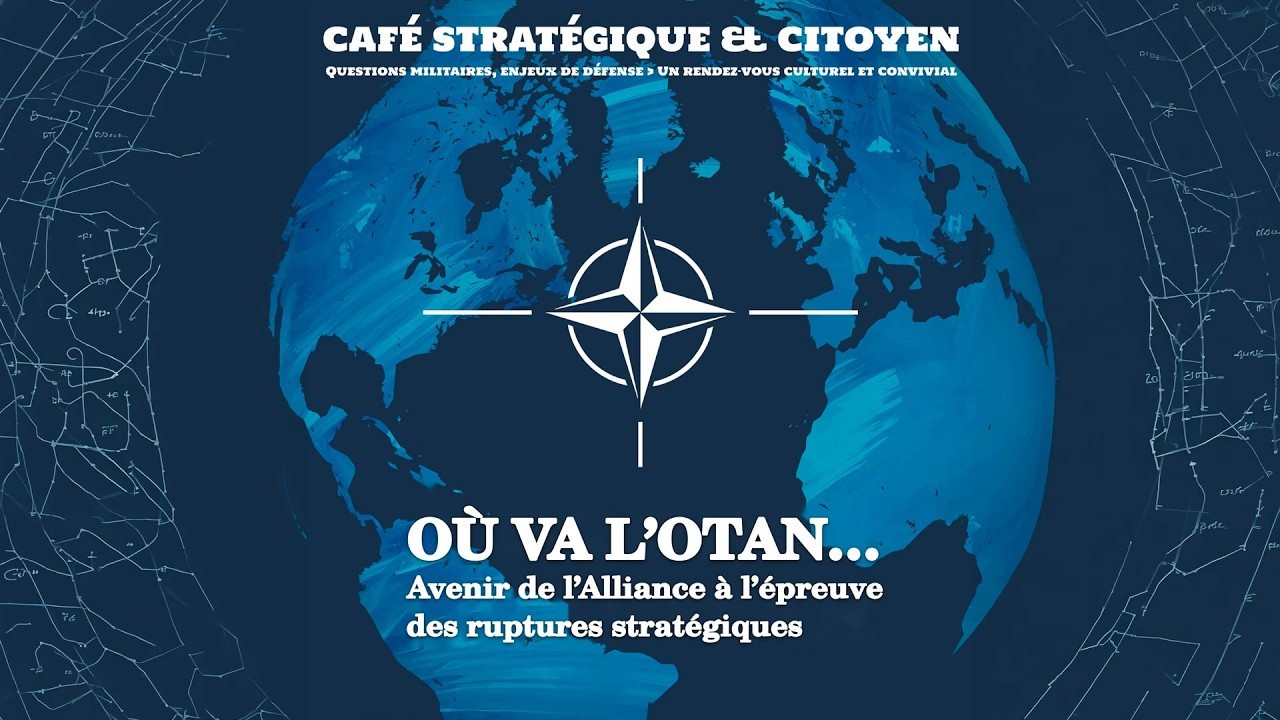
Café stratégique et citoyen - Où va l’OTAN ?
Strategic and citizen café - Where is NATO going?
Keywords
Summary
236 words
Critical Evaluation
Value of the Information & Strength of the Argument
The content is of high analytical value, built from the speaker’s unique insider experience of NATO operations and structures (he worked in operational and strategic headquarters and participated in several NATO missions). He does not simply expose historical facts but offers a decisive strategic analysis, articulating complex issues (the crisis of trust, the effects of the American president’s actions, the European dependency) in a forward-looking way. His argumentation is solid: he avoids definitive answers, preferring to present scenarios and lines of reflection, which is both a strength (honesty on uncertainties) and a weakness (less assertiveness). He however skillfully uses thought experiments and historical comparisons (the alliance as a hostage to the article 5, the ’leading from behind’ of Obama, the warnings of Robert Gates) to structure his thinking.
Scientific Rigor, Source Quality, Title Accuracy
The speaker demonstrates great rigor: he insists on the definition of terms (alliance vs coalition), on the historical context, and he does not hesitate to recall the specificities of the legal and institutional framework of NATO. Although he cites few external sources in a systematic way, his references are primarily to his own career and to well-identified strategic events (Gates, Obama, the NATO Strategic Concept of 2022). The sources are therefore not academically documented but testimonial and experiential. The title perfectly matches the content: the question is clearly addressed, and the subtitle ’to the test of strategic ruptures’ announces the announced plan. No public comments are available to analyze (views are 0).
255 words
Title / Content Match
The title perfectly reflects the content: a strategic reflection on NATO's future, with a citizen-oriented, educational and exploratory approach.
Quality & Reliability
8/10
Conference by a senior French general with 10 years inside NATO (tactical, strategic, operational levels). He is a recognized expert. However, no cited sources or academic references in the description, and uncertainties remain (scenarios, forward-looking views). Credible but based on experience and analysis, not verifiable data.
Key Moments
Markers derived by PSI from the transcript: the creator did not define chapters.
- Introduction and subject presentation by GDI (2S) Eric Roussel
- Definition of the alliance and presentation of the founding principles
- Book of NATO: history, role, organization, Article 5
- Strategic ruptures: 2014 Crimea and invasion of Ukraine
- Trump 1.0 and 2.0: questioning the transatlantic link and NATO's credibility
- NATO decision-making processes: political and military chains, consensus rule, force generation
- Reinforcement of the eastern flank: battalions, NFI units, exercises
- Presentation of the different possible scenarios for the future of NATO
- The question of trust and European autonomy in defense
- Conclusion: no definitive answer, but recommendations and possible paths
Cited Sources
- Vidéo de la conférence sur YouTube — Conférence complète de l'Université Bretagne Sud avec l'intervention du GDI (2S) Eric Roussel.
Concurring Sources
- NATO Strategic Concept 2022 — Document mentionné par l'intervenant comme le cadre officiel de l'Alliance.
Contribution & Novelties
86 words
Radar Profile
The radar profile shows a balanced funding between information quantity (8), quality (8) and technical level (6), with slightly lower reliability (7) due to the testimonial rather than verified nature of the sources. The high information content indicates a dense conference, with a strong analytical foundation but a moderate technical difficulty.