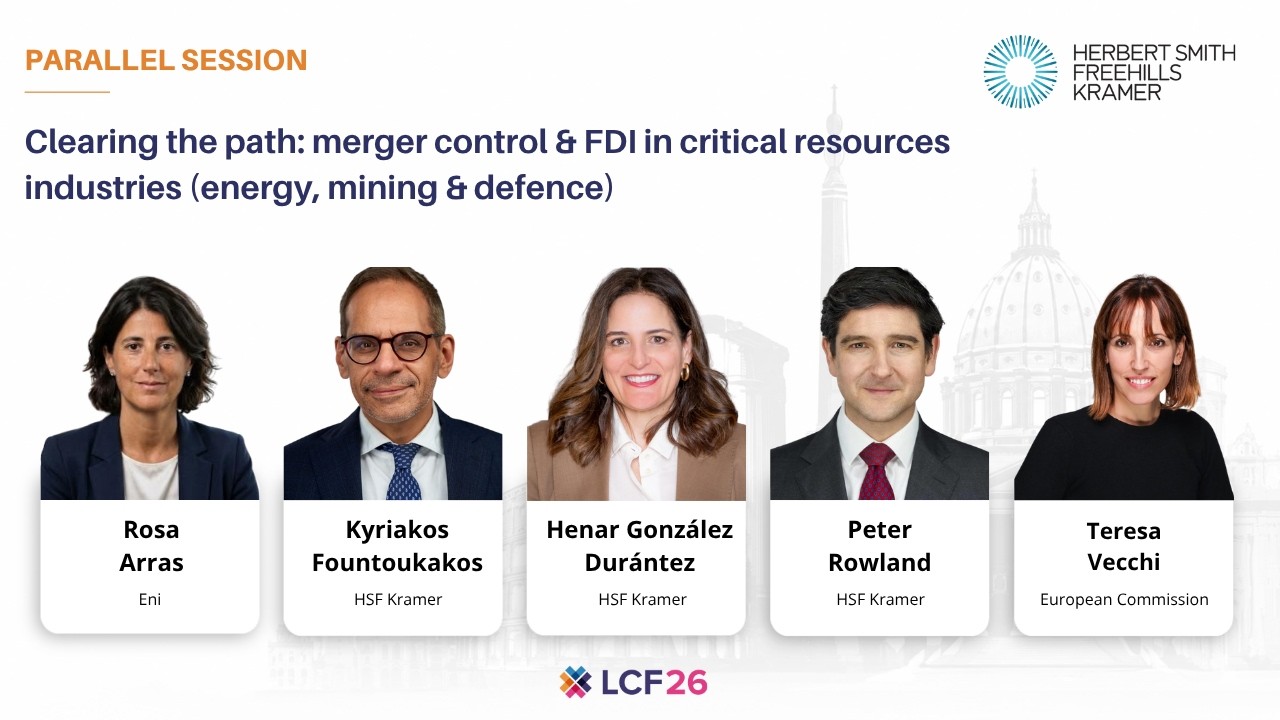
LCF26 | Clearing the path: merger control & FDI in critical resources industries
Keywords
Summary
189 words
Critical Evaluation
Value of the Information & Strength of the Argument
The value lies in the practical, multi-stakeholder perspective on how overlapping regulatory instruments affect deal-making in critical sectors. The argumentation is solid, grounded in concrete examples (e.g., BBVA-Sabadell takeover, Goldwind investigation) and statistical data from the Commission. The panelists effectively convey the complexity and, at times, inefficiency of the current system, while also acknowledging the legitimate objectives behind each tool. The discussion that the FSR reaches intra-EU transactions due to its financial contribution test (not buyer nationality) is particularly informative. The argument that regulatory risk is now primarily a timeline-management issue is well-supported by the in-house and practitioner anecdotes. However, the debate remains at a high-level, expert-oriented albeit practical plane, without delving into deeper theoretical or economic justifications for the regulations.
Scientific Rigor, Source Quality, Title Accuracy
The panel is composed of authoritative figures: a European Commission head of unit, a global antitrust head at a major law firm, and in-house counsel from an energy company. References to specific regulations (Foreign Subsidies Regulation, EU Merger Regulation, FDI Screening Regulation) are precise, and the data cited (e.g., number of FSR filings, overlap percentages) aligns with official Commission statistics. The title accurately encapsulates the content, focusing on clearing regulatory paths in critical resources industries. The discussion is directly on-topic throughout, with no tangents. While no external sources are cited in the video description, the references to legal instruments are traceable and verifiable. The rigor is high, though the analysis is naturally shaped by the legal professional context.
254 words
Title / Content Match
The title accurately reflects the content: the panel focuses on merger control and FDI procedures in critical resources sectors, offering practical insights on navigating these regulatory regimes.
Quality & Reliability
8/10
Panel includes a European Commission official, an in-house counsel from a major energy company, and experienced private practitioners, ensuring a high level of expertise. The discussion draws on recent official data and practical experience, though the perspective is necessarily limited to the legal and regulatory framing.
Key Moments
Markers derived by PSI from the transcript: the creator did not define chapters.
- Introduction by moderator Kiryakos, outlining the triple impact of merger control, FSR, and FDI.
- Rosa from Eni describes in-house challenges: regulatory risk as timeline risk, pre-notification burden, and unpredictable FDI processes.
- Peter discusses mapping filing requirements, strategic sequencing, and the importance of early engagement with regulators.
- Nuria presents FSR data: 40% of filings are intra-EU, 20% same member state, 80% overlap with EU merger control.
- Teresa from the Commission acknowledges business constraints and discusses simplification efforts, including the new merger guidelines.
- Discussion on new draft merger guidelines, incorporating industrial policy and resilience factors.
- Panelists debate how to align remedies across jurisdictions and coordinate with multiple regulators.
Cited Sources
- Foreign Subsidies Regulation (EU) 2022/2560 — Referenced as the core instrument for FSR notifications, requiring parties to declare financial contributions from outside the EU over the past three years.
- EU Merger Regulation (EC) No 139/2004 — Governs EU merger control, with thresholds that interact with FSR and FDI screening, leading to frequent parallel filing requirements.
- FDI Screening Regulation (EU) 2019/452 — Establishes a framework for member states to screen foreign direct investments on grounds of security or public order, often overlapping with merger control.
- EU draft merger guidelines (2025) — Mentioned as a generational update incorporating industrial policy, resilience, and public interest considerations; not yet finalized, so no official URL provided.
Concurring Sources
- European Commission merger statistics (2025) — The panel's cited figures on merger notifications and FSR filings align with publicly available Commission data, reinforcing reliability.
Contribution & Novelties
The panel provides a fresh, practical lens on the cumulative regulatory burden of merger control, FSR, and FDI in critical resources industries, moving beyond academic analysis to frontline deal-making experience. A key insight is the statistical evidence showing that 40% of FSR filings involve purely intra-EU transactions, correcting the misperception that FSR only targets foreign buyers. Another novel point is the strategic advice on sequencing filings across jurisdictions to align review timelines, especially when remedies require consistency. The discussion also highlights the human resource strain on both parties and regulators, with pre-notification becoming a central stage.
Pour aller plus loin :
- Foreign Subsidies Regulation (EU) 2022/2560) — Official text, essential for understanding notification thresholds and conditions.
- Competition policy in the EU — Overview of EU competition law, including merger control and state aid, providing broader context.
- European Commission merger control page — Official resource for current merger rules, guidelines, and case statistics.
152 words
Radar Profile
The radar profile shows high reliability (9) and technical depth (8), indicating a well-grounded, expert-level discussion. Quantity of information (7) is moderate due to the specialized focus, while quality (8) is strong. The balance suggests a dense, authoritative resource for legal practitioners, though less accessible to non-specialists.