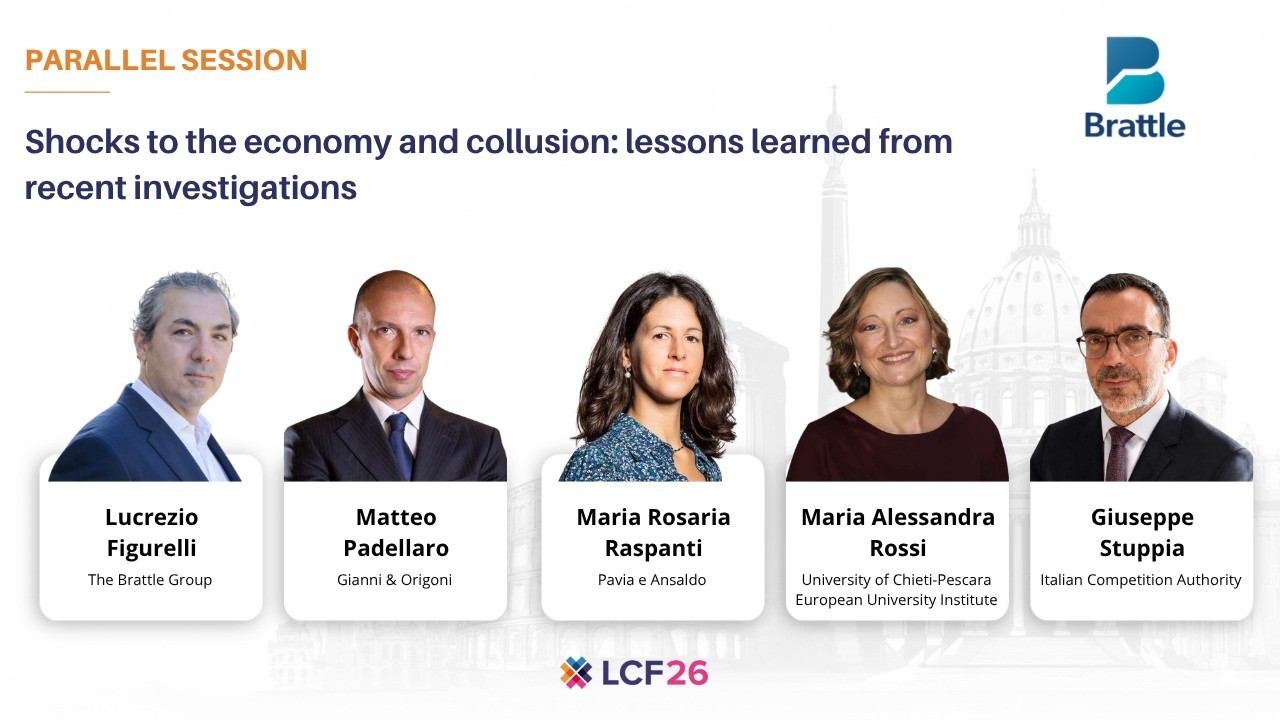
LCF26 | Shocks to the economy and collusion: lessons learned from recent investigations
Keywords
Summary
216 words
Critical Evaluation
Value of the Information & Strength of the Argument
The information presented is highly valuable for competition law practitioners and economists, offering a blend of legal case analysis and economic reasoning. The speakers argue convincingly that while economic shocks increase the likelihood of collusion (due to pressure on margins and uncertainty), they also make it harder to prove because common cost increases offer a plausible legitimate explanation for parallel price behavior. The argumentation is solid: Giuseppe Pescopio demonstrates with three cases how the presence or absence of exogenous evidence (e.g., information exchange, coordinated price indices) determines outcomes. Natalia Delaro introduces an interesting economic angle by questioning whether proactive market studies become more economically justified during shocks, weighing factors like detection probability, harm magnitude, and timing. The discussion is nuanced and avoids oversimplification, though it relies on anecdotal observations and does not provide systematic empirical evidence. The defense of the Italian authority’s approach—opening cases based on suspicious parallel price increases but closing them when evidence fails—is logically coherent and supports the rule of law under stress.
Scientific Rigor, Source Quality, Title Accuracy
The rigour is high for a professional panel: speakers cite economic theory (Wood Pulp doctrine, sole-plausible-explanation test), recent cases (Michelin, Italian biofuel and foundry cases), and institutional practices (EC memorandum on COVID). However, no URLs or specific sources other than case names and the EC memorandum are provided; references are verbal, which limits verifiability. The title accurately reflects the content, focusing on ‘shocks to the economy’ and ’lessons learned from recent investigations.’ The description mentions an EC 2020 memorandum on relaxing Article 101 during COVID, but the video does not delve deeply into that; instead it focuses on enforcement practice. The overall structure is clear, with each panelist addressing a distinct aspect. No obvious discrepancies between title and content, though the ’lessons learned’ are implicit rather than exhaustively itemized.
310 words
Title / Content Match
The title accurately reflects the content: a panel discussion on how economic shocks affect collusion detection and enforcement, using recent investigations as case studies.
Quality & Reliability
7/10
Panel of experienced competition economists and enforcement officials discussing recent cases with clear economic reasoning and references to legal precedents, though not peer-reviewed and based on anecdotal evidence.
Key Moments
Markers derived by PSI from the transcript: the creator did not define chapters.
- Introduction by Lucio Figurelli: context of COVID and inflationary shocks leading to parallel price increases.
- Giuseppe Pescopio begins: outline of the enforcer's challenge in distinguishing collusion from legitimate reaction to shocks.
- Discussion of the biofuel case (A64) with fine of ~1 billion euros, highlighting information exchanges and public signaling.
- Iron foundry case (A66): trade association as part of cartel, use of price indices as focal point.
- Low glass case (A867) closed without infringement due to lack of exogenous evidence; emphasis on compliance.
- Natalia Delaro: proactive vs reactive detection tools, OECD data on increased cartel investigations and leniency applications.
- Delaro discusses UK market study on fuel sector and the importance of timing in enforcement during shocks.
- Matteo Padelo: implications for public enforcement, including digital screening in Michelin case.
- Padelo on the role of compliance programs and evidence gathering before formal investigations.
- Discussion on counterfactual and damages calculation in private enforcement during crises.
Contribution & Novelties
The video provides a practitioner’s perspective on how competition authorities adapt their detection strategies during economic shocks, using recent Italian cases as concrete illustrations. It contributes original insights into the balance between reactive and proactive enforcement, the use of digital tools for screening public statements (as in Michelin), and the role of compliance programs in preventing inadvertent collusion. The discussion on the counterfactual in damages calculations when price increases are driven by both cost shocks and collusion is particularly novel.
Pour aller plus loin :
- Article 101 TFEU — Legal foundation for cartel prohibition; essential for understanding the regulatory framework discussed.
- Leniency program — Mechanism for detecting cartels; relevant to the discussion on reactive detection tools and increased leniency applications during shocks.
- Market study — Proactive tool used by authorities like the CMA; relevant to Delaro’s argument for proactive detection during crises.
142 words
Radar Profile
The radar profile shows moderate to high scores across all dimensions, with information quality and reliability slightly higher than technical level, indicating a balanced presentation with practical insights rather than deep theoretical novelty.