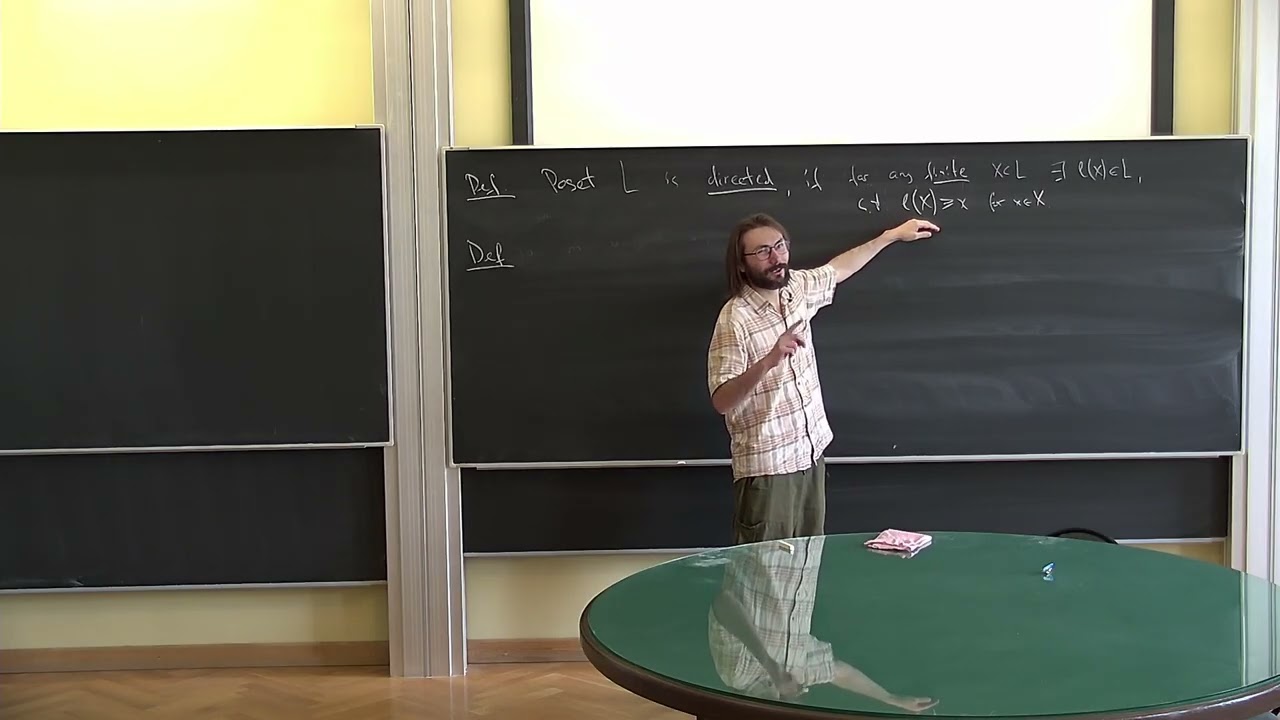
Лекция 1 | Локально представимые категории | Денис Терёшкин
Keywords
Summary
138 words
Critical Evaluation
Value of the Information & Strength of the Argument
The lecture provides a solid introduction to locally presentable categories, emphasizing the combinatorial and algorithmic aspects, which is valuable for those wanting to work with these concepts in a practical manner. The argumentation is clear and logically structured: starting from basic definitions (filtered categories, λ-compact objects) and building up to the main definition, with examples and proofs sketched. The speaker also highlights subtle points, such as the distinction between finite and infinite filtered colimits, and the role of regular cardinals. The content is well-informed and reflects deep understanding, though at times the delivery is interrupted by digressions or internal corrections, which suggest a live, unedited session.
Scientific Rigor, Source Quality, Title Accuracy
The scientific rigor is high, with careful definitions and references to standard literature, particularly the book ‘Locally Presentable and Accessible Categories’ by Adámek and Rosický. The speaker also mentions Birkhoff’s work on lattices, grounding the subject historically. The title accurately reflects the content: the lecture is the first of a series on locally presentable categories. No external sources are cited in the video description, but the lecturer explicitly refers to a specific book and page for further study, which adds credibility. The audience in the video appears to be a small group, and the content is advanced, targeting graduate students or researchers. The overall reliability is strong, though as a lecture it does not have peer review or formal publication.
241 words
Title / Content Match
The title accurately describes the content: a lecture on locally presentable categories, with the first in a series, presented by Denis Tereshkin.
Quality & Reliability
8/10
The content is presented by a mathematician (Denis Tereshkin) and is technically rigorous, with careful definitions and proofs sketched. As a lecture, it reflects solid expertise, though it is not peer-reviewed and has very limited distribution.
Key Moments
Markers derived by PSI from the transcript: the creator did not define chapters.
- Historical introduction: Birkhoff and lattice theory
- Definition of filtered categories and their characterization via finite-limit commuting
- Discussion of λ-filtered categories and regular cardinals
- Definition of λ-compact objects and lemma for checking compactness
- Example: compact objects in Set are exactly small sets
- Final definition of locally presentable category
Cited Sources
- Locally Presentable and Accessible Categories — Mentioned as a reference for detailed proof of the compactness lemma (page 27)
- Birkhoff on Lattice Theory — Historical context of algebraic structures and substructures
Concurring Sources
- Adámek & Rosický, Locally Presentable and Accessible Categories — The canonical reference for the theory, consistent with the lecturer's statements.
Contribution & Novelties
The lecture offers an accessible yet rigorous introduction to locally presentable categories, emphasizing a combinatorial viewpoint that is often understated in standard treatments. The speaker’s pedagogical approach includes concrete examples and exercises that aid understanding. This is valuable for self-learners or students seeking a first encounter with the topic.
For further reading:
- Locally presentable category (Wikipedia) — Provides a concise overview and relationships to other concepts.
- Locally presentable category (nLab) — A more detailed, category-theoretic perspective with references.
- Accessible category (nLab) — Discusses the broader class of accessible categories, essential for understanding presentability.
- Filtered colimit (nLab) — Clarifies the notion of filtered colimits and their properties.
106 words
Radar Profile
The profile shows a strong emphasis on technical depth (niveau_technique) and quality of information, with slightly lower but still high scores on quantity and reliability, indicating a focused, expert-level lecture with substantial content but limited outreach.