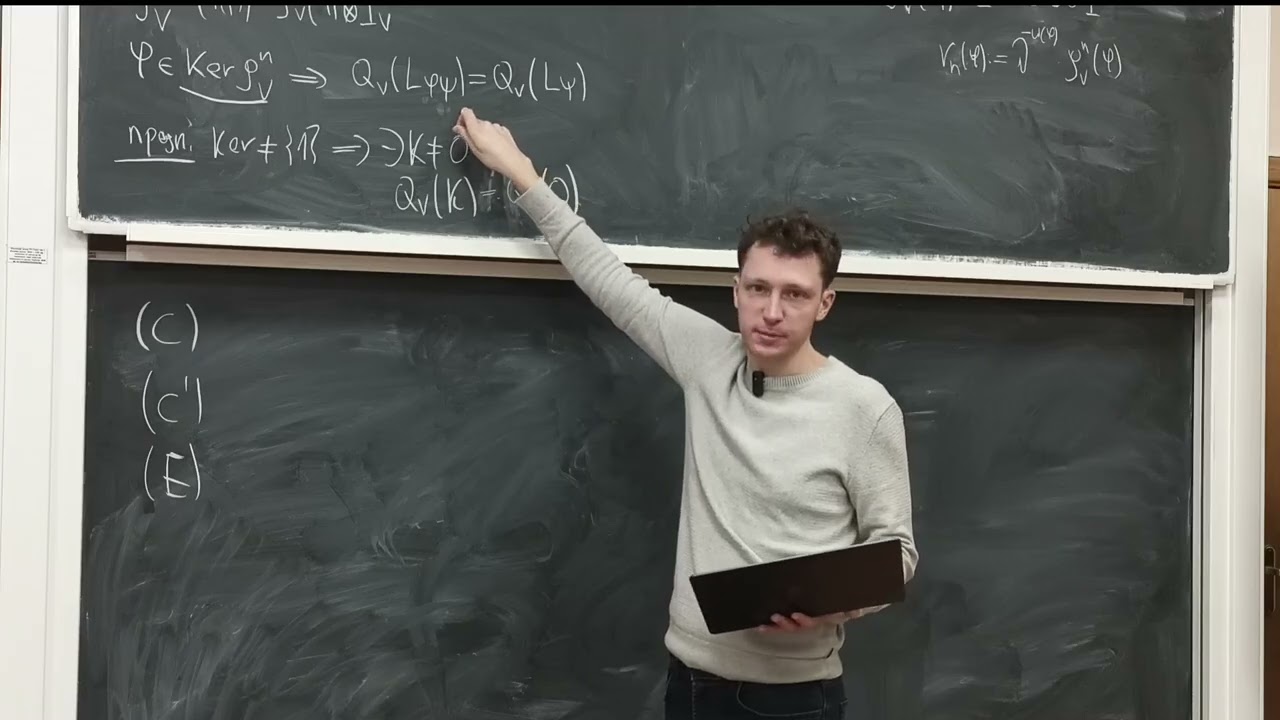
Гипотезы Бигелоу: от ядер представлений кос к узлам неограниченной сложности | QTC | Илья Алексеев
Title history
- Гипотезы Бигелоу: от ядер представлений кос к узлам неограниченной сложности | QTC | Илья Алексеев — observed on 20261111-1322 UTC (YouTube)
Keywords
Summary
209 words
Critical Evaluation
Value of the Information & Strength of the Argument
The value of the information is high: the talk presents cutting-edge research results, including a new theorem (the intermediate Bigelow hypothesis) and a comprehensive overview of the state of the art. The argumentation is rigorous and well-structured: Alekseev carefully defines all introduced objects, explains the logical chain from kernels of representations to the existence of nontrivial knots, and distinguishes between constructive and existential hypotheses. He also identifies the exact role of quasimorphisms and the translation number in overcoming obstacles. The exposition is dense but precise, with clear connections to known results (Bigelow, Ito, Malyutin) and a transparent discussion of limitations and open questions. The proof sketches are convincing, and the quantitative constructions are particularly noteworthy for their novelty and potential impact.
Scientific Rigor, Source Quality, Title Accuracy
The scientific rigor is exemplary: the talk is based on peer-reviewed and preprint sources, and the speaker explicitly cites Bigelow’s 2002 paper, Ito’s 2014 preprint (published 2015), Malyutin’s work, and his own dissertation. The sources are directly relevant and accurately referenced. The title is faithful: it precisely announces the topic (Bigelow’s hypotheses, braid group kernels, and knots of unbounded complexity) and matches the content. The talk does not resort to sensationalism, and the mathematical reasoning is presented with appropriate caution, openly acknowledging open problems and the non-constructive nature of some proofs. The absence of a commercial sponsor or paid promotion reinforces the scientific character of the presentation.
243 words
Title / Content Match
The title accurately reflects the content: the talk centers on Bigelow's hypotheses, braid group representation kernels, and constructions of knots with unbounded complexity, all as announced.
Quality & Reliability
8/10
The talk presents rigorous mathematical work, including a proof of an intermediate Bigelow hypothesis and new constructions of knots with prescribed invariants. Sources are clearly cited and the reasoning is detailed, though it remains a seminar presentation rather than a peer-reviewed publication.
Key Moments
Markers derived by PSI from the transcript: the creator did not define chapters.
- Introduction to quantum invariants from braid group representations and the definition of the invariant via a quantum trace.
- Statement of Bigelow's three hypotheses (C, C′, E) and explanation of their logical connections.
- Introduction of quasimorphisms and their properties, including homogenization and the example of the translation number.
- Sketch of Ito's proof of the weakest hypothesis E using quasimorphisms and Malyutin's results.
- Discussion of counterexamples to stronger Bigelow hypotheses and the speaker's own proof of an intermediate hypothesis.
- Quantitative constructions: hyperbolic knots with prescribed invariants and unbounded complexity, using asymptotic translation numbers.
- Discussion of limitations of quasimorphism-based methods and open questions, particularly regarding Temperley–Lieb representations.
Cited Sources
- Does the Jones polynomial detect the unknot? — Original paper by Stephen Bigelow (2002) proposing the hypotheses and establishing a reduction for the Burau representation at four strands.
- A kernel of a braid group representation yields a knot with trivial knot polynomials — Paper by Tetsuya Ito (2015) proving the weakest Bigelow hypothesis (E).
- Закрученность (замкнутых) кос — Article by Andrey Malyutin (2004) on the fractional Dehn twist coefficient, used in the proof of the E hypothesis.
- Стабильная коммутаторная длина в динамике классов отображений поверхностей и ее приложения в трехмерной геометрии и топологии — Doctoral dissertation of Ilya Alekseev (2026), containing the proof of an intermediate Bigelow hypothesis and applications to hyperbolic knots.
Contribution & Novelties
This talk contributes new results in the study of Bigelow’s hypotheses: the speaker proves an intermediate form of the conjecture and introduces a novel method based on an asymptotic translation number for braid group actions on boundary arc graphs. This method allows constructing families of hyperbolic knots with identical classical and quantum invariants but arbitrarily large geometric complexity (volume, slice genus, homology dimensions). The talk also clarifies the logical hierarchy of the hypotheses and the limits of quasimorphism-based approaches.
Pour aller plus loin :
- Jones polynomial — The central invariant in Bigelow’s conjecture; understanding its detecting power is the core motivation.
- Braid group — Algebraic structure underlying the representations and constructions discussed.
- Quasi-morphism — The key tool used in the proofs; its properties enable the detection of nontrivial elements in kernels.
- Reshetikhin–Turaev invariant — The general framework from which quantum invariants are derived.
143 words
Radar Profile
The radar profile shows very high levels of information quantity, quality, and technical depth, with slightly lower but still strong scores for global reliability, reflecting the rigorous but not-yet-peer-reviewed nature of some presented results. The overall balance indicates a deeply specialist seminar talk with authoritative mathematical content.