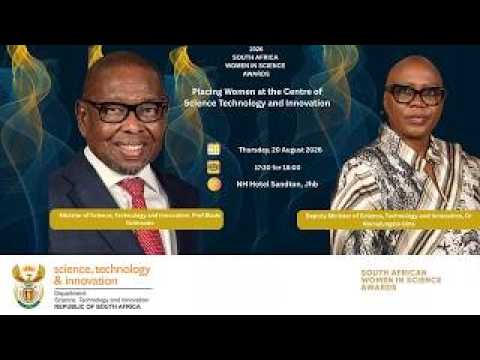
South African Women In Science Awards (SAWiSA) 2026
Keywords
Summary
178 words
Critical Evaluation
Value of the Information & Strength of the Argument
The informational value of this video lies primarily in its documentation of an official national event and its articulation of the South African government’s stated commitment to placing women at the centre of science, technology and innovation. The speeches provide a clear statement of the 2026 theme and connect it to broader policy goals such as inclusive research funding, mentorship, and institutional reform. However, the arguments presented are largely rhetorical and normative rather than analytical. Claims about women’s underrepresentation, unequal access to venture capital, and caregiving burdens are asserted without supporting data, case studies, or references to specific studies. The reasoning is coherent and consistent with widely recognised equity concerns, but it does not advance a novel or evidence-based argument. The ceremony’s value is therefore more symbolic and declaratory than informative in a scientific sense.
Scientific Rigor, Source Quality, Title Accuracy
The video does not cite any scientific sources, studies, or data. It is a ceremonial event, and its factual claims are limited to the existence and history of the SAWiSA programme, which is self-evident from the event itself. The title accurately describes the content: it is a recording of the 2026 South African Women in Science Awards. There is no mismatch between title and content, though the video is a long ceremonial broadcast rather than a focused scientific presentation. No comments were provided for analysis.
235 words
Title / Content Match
The title accurately reflects the content: the video is a full recording of the 2026 South African Women in Science Awards ceremony. It delivers exactly what the title promises, though it is a long ceremonial event rather than a focused scientific presentation.
Quality & Reliability
7/10
The video is an official recording of a government-hosted awards ceremony, so the factual claims about the programme's existence, its 23rd anniversary, and the 2026 theme are directly verifiable from the event itself. However, the content is largely ceremonial and rhetorical, with no data, methodology, or independent verification presented. Claims about women's underrepresentation and institutional barriers are asserted rather than evidenced with statistics or citations. The reliability of the event's factual framing is high, but the analytical depth and evidential support are limited.
Key Moments
Markers derived by PSI from the transcript: the creator did not define chapters.
- Opening and welcome of distinguished guests, including the Minister of Science, Technology and Innovation.
- National anthem and formal start of the 2026 South African Women in Science Awards.
- Safety briefing from hotel representative.
- Programme director Sakina Camwendo introduces the event and the 2026 theme.
- Welcoming remarks by Mr. Tapello Ahmed, MMC for Community Development, City of Johannesburg.
- Message of support from Ms. Lucizo Sharon Makubella, chairperson of the parliamentary portfolio committee on science, technology and innovation.
Contribution & Novelties
The video does not present new scientific findings or original research. Its novelty lies in documenting the 2026 SAWiSA ceremony and the official discourse around women in science in South Africa, including the 2026 theme and the 23rd anniversary of the awards. It serves as a primary source for understanding current policy rhetoric and institutional commitments.
Pour aller plus loin :
- South African Women in Science Awards — Official page of the Department of Science and Innovation on the awards.
- Women in science — Wikipedia overview of women’s participation and historical barriers in science.
- 1956 Women’s March — Historical context referenced in the ceremony.
104 words
Radar Profile
The radar profile shows low scores for technical depth and information quantity, reflecting the ceremonial nature of the event. Reliability is relatively high due to the official source, but the content is not scientifically rigorous. The overall profile is typical of a policy-oriented celebration rather than an analytical or educational video.