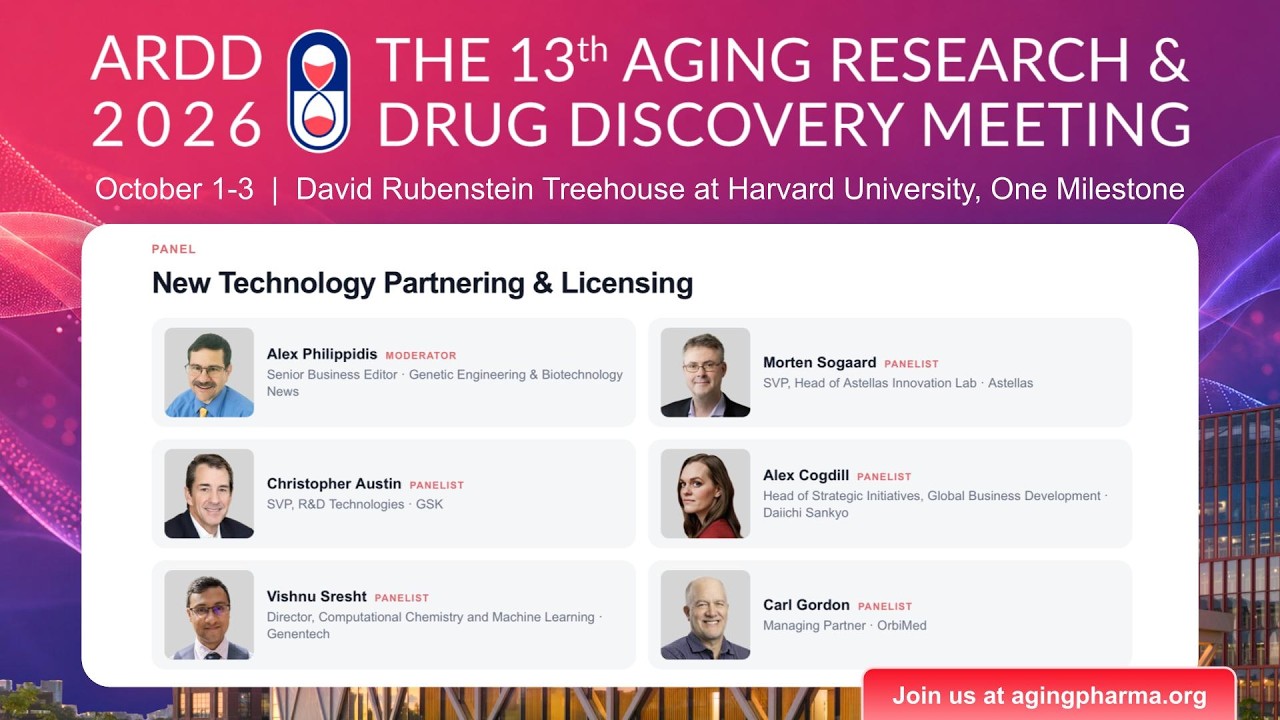
New Technology Partnering & Licensing Panel at ARDD2026
Title history
- New Technology Partnering & Licensing Panel at ARDD2026 — observed on 20261103-1843 UTC (YouTube)
- Panel at ARDD2026: New Technology Partnering & Licensing — observed on 20261102-1806 UTC (YouTube)
Keywords
Summary
130 words
Critical Evaluation
Value of the Information & Strength of the Argument
The discussion provides valuable insights into the strategic considerations of pharma and investors regarding aging research. Panelists argue from their direct experience, with concrete examples such as GSK’s collaboration with Relation Therapeutics and Genentech’s approach to data sharing. Carl Gordon’s frank analysis of why few deals target aging directly (near-term revenue needs) is particularly enlightening. The argumentation is coherent, with each expert contributing unique perspectives, though some divergence exists on the definition of aging research. Overall, the panel offers a nuanced view of the barriers and opportunities in this nascent field.
Scientific Rigor, Source Quality, Title Accuracy
The panelists cite specific market data from J.P. Morgan, Deal Pharma, BioBucks, and a LongevityTechnology report, enhancing credibility. However, no peer-reviewed scientific sources are referenced; the focus is on business and regulatory aspects. The title is accurate and well-matched to the content, which revolves around partnering and licensing in new technology contexts. The discussion demonstrates strong integration of current market trends with expert opinions, though it lacks direct citation of primary literature.
178 words
Title / Content Match
The title accurately reflects the panel's focus on new technology partnering and licensing in aging research.
Quality & Reliability
8/10
Panelists are senior executives from major pharmaceutical companies and investment firms (GSK, Genentech, Astellas, OrbiMed), providing credible insights. Market data and deal examples are referenced, enhancing reliability.
Key Moments
Markers derived by PSI from the transcript: the creator did not define chapters.
- Introduction and market data on licensing deals growth (166.7 billion in H1 2026).
- Definition of aging research: panelists share perspectives on how it differs from disease-specific research.
- Christopher Austin discusses unified mechanisms underlying aging and GSK's focus on immune aging.
- Discussion on FDA regulatory science and its potential impact on future P&L deals.
- Trends in partnering: holistic platforms, pre-competitive data sharing, and AI collaboration strategies.
- Carl Gordon explains why few aging-specific deals occur, citing revenue pressures and near-term needs.
Cited Sources
- ARDD Official Website — Conference website for ARDD, the event where this panel took place.
- ARDD LinkedIn — LinkedIn page for updates on ARDD and related content.
Contribution & Novelties
This panel provides a rare, unfiltered view from industry insiders on the current state of partnering and licensing in aging research, highlighting the disconnect between scientific promise and commercial reality. It brings together perspectives from pharma, biotech, and investment, offering a balanced assessment of why deals are scarce in this field and what might change.
Pour aller plus loin :
- Aging Wikipedia page — Background on the biological and societal aspects of aging.
- Drug discovery Wikipedia page — Overview of the drug development process.
- Artificial intelligence in healthcare (Wikipedia) — Explains AI applications in drug discovery and development.
- [GPCRs and aging (reference concept without URL) — A potential area discussed indirectly but not explicitly cited.]
115 words
Radar Profile
The radar profile shows high scores in information quantity/quality and reliability, with a slightly lower technical level, indicating an expert discussion accessible to a broader audience. The moderate technical score reflects the business-oriented nature, while the high reliability stems from the credibility of the panelists.