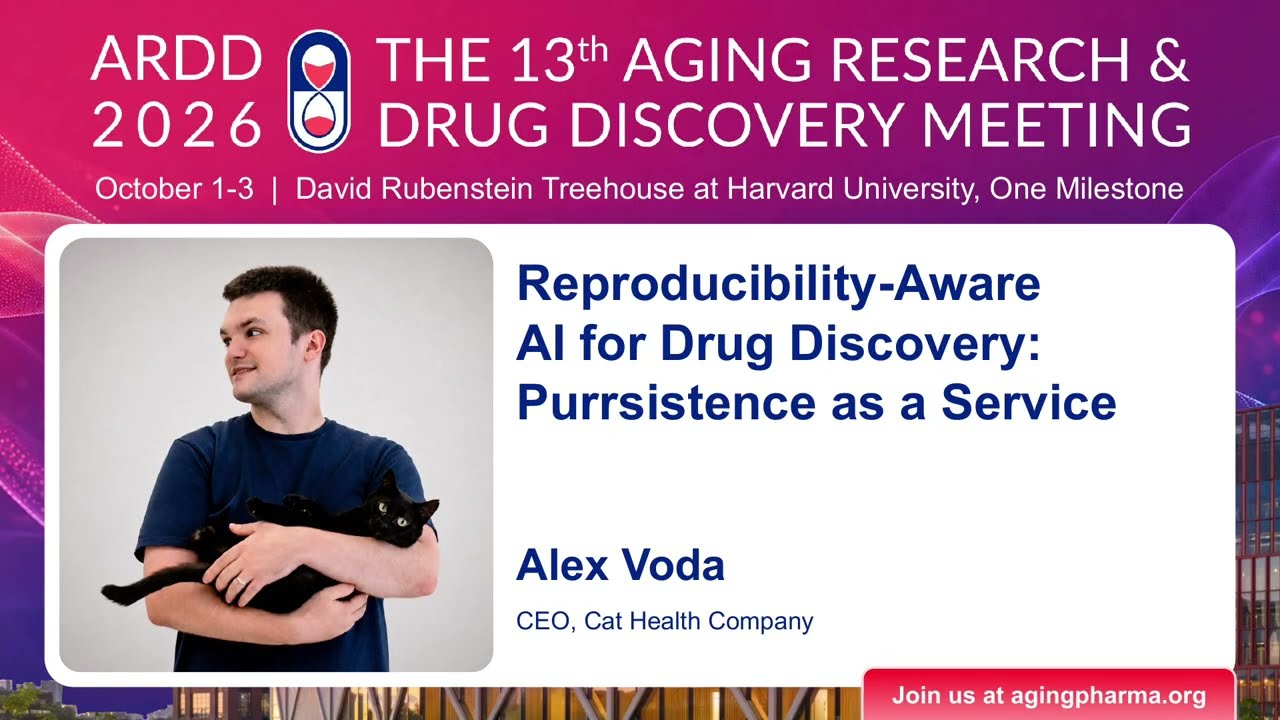
Alex Voda at ARDD2026: Reproducibility-Aware AI for Drug Discovery
Keywords
Summary
156 words
Critical Evaluation
Value of the Information & Strength of the Argument
The talk provides a compelling argument for the need to filter unreliable scientific literature in drug discovery, using concrete examples such as the Alzheimer’s field and the high rate of fraudulent papers. Voda argues that companies like Recursion and Insilico succeed through in-house verification rather than trusting the literature. He presents his own company’s approach as evidence, with successful clinical outcomes in cats and a larger database than DrugAge. The argumentation is persuasive but relies heavily on anecdotal success and does not provide quantitative details on how the fraud index is calculated or validated. The value lies in highlighting a real problem and proposing a pragmatic solution, though the scientific rigor is limited by the lack of disclosed methodology.
Scientific Rigor, Source Quality, Title Accuracy
The talk references the Ringel study from Nature Reviews Drug Discovery (2020) on rising drug development costs and mentions the DrugAge database and the Retraction Watch database as resources. However, the speaker does not provide direct URLs or specific citations for these, and the description only includes links to agingpharma.org and LinkedIn. The claim about 10% fraud in PubMed is stated without a precise reference, though it is a known issue discussed in the field. The title accurately reflects the content, and the talk does not misrepresent its scope. Overall, the rigor is moderate: the problem is well-known, but the speaker’s own data and methods are not fully transparent to the audience.
246 words
Title / Content Match
The title accurately describes the content, which focuses on using AI to assess reproducibility in drug discovery.
Quality & Reliability
6/10
The talk presents a company-specific approach with anecdotal clinical results and references to known studies (e.g., Ringel 2020, DrugAge) but lacks detailed methodology or rigorous citations for many claims.
Key Moments
Markers derived by PSI from the transcript: the creator did not define chapters.
- Introduction and background of the company and the talk focus on reproducibility
- Rising cost of drug discovery and the need for change
- Examples of fraudulent data in scientific literature (e.g., Alzheimer's paper) and its impact
- Description of their platform: mining retraction watch and community data to create a fraud index
- Expansion of DrugAge database and focus on age-related diseases in cats
- Clinical case results: cat with chronic kidney disease showing improved biomarkers
- Team and advisory board, plans for Series A fundraising
- Q&A session: discussing approach to big pharma and other therapeutic areas
Cited Sources
- Aging Pharma - ARDD — Official website of the Aging Research and Drug Discovery meeting, organizer of the event
- Aging Pharma on LinkedIn — LinkedIn page for ARDD, providing updates and networking
Contribution & Novelties
The talk presents a novel application of AI to assess reproducibility in drug discovery, specifically by creating a ‘fraud index’ that filters unreliable literature. This is applied to a niche market (feline aging diseases) which allows faster and cheaper clinical trials. The claim of expanding DrugAge from ~1,000 to ~9,000 compounds indicates a significant data aggregation effort. The original contribution is the combination of retraction data, community feedback, and literature mining to rank drug targets, potentially saving resources and improving success rates.
Pour aller plus loin :
- Reproducibility crisis - Wikipedia — Context on the broader issue of scientific reproducibility.
- DrugAge Database — The original database mentioned, focusing on compounds affecting aging.
- Retraction Watch — Resource for tracking retracted scientific papers, used as a data source in the talk.
129 words
Radar Profile
The profile shows moderate scores across all dimensions, with highest in quantity of information (7) and lowest in reliability (5). This is typical of a conference talk that presents a compelling business pitch with limited peer-reviewed evidence. The technical level is adequate for a general audience, and the overall quality is average, reflecting the anecdotal nature of the claims.