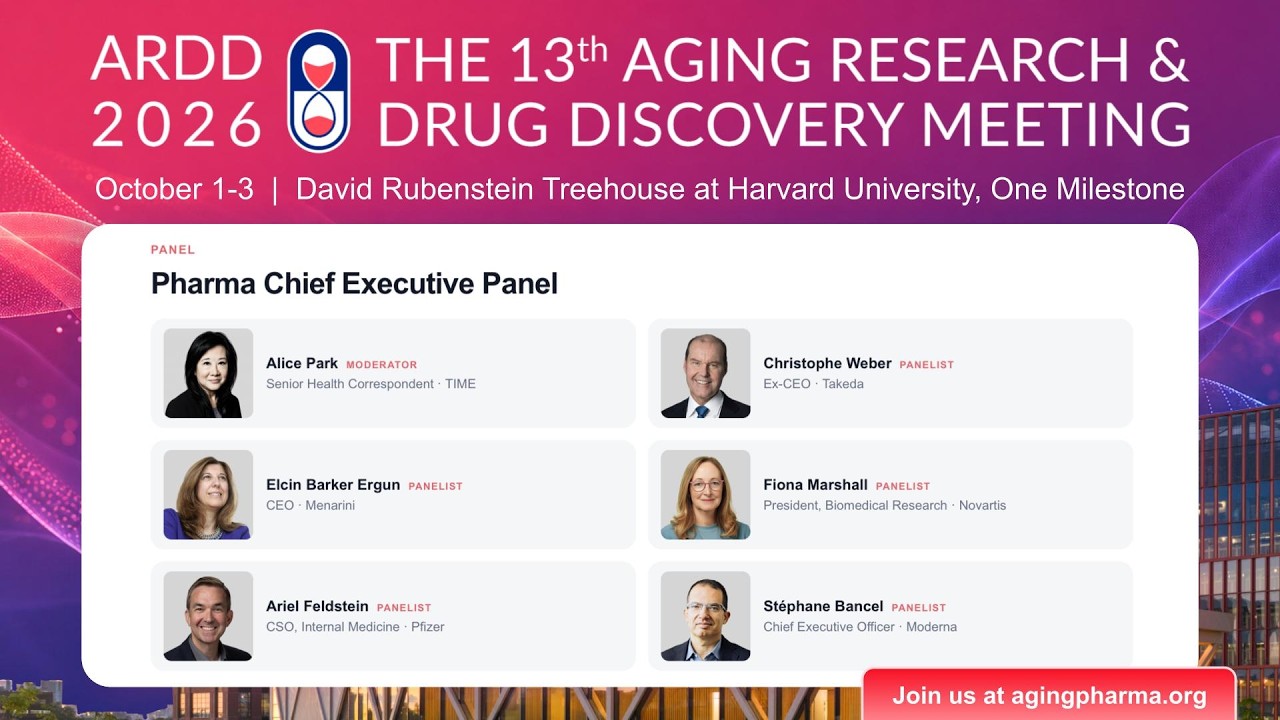
Pharma Chief Executive Panel at ARDD2026
Title history
- Pharma Chief Executive Panel at ARDD2026 — observed on 20261112-1554 UTC (YouTube)
Keywords
Summary
189 words
Critical Evaluation
Value of the Information & Strength of the Argument
The value of the information lies in its high-level strategic and industrial perspective on aging and prevention, coming from leaders who wield significant influence in drug development. The panel provides concrete examples of pipeline initiatives (e.g., Moderna’s mRNA cancer vaccines, Pfizer’s GLP-1 investments) and articulates a coherent rationale for shifting toward prevention and multi-target approaches. The argumentation is generally sound, though it relies heavily on anecdotal evidence and personal conviction rather than systematic data. The discussion on AI’s potential is promising but speculative, with Callan and others admitting that no AI-designed drug has yet reached the market. They argue convincingly that the bottleneck of clinical trials and reimbursement is a systemic problem, and they advocate for regulatory innovation such as biomarker-based approvals. However, the perspectives are self-serving, as the speakers represent companies that would benefit from such changes. Overall, the panel offers valuable strategic insights but lacks rigorous empirical backing.
Scientific Rigor, Source Quality, Title Accuracy
The video is a conference panel, not a scientific publication, so the rigor is limited. The speakers are credible executives, but they do not cite primary literature; instead, they reference internal pipeline data and ongoing trials (e.g., Moderna’s phase 2/3 lung cancer results) which are not yet peer-reviewed. The official description provides context and lists sponsors, including the conference organizer Insilico Medicine, but does not link to supporting data. The title ‘Pharma Chief Executive Panel at ARDD2026’ is accurate and aligns with the content. The description clearly indicates the theme ‘Matching Clinical Trials of Therapeutics & Regulatory Mandates,’ which is addressed in the discussion. No external verification of claims is provided, and the low view count suggests minimal public scrutiny. The discussion does not cite sources but relies on the authority of the speakers, which is acceptable for a keynote-style panel but not for evidence-based scientific communication.
312 words
Title / Content Match
The title accurately describes a panel of pharmaceutical CEOs discussing aging and drug development at ARDD2026.
Quality & Reliability
7/10
Panel of senior pharmaceutical executives discussing aging and prevention, with credible but unverified claims; contains some specific data points (e.g., mRNA cancer trial) but largely opinion-based and promotional. The low view count and lack of independent verification reduce reliability.
Key Moments
Markers derived by PSI from the transcript: the creator did not define chapters.
- Introduction by Alice Park and panelist introductions
- Fiona Marshall on prevention challenges and trial endpoints
- Christophe Weber on prevention mindset and healthcare systems
- Ariel Feldstein on GLP-1 drugs and healthspan
- Stefan Bancel on mRNA vaccines for cancer and Lynch syndrome
- Discussion on unmet outcomes and regulatory endpoints
- Stefan Bancel on AI streamlining clinical trials and BLA filing
- Fiona Marshall on AI for cross-disease target identification and data sharing
Cited Sources
- Aging Pharma (ARDD official website) — Official website of the Aging Research and Drug Discovery meeting, providing information about ARDD and related resources.
- ARDD LinkedIn — Official LinkedIn page for ARDD, offering updates and networking opportunities for the longevity biotech community.
Contribution & Novelties
The panel provides a rare, high-level industry perspective on how major pharmaceutical companies are integrating longevity science into their pipelines. It highlights a convergence on prevention and multi-system mechanisms, with AI emerged as a key enabling tool. Notable novel elements include Moderna’s prophylactic mRNA vaccine for Lynch syndrome and the discussion of ‘one-click BLA’ as a vision for regulatory submission efficiency. The exchange also underscores the need for biomarker-based endpoints and better data sharing across the industry.
Pour aller plus loin :
- Lynch syndrome — A genetic condition predisposing to colorectal and other cancers; Moderna’s vaccine targets this population.
- GLP-1 receptor agonist — A class of drugs used for diabetes and obesity that is reshaping prevention approaches in pharmaceutical pipelines.
- AI in drug discovery — Overview of how AI is being applied to target identification and clinical trial design, as discussed by the panel.
144 words
Radar Profile
The radar profile shows a balanced score across quantitative information, quality, technical level, and reliability, with all around 7. This indicates a moderately high-information content with good industry insight but lacking depth in primary data. The profile suggests a video that is informative for a general audience interested in pharmaceutical strategy and aging, but not heavily technical or evidence-based.