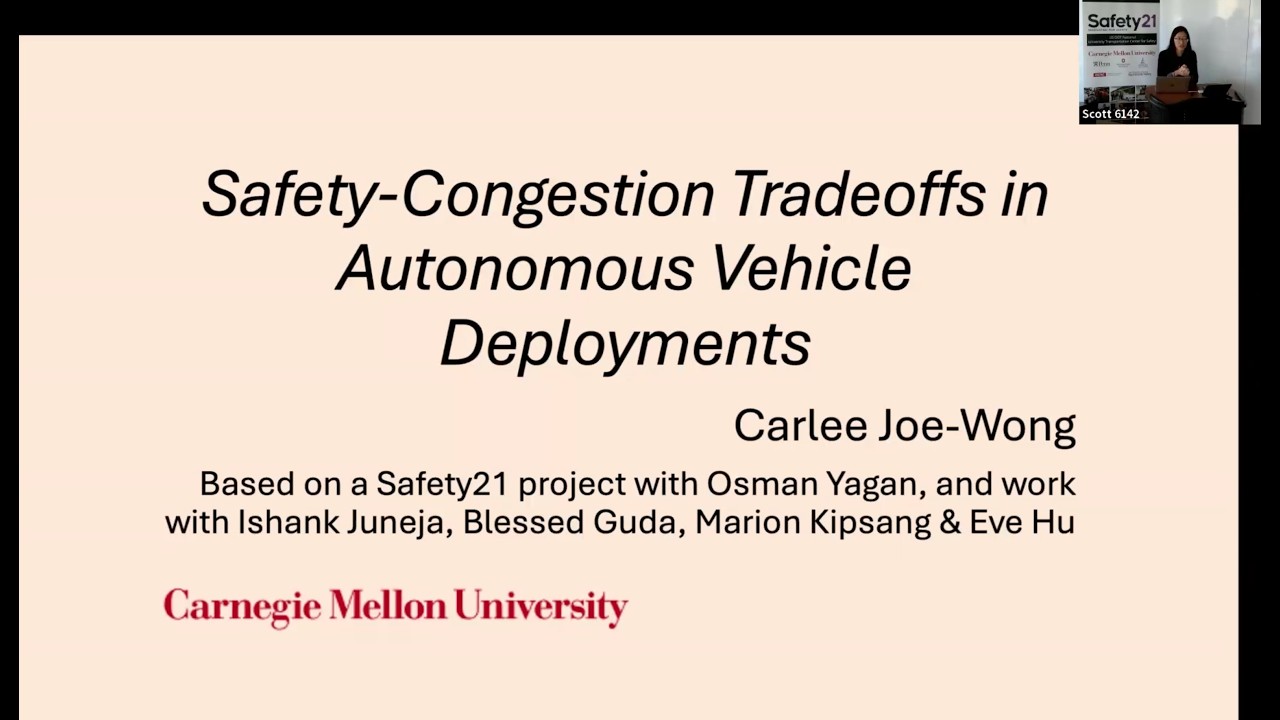
9.25.26 - Carlee Joe-Wong
Keywords
Summary
165 words
Critical Evaluation
Value of the Information & Strength of the Argument
The talk offers substantial value by clearly articulating a real-world problem: the lack of reliable safety data for autonomous vehicles and the need to balance safety with congestion in mixed-traffic environments. The argumentation is structured and logical, moving from problem motivation to mathematical formulation, algorithm design, theoretical guarantees, and simulation results. The speaker explicitly acknowledges limitations, such as the absence of safety data and the reliance on simulators for congestion. The use of constrained online learning and regret analysis is well-motivated and demonstrates a rigorous approach. The discussion of scalability and timeliness adds practical relevance. However, the talk remains at a high level in places, and the lack of concrete safety metrics or real-world deployment results leaves some questions unanswered. The Q&A reveals thoughtful engagement with ethical dimensions, though these are not central to the project.
Scientific Rigor, Source Quality, Title Accuracy
The scientific rigor is high: the problem is formalized mathematically, with definitions of cost and quality regret, and theoretical bounds are provided. The methodology is transparent, and the speaker distinguishes between known (congestion) and unknown (safety) quantities. Sources are not explicitly cited in the transcript, but the project is attributed to Safety21 and collaborators are named. The title is merely a date and speaker name, which does not reflect the content; however, the content itself is accurately described in the abstract. No comments were provided for analysis.
238 words
Title / Content Match
The title is simply the date and speaker's name, which does not describe the content. The talk itself is a coherent research seminar on safety and congestion trade-offs in mixed autonomy traffic, so the title is not misleading but is uninformative.
Quality & Reliability
7/10
The presentation is given by a recognized academic (Carnegie Mellon University) and is based on a funded research project (Safety21) with named collaborators. The methodology is clearly described, including the mathematical formulation (constrained online learning, regret bounds) and simulation results. However, the talk is a work-in-progress seminar: no peer-reviewed publication is explicitly cited in the transcript, safety data are acknowledged as scarce, and the results are preliminary. The absence of direct links to papers or datasets in the description limits independent verification.
Key Moments
Markers derived by PSI from the transcript: the creator did not define chapters.
- Introduction by host and speaker background.
- Overview of increasing vehicle autonomy and mixed traffic.
- Explanation of safety concerns and lack of data.
- Definition of congestion and safety trade-offs.
- Project goals and challenges: scalability, timeliness, adaptation.
- Q&A on decision granularity and traffic light control.
- Formulation as online learning problem with safety constraint.
- Exploration vs exploitation and algorithm design.
- Regret metrics and theoretical guarantees.
- Simulation results and comparison with baselines.
Contribution & Novelties
The project’s originality lies in addressing the safety-congestion trade-off under data scarcity by combining constrained online learning with large language models (LLMs) to leverage built-in knowledge and avoid costly simulations. It provides theoretical regret bounds for a bandit problem where the constraint is unknown, and demonstrates scalability via traffic light control. The integration of LLMs for policy optimization in transportation is a novel direction.
Pour aller plus loin :
- Multi-armed bandit problem (Wikipedia) — foundational concept for the exploration-exploitation trade-off.
- Constrained Markov Decision Processes — framework for optimization with safety constraints.
- CityFlow simulator — open-source traffic simulation environment used in the project.
- Large language models for decision-making — emerging area of research.
112 words
Radar Profile
The radar profile shows high technical depth and information quality, with moderate quantity and reliability due to preliminary results and lack of peer-reviewed citations. The balance reflects a rigorous but early-stage research presentation.